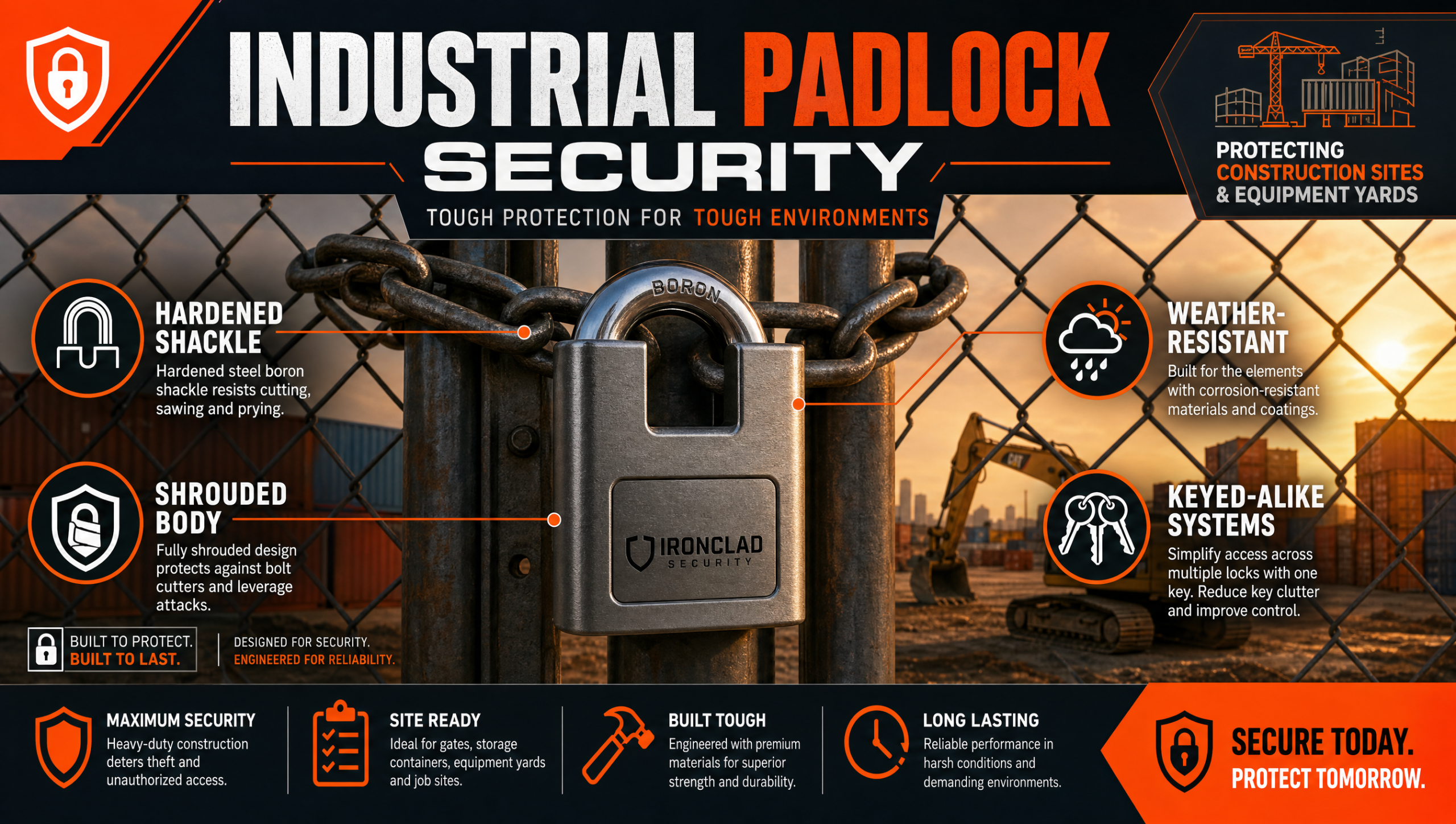
High-security industrial padlock locking a construction yard gate in Mesa, Arizona

Industrial Padlock Security: High-Security Padlocks for Construction Sites and Yards

A contractor walks onto the job site and finds the gate chain cut, a generator gone, and copper wire stripped from the equipment trailer. Standard hardware-store locks invite exactly this kind of loss, because their soft shackles and exposed bodies give bolt cutters and pry bars an easy target. The answer is purpose-built industrial padlock security: hardened, shrouded, weather-tested locks engineered for outdoor abuse. As a Mesa-based team with more than a decade securing yards across the East Valley, we want to walk you through what truly protects a site, so read on.

Industrial padlock security relies on three things: a hardened boron-alloy shackle that resists cutting, a shrouded or shielded body that blocks pry and impact attacks, and a corrosion-rated finish built for outdoor exposure. Pairing the right padlock grade with keyed-alike management is what keeps construction sites and storage yards protected.

Why Construction Sites and Yards Are Targets

Open lots, perimeter fencing, and high-value equipment make construction sites and equipment yards a standing invitation for theft. The National Insurance Crime Bureau reports that heavy equipment and tool theft ranks among the heaviest losses the construction industry absorbs, and most of those losses trace back to a single weak point: the lock on the gate, the gang box, or the conex container.

Thieves rarely pick locks on a job site. They cut them. A pocket-size bolt cutter defeats a brass shackle in one squeeze, and a long pry bar can shear a thin lock body off its hasp. That is why our commercial locksmith team treats site security as a system rather than a single product. The padlock is the front line, but the hasp, the chain, and the key management plan all matter just as much.

What Makes Industrial Padlock Security Different

A genuine industrial padlock is built around attack resistance, not convenience. Three engineered features separate it from a discount-bin lock.

Hardened Shackles and Shrouded Bodies

The shackle is the U-shaped loop most people grab first. Industrial models use boron-alloy or hardened steel shackles that dull and damage cutting blades instead of yielding to them. Better still, a shrouded padlock encloses most of the shackle inside a thick steel collar, leaving almost nothing for a cutter to grip. We see this design on manufacturers like ABUS, and we cover its real-world quirks in our guide on removing the Z-bar retainer on an ABUS padlock.

Weather and Corrosion Resistance

Mesa heat punishes hardware. A lock that seizes in dust and high temperatures is as useless as one that gets cut. Industrial padlocks carry sealed cylinders, brass or stainless internals, and weatherproof boots so the mechanism keeps turning after heavy exposure on a fence line. When a cylinder does fail in the field, our high-security lock and key service can rebuild or replace it without scrapping the whole assembly.

Choosing the Right Padlock Grade for Your Site

Not every gate needs the same lock. A tool cage inside a fenced yard faces a different threat than a street-facing entry gate. Matching the grade to the exposure keeps you protected without over-buying. The comparison below reflects how we spec hardware for clients across Mesa and the East Valley.

Padlock Grade Best Use On Site Shackle & Body Cut Resistance Weather Rating
Standard Brass Low-risk interior cages Exposed brass shackle Low Basic
Hardened Steel General gates & gang boxes Hardened steel shackle Moderate Coated, dust-sealed
Boron-Alloy Shrouded Perimeter & container doors Boron shackle, shrouded body High Sealed, corrosion-rated
High-Security Restricted Main entry & high-value yards Shrouded body, restricted keyway Very High Marine-grade sealed

The grade you choose should also account for key control. A site running ten gates with ten different keys becomes unmanageable, which is why we often set up keyed-alike or master-keyed systems and handle business re-keying when crews rotate. If a key ever goes missing, you can read more about duplicating high-security keys and why those blanks are deliberately restricted.

Pro Tip From the Field

After years of pulling cut locks off Mesa gates, here is the lesson that surprises most site managers: the padlock is rarely the weak link once you upgrade it. The hasp is. We have replaced dozens of premium padlocks that survived an attack while the bargain hasp they hung on was peeled away with a crowbar. Spec a welded, concealed-screw hasp rated to match the lock, and back the gate chain with a hardened, case-protected chain rather than a hardware-store loop. A lock is only as strong as the steel it secures, and a commercial lock change that ignores the mounting hardware leaves the door half open.

Layering Padlocks With Access Control

Padlocks guard the perimeter, but the most secure yards add a second layer at the office trailer and storage container. A keypad lock on the trailer door removes shared physical keys from the equation, and a full access control system logs who enters and when. For the trailer’s main door, a commercial-grade deadbolt adds real holding power — the same deadbolt installation and thumbturn hardware we fit on homes scales up to job-site offices. The principle behind strong home safety and strong site security is identical: remove the easy entry point before anyone tests it.

We also recommend securing on-site cash boxes and document safes; if one ever jams or the combination is lost, our safe service handles it without destroying the unit. And when a crew needs to rotate a single padlock instead of buying new, our walkthrough on how to re-key a padlock shows the process step by step.

Frequently Asked Questions

What makes a padlock “industrial” instead of standard?
An industrial padlock uses a hardened boron-alloy or steel shackle, a shrouded or shielded body that resists prying, and a sealed, corrosion-rated cylinder built for outdoor exposure. Standard brass locks have none of these, which is why they fall to bolt cutters.
Will a high-security padlock survive Mesa heat and dust?
Yes. Industrial padlocks carry sealed cylinders and weatherproof boots that keep the mechanism turning after heavy exposure on a fence line. Our technicians can service or rebuild a cylinder in the field if dust ever works its way in.
Can multiple gates share one key?
They can. We set up keyed-alike and master-keyed systems so a single key opens every gate you authorize, and we re-key the system whenever crews rotate or a key goes missing.
Is the padlock or the hasp the real weak point?
Once the padlock is upgraded, the hasp usually becomes the weakest link. A welded, concealed-screw hasp rated to match the lock is essential, because a premium padlock on a bargain hasp can still be peeled off with a pry bar.
Should I add access control as well as padlocks?
For office trailers and storage containers, yes. Keypad locks and access control systems remove shared physical keys and log who enters, layering electronic control on top of the mechanical protection your padlocks provide at the perimeter.
Can our team service padlocks instead of replacing them?
Often, yes. A padlock with a working body can be re-keyed rather than discarded, which keeps your hardware standardized. Our technicians assess the lock and recommend service or replacement based on its condition and your security needs.

Lock Down Your Mesa Job Site the Right Way

Equipment theft does not announce itself, and the gap between a cut brass lock and a shrouded industrial padlock is the gap between a secured site and a stripped one. If you manage a site or yard around the Valley, let our certified technicians audit your gates, hasps, and containers and spec hardware that matches the real threat — the same field-tested approach we describe in our piece on heavy-duty door closers and wind resistance. You can learn more about our team, review the full range of services we bring to commercial clients, and reach out through our contact page to schedule a security audit. Find us and read verified reviews on our Google Business listing, then call Locksmith Near Me to protect what your crew works hard to build.
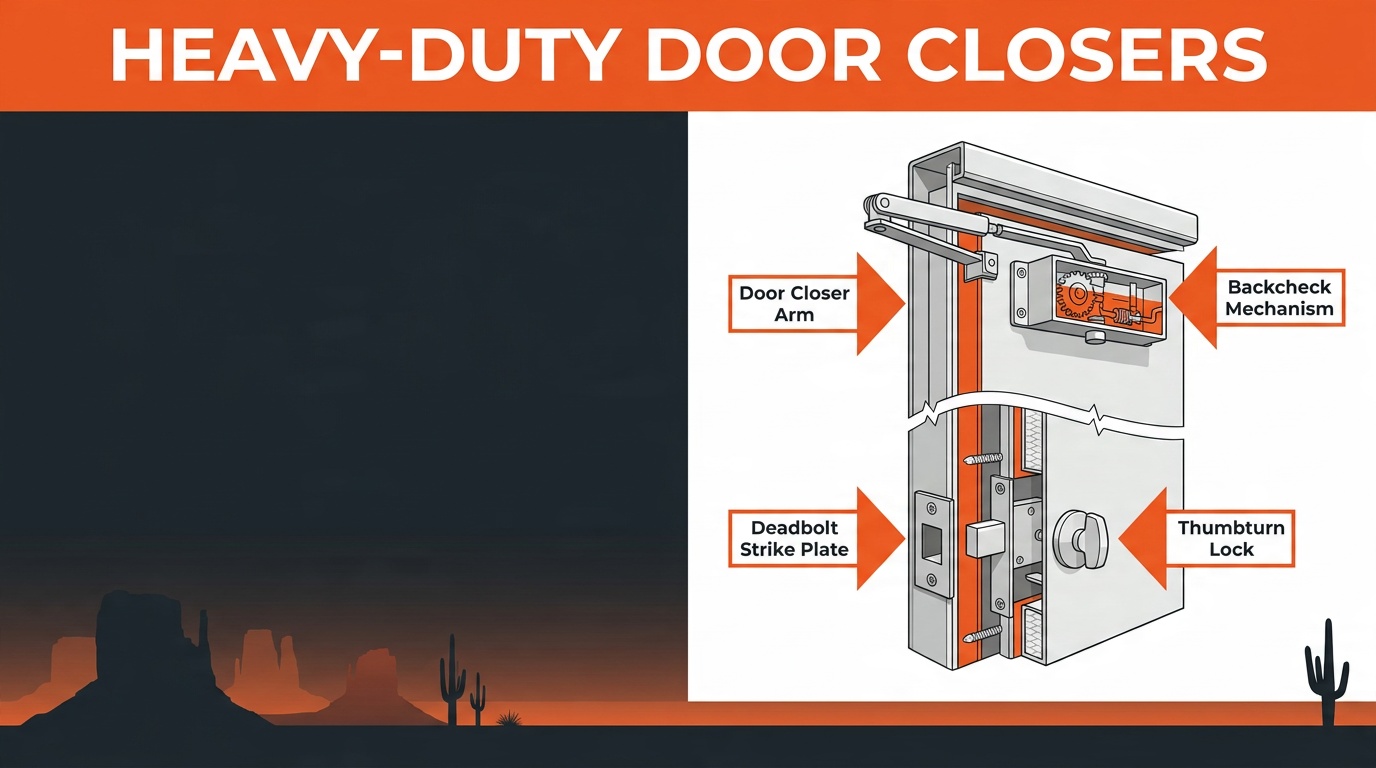
Infographic showing heavy-duty door closer components for commercial wind resistance in Mesa AZ

Heavy-Duty Door Closers: Why Your Business Needs Wind-Resistant Hardware

Every commercial property owner in Mesa, Arizona knows what a powerful desert gust can do to an uncontrolled door. One strong surge of wind swings the entry wide open, slams it back against the stop, stresses the frame, and — over time — quietly destroys the latch geometry that keeps your business locked at night. Heavy-duty door closers engineered for wind resistance are the hardware solution that stops this damage chain before it starts. Keep reading and we’ll walk you through how these systems work, how they protect your building’s overall security, and what to look for before buying.

What Separates a Standard Door Closer From a Heavy-Duty Door Closer

A standard residential closer is built for one purpose: pulling a lightweight interior door shut after someone walks through. It is not rated for exterior commercial doors, high-traffic cycles, or wind loading — and asking it to perform that job is how frame damage and latch failures begin.

Heavy-duty door closers are built to a completely different specification. The ANSI/BHMA hardware standards grade door closers on a Size 1 through 6 scale. Size 1 handles lightweight interior doors in low-traffic environments. Size 6 — the top of the range — handles massive fire-rated commercial doors in exposed exterior locations with engineered wind resistance built directly into the hydraulic mechanism.

Three features distinguish heavy-duty units in practice:

Hydraulic valve control: Adjustable closing speed, latching speed, and backcheck tension are all critical for managing a door under wind load. Without them, a gust dictates the door’s behavior — not the hardware.

Backcheck function: This acts as a hydraulic shock absorber, decelerating the door dramatically before it reaches its maximum open position. Without backcheck, a strong wind simply tears the door — and often the closer arm — off the frame.

Cycle ratings: A standard closer may carry a 250,000-cycle rating. Commercial-grade units from manufacturers like LCN Door Controls and ASSA ABLOY exceed one million cycles — because a busy commercial entry door reaches that volume.

When Wind Becomes a Deadbolt Security Issue

A door that repeatedly slams or blows open against its stop puts stress on every component in the assembly — including the deadbolt strike plate, the door frame, and the thumbturn lock on the interior side. That stress creates micro-fractures in the frame, loosens strike plate fasteners, and misaligns the latch over time — producing exactly the gap a forced-entry attempt exploits.

Our commercial locksmith team in Mesa encounters this pattern consistently: a business owner calls about a deadbolt that’s difficult to turn or a latch that no longer seats cleanly, and when we inspect the door, the root cause is not the lock — it is an undersized door closer that has allowed months of wind stress to silently degrade the frame and hardware around it.

Heavy-Duty Door Closer Comparison

Feature Standard Closer Heavy-Duty Closer Commercial Grade Closer
ANSI/BHMA Size Rating Size 1–3 Size 4–5 Size 5–6
Wind Resistance Low (interior only) Moderate–High (exposed doors) High (engineered exterior)
Cycle Rating ~250,000 cycles 500,000+ cycles 1,000,000+ cycles
Backcheck Function Rarely included Standard Standard + adjustable
Delayed Action No Optional Standard
ADA Opening Force Compliance Varies Adjustable to comply Yes — adjustable
Fire Door Compatibility No Often yes Yes — NFPA 80 compliant
Best Application Interior residential Commercial entry doors High-traffic exterior doors

Choosing the Right Heavy-Duty Door Closer for Your Property

Not every heavy-duty unit suits every commercial application. These are the variables that determine correct sizing:

Door weight and width: A 36-inch solid wood door and a 48-inch aluminum storefront door require different size ratings. Matching the closer to the door specification is the most critical decision in the selection process.

Exposure and wind direction: Doors directly exposed to prevailing wind need a higher backcheck rating than sheltered interior courtyard openings. In the Mesa area, the dominant wind patterns move from the southwest — doors with a southwest-facing exposure warrant close attention when sizing hardware.

ADA opening force limits: ADA standards cap interior door opening force at 5 lbf for accessibility compliance. Quality hydraulic closers can be adjusted to meet this threshold without giving up controlled closing performance.

Fire door rating: Many commercial exit doors carry an NFPA 80 fire-rated designation. That standard requires the door to close completely and latch under all conditions — including during a wind event. A closer that fails to consistently seat the latch is a code violation waiting to be flagged.

Pro Tip: If your commercial property is in a strip mall or shared building complex, the door closer you select may affect fire egress compliance for the entire unit — not just your suite. Before purchasing hardware independently, have a licensed Mesa locksmith inspect the full door assembly. A short inspection confirms the NFPA status, ADA requirements, and the correct closer size before any hardware is ordered. Getting that sequence wrong means pulling the unit back out and starting over.

How Door Closer Failures Undermine Deadbolt Security and Thumbturn Locks

Deadbolt security depends on the door sitting correctly in its frame. A BHMA Grade 1 deadbolt installed in a wind-damaged, misaligned frame is no longer operating at specification. The bolt throw may not fully seat in the strike box, or the clearance may have widened enough that the latch can be worked without a key.

The same principle applies to thumbturn locks on commercial interior doors — conference rooms, server closets, supply rooms. These components require the door to sit true. Once repetitive impact stress warps the frame, a thumbturn lock can bind, fail to latch, or lose the material contact that provides meaningful resistance to forced entry.

In many cases the fix is not a lock replacement. Correcting the closer to a properly rated unit, re-squaring the frame, and reinforcing the strike plate restores the deadbolt performance the property owner assumed they already had. Our professional locksmith services in Mesa, AZ include exactly this kind of door assembly audit — not just hardware sales.

Why Professional Locksmith Installation Makes the Difference

A heavy-duty door closer installed with the wrong arm geometry, incorrect spring tension, or a misaligned bracket defeats its own engineering. We have inspected commercial properties where a properly rated Size 5 unit was mounted in the wrong arm configuration — parallel instead of top-jamb — leaving the backcheck function completely disengaged.

ALOA-certified locksmiths are trained to evaluate the full door assembly: frame condition, door handing, fire rating, ADA compliance, and hardware compatibility. The installation requires reading the door, reading the environment, and calibrating the hydraulic adjustments to the specific conditions of that opening.

Our team at Locksmith Near Me Mesa approaches every commercial door closer installation as a full door security assessment. Find us on Google Maps to confirm our service area covers your property in the East Valley.

Frequently Asked Questions

Most standard commercial entry doors — 36 to 48 inches wide, solid wood or hollow metal construction — require a Size 4 or Size 5 closer under ANSI/BHMA standards. Doors in high-wind exposure locations, oversized fire doors, or high-traffic entrances typically require a Size 5 or 6. The correct size depends on door weight, width, and the specific environmental conditions of the opening. A licensed locksmith can verify the correct specification for your property before any hardware is purchased.

Yes — and it does so gradually. Repeated impact stress from an uncontrolled door loosens strike plate screws, micro-fractures wood door frames, and misaligns the latch over time. A deadbolt that once operated at BHMA Grade 1 tolerances can develop enough play in the strike that the bolt no longer fully engages. This compromises your lock’s rated security performance without any obvious signs of damage to the lock itself. A door assembly inspection identifies this before it becomes a vulnerability.

For doors along accessible routes, yes. ADA standards limit door opening force to 5 lbf on interior doors. Quality hydraulic door closers include adjustable spring tension that can be set to meet this threshold. The challenge is balancing ADA opening force compliance with enough closing power to fully seat the latch — especially on exterior doors with wind exposure. This balance is one of the key reasons professional installation matters: the hydraulic adjustments need to be dialed to both requirements simultaneously.

Backcheck is a hydraulic cushion built into the closer that decelerates the door sharply before it reaches its maximum open position. Without it, a strong wind gust — or a person pushing the door forcefully — drives it into the stop at full speed, stressing the frame, the hinges, and the closer arm itself. For any exterior commercial door or any door in a wind-exposed location, backcheck is not optional. On interior doors with heavy foot traffic, it also prevents damage from doors swinging into walls or adjacent fixtures.

Common signs include: the door fails to latch completely when released from midpoint, the arm struggles to pull the door closed against wind, the closer leaks hydraulic fluid (indicating internal wear from overwork), or the door slams shut faster than the latching speed adjustment can control. If any of these are present, the closer is likely undersized or at end of service life. A professional assessment will confirm the right replacement specification and identify any frame or strike damage that occurred while the undersized unit was in service.

Yes. NFPA 80 requires that every fire door assembly include a self-closing device capable of closing and latching the door from any open position, under all normal use conditions. This means the closer must have enough spring tension to seat the latch against the strike every single time — including during wind events that create negative pressure differentials across the opening. Not every commercial door closer carries the fire door listing required by NFPA 80. Our Mesa locksmith team verifies fire door compliance as part of every commercial door closer installation.

Secure Your Entry Points Before the Next Wind Event

Heavy-duty door closers are not a premium upgrade for Mesa commercial properties — they are a baseline requirement for any exterior door exposed to desert wind conditions. When the closer fails to control the door, every downstream component in your security stack begins absorbing damage that accumulates silently: the deadbolt strike loosens, the frame shifts, the thumbturn lock binds, and one day something fails at exactly the wrong moment.

If your business entry doors are currently running standard or light-commercial closers, this is the moment to schedule a hardware assessment. Our commercial locksmith services in Mesa, AZ include a full door assembly inspection, proper closer sizing, and professional installation with hydraulic adjustments calibrated to your specific opening. Contact Locksmith Near Me Mesa to get started, or visit our Google Maps listing to find us in the East Valley — your door hardware should be working with your security system, not undermining it.

Commercial access control door service by locksmith in Mesa Arizona

Locksmith Mesa AZ: Why Locks Fail in Heat (and What We Check)

Most “sudden” lock failures in Mesa are alignment and tolerance problems—heat expands doors and frames, dust dries lubrication, and worn keys change cylinder timing. A locksmith isolates whether the issue is the key, cylinder, latch, strike plate, or door geometry, then corrects the friction/fit problem instead of forcing the hardware and causing damage.

In Mesa and the Phoenix Metro, you’ll see a pattern: the door locks fine early morning, then “acts up” mid-day, then behaves again at night. That swing isn’t random—it’s the lock system reacting to heat expansion, airborne dust, and daily wear.

If you’re trying to decide whether you need a rekey, a lock change, a realignment, or a deeper repair, start with the same logic we use in the field: isolate the moving parts and measure where friction is building. This guide reflects how our team approaches everyday calls across residential locksmith services in Mesa and nearby cities.

When the symptoms feel urgent, it’s tempting to force the key or slam the door. That usually turns a minor tolerance issue into a bent latch, cracked strike plate, or damaged cylinder. The better route is diagnosis first, then the correct repair path—especially if you’re dealing with a modern deadbolt, a worn keyway, or a smart lock that’s sensitive to alignment.

You can learn more about who we are on our About Us page, or reach out directly through our Contact page. Directions and reviews: Google Maps.

Why Mesa Heat and Dust Make Lock Problems Show Up “All at Once”

Heat changes dimensions. Not by inches—by fractions of a millimeter. But locks are tolerance devices. A deadbolt, latch, and strike plate can be perfectly happy until the door expands or the frame shifts just enough to create drag.

Dust changes friction. It mixes with old lubricant and becomes abrasive. In a keyway, that abrasive paste accelerates wear on both the key blade and the cylinder’s internal surfaces.

Wear changes timing. A key that’s rounded at the tip, worn along the bitting, or slightly twisted can still “kind of” work—until expansion and friction push the cylinder past its comfort zone.

Key takeaway: If a lock works in the morning and fights you mid-day, suspect alignment and friction—not “bad luck.”

What’s Actually Failing: Key, Cylinder, Latch, or Door Alignment?

When people say “the lock is broken,” they’re usually describing one of these:

1) The keyway + key blade interface

  • Keyway wear shows up as slop, rough insertion, or inconsistent turning.
  • Key blank wear (especially on copies of copies) changes how the pins/wafer surfaces line up.

Most residential door locks are pin-tumbler. Many automotive components (like some ignitions) use wafer behavior that reacts differently to worn keys. Either way, the principle is the same: worn metal + heat expansion = unreliable alignment.

2) The cylinder tolerances

Inside the cylinder, pins (or wafers) have to hit a precise shear line. Dirt, dry lubricant, and slight wear can push that tolerance over the edge. Sometimes the correct solution is to rekey the existing hardware; sometimes it’s smarter to replace the cylinder entirely depending on condition and security goals.

If you’re leaning toward rekeying, start here: rekey door locks.

3) Latch timing + strike plate alignment

If the latch/bolt doesn’t land cleanly in the strike opening, people force the door. That creates a cycle:

  • minor misalignment → forcing → more misalignment → early failure

Door sag, hinge wear, and frame movement all show up as latch timing problems. When this is the root cause, changing the lock without correcting alignment can repeat the problem.

For a full hardware refresh (especially after a move-in or tenant change), see: change locks.

4) Hardware type matters (handleset, deadbolt, mortise)

A handleset deadbolt installation has different alignment sensitivities than a basic knob-and-deadbolt setup. And mortise locks in commercial doors behave differently than cylindrical locks, especially when doors see heavy daily use.

If your storefront door uses mortise hardware, this is the right category to start: mortise lock repair.

Quick Diagnosis: Symptom → Likely Cause → What a Pro Checks

Symptom Likely cause What a pro checks
Key inserts rough keyway wear / debris keyway condition, debris load
Key turns hard mid-day expansion + drag door fit, latch path
Deadbolt won’t extend strike misalignment strike plate, bolt centerline
Door “needs a pull” to lock door sag hinge play, frame shift
Smart lock errors / jams misalignment bolt travel, door gap
Key works, then doesn’t worn key blank key wear, cylinder timing
Business door won’t latch closer/door geometry latch timing, strike opening
Car key turns rough ignition wear key wear, ignition feel (no bypass)

Key takeaway: We don’t start by guessing “replace the lock.” We start by proving what’s binding and why.

The Most Common Fix Paths for Mesa Homes

Rekey when the hardware is solid, but the key control is not

Rekeying makes sense when:

  • the lock body is in good shape
  • you want to control who has working keys
  • you’re dealing with inconsistent copies

Explore: rekey door locks.

Change the lock when the cylinder or body is worn, damaged, or outdated

Lock changes are the better move when:

  • the cylinder has excessive play
  • the keyway is severely worn
  • the lock has physical damage or corrosion

Start here: change locks.

Upgrade alignment-sensitive entry points with the right modern hardware

Smart locks add convenience, but they punish misalignment. If the bolt drags even slightly, the motor strains and reliability drops.

For modern installs and alignment checks, see: install smart lock and smart keyless deadbolt installation.

Don’t ignore secondary locks (mailboxes, side gates, interior doors)

Mailbox locks fail from dust + tiny components + constant key wear. If you’re fighting a sticky mailbox cam lock, this service page matches the issue: mailbox lock repair.

Commercial Doors in Mesa: Push Bars, Mortise Locks, and Access Control

Commercial doors take a different kind of abuse: higher cycles, tighter compliance requirements, and hardware stacks that must work together.

If your exit door uses panic hardware, reliability is about latch timing and door geometry as much as the bar itself. Start with these service pages:

For business security upgrades, two common paths are:

And when the hardware itself is worn from constant traffic, a refresh can be the cleanest fix: commercial lock change.

Key takeaway: On storefront doors, “it sticks” is often a door-and-frame problem before it’s a lock problem.

Vehicles: When a “Lock Issue” Is Really a Key + Authorization Issue

Automotive calls feel similar—key won’t turn, fob won’t work, the car won’t start—but modern vehicles add an authorization layer.

Here’s the safe, high-level way to think about it:

  • The mechanical side is the key blade interacting with an ignition/door cylinder (often with wafer-style behavior). Worn key edges can cause rough turning.
  • The electronic side is the transponder/immobilizer authorization concept: the vehicle expects a recognized credential before it allows operation (no bypasses, no shortcuts).

If your key is turning rough or intermittently, start here: auto ignition repair.

If the issue is the credential itself (lost/damaged keys or fobs), these pages match the intent:

For the full category scope, see: automotive locksmith services.

How to Choose a Legit Locksmith in Mesa Without Risking Your Property

A good locksmith call should feel structured and verifiable. Here’s what we recommend as a baseline (and how we operate):

  • Verify ownership/authorization before work begins (protects you and your property).
  • Get a written quote so pricing is clear before any changes happen.
  • Ask what they plan to check first (alignment, cylinder condition, key condition) before they suggest replacements.
  • Avoid anyone pushing destructive entry when a non-destructive diagnostic path exists.

If you need an outside checklist to compare providers, add your preferred references here:

When you’re ready to schedule or ask a question, use our contact page or start from the homepage.

Where This Applies Around Mesa and the Phoenix Metro

These heat-and-dust patterns show up across the Valley: Mesa, Phoenix, Tempe, Chandler, Gilbert, Scottsdale, and nearby areas where doors and frames see constant temperature swings and daily use.

If your issue overlaps home, business, and vehicle concerns, it’s normal to need more than one category:

FAQs

Why does my lock work at night but not during the day?

Heat expansion changes door and frame geometry, which can shift bolt alignment and increase friction. A locksmith checks strike alignment, door sag, and cylinder feel to confirm whether it’s alignment or internal wear.

Is it better to rekey or change the lock?

Rekeying is ideal when the lock hardware is still solid and you mainly need new key control. A lock change is smarter when the cylinder or body is worn, damaged, or outdated for your security needs.

Why does my key feel rough going into the lock?

Dust and dried lubricant can load the keyway, and worn key edges can scrape more than they should. A pro inspects the keyway condition and the key’s wear pattern to determine whether cleaning, rekeying, or replacement is appropriate.

Are smart locks more sensitive in Arizona heat?

Yes—smart lock motors are sensitive to drag. If alignment is off, the bolt travel strains, and reliability drops. The right fix usually involves alignment verification plus correct installation, not forcing the bolt.

My business door won’t latch unless I push hard—what’s happening?

That usually points to door geometry and latch timing, not just the lock. A locksmith checks strike placement, door closer behavior, and hardware wear to restore consistent latching.

Can a worn car key cause ignition problems?

Yes. Worn key edges can change how the ignition components align, which can create rough turning or intermittent behavior. A pro evaluates key wear and ignition feel and recommends the least invasive repair path.

Do you need to see ID before helping with a lock problem?

In legitimate service, authorization checks are normal—especially for vehicles, businesses, and restricted-access doors. It protects the customer, the property, and the technician, and it reduces liability and damage risk.

Closing Thoughts

If your lock is failing “out of nowhere” in Mesa, the odds are high it’s a tolerance and alignment issue made worse by heat, dust, and normal wear. The symptoms look dramatic, but the root cause is usually measurable.

The correct path forward is diagnosis first: confirm whether the friction is in the door geometry, the latch/strike relationship, the cylinder tolerances, or the key itself—then choose the right repair, rekey, or replacement strategy.

We’re a local Mesa team with an established office and a technician-led process built around verification, written quotes, and clean workmanship. If you want help identifying the true failure point, we’ll walk you through what we see and why we recommend a specific fix.

Call (480) 418-7560 to schedule service, or contact us through our Contact page. For background on our team and approach, visit About Us. Always avoid risky shortcuts—authorization checks, damage prevention, and high-security handling matter.

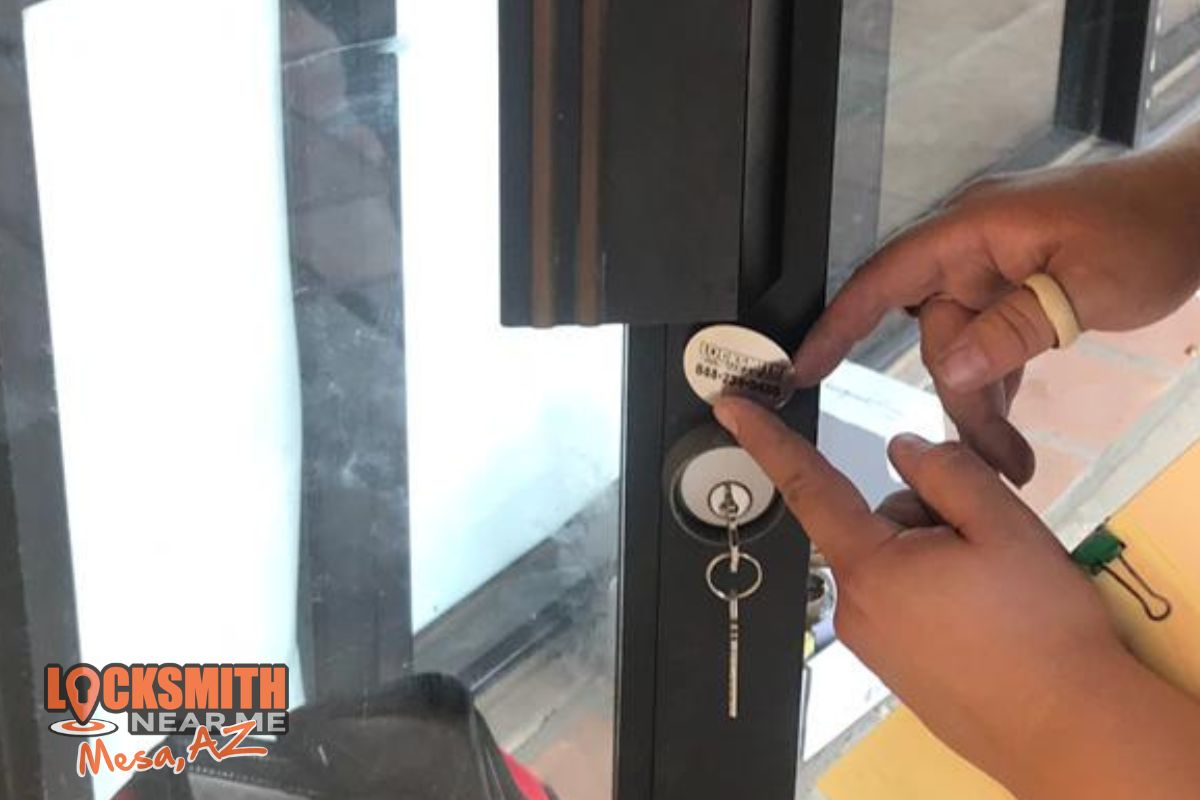
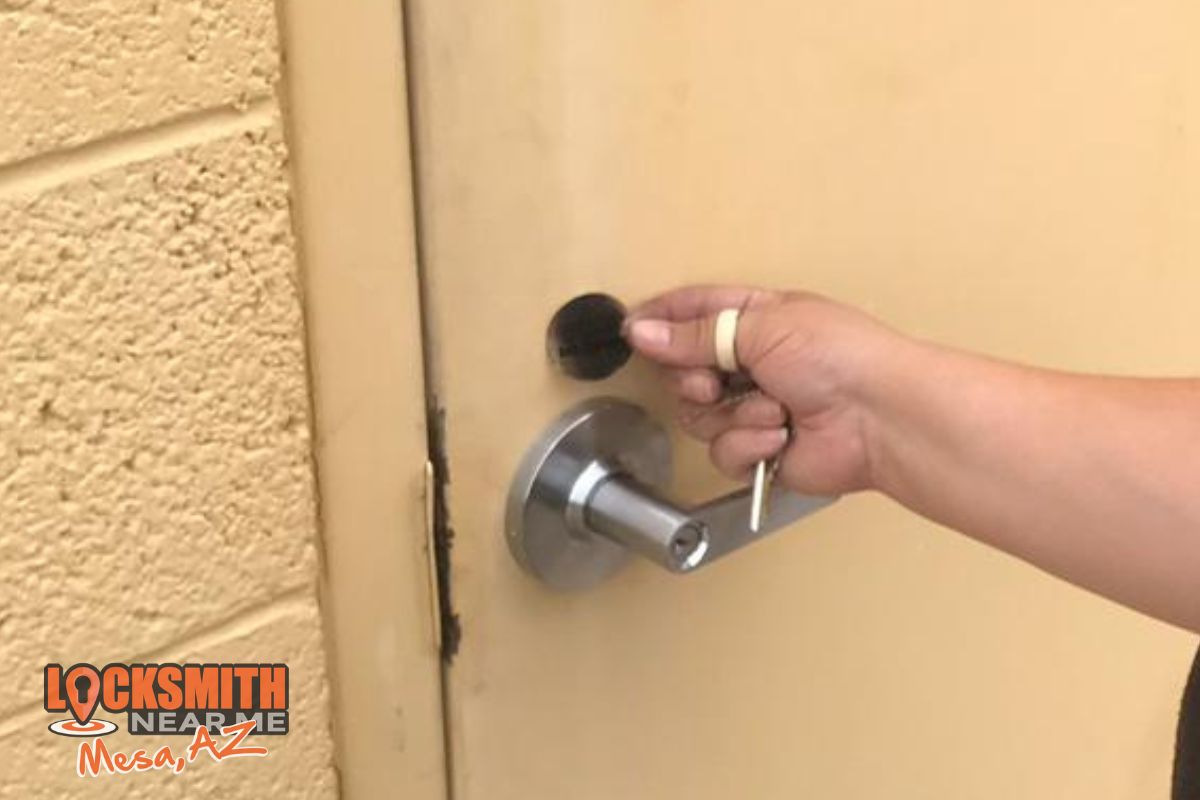
Locksmith opening commercial glass door lock in Mesa AZ

Mesa Locksmith AZ Guide: Rekey vs Lock Change vs Repair (Real-World Use Cases)

Most “lock problems” in Mesa aren’t random failures—they’re friction, alignment, or key-control issues that show up when heat expansion and dust push worn hardware past its tolerances. The right fix depends on what’s actually failing: the keyway/cylinder, the latch/strike alignment, or the door’s geometry—not just the lock brand.

If you’re in Mesa and the lock suddenly feels stiff, the key turns rough, or the deadbolt “almost” throws, you’re seeing a predictable pattern in the Phoenix Metro: doors and frames move with temperature, dust dries out lubrication, and everyday wear changes how tightly parts fit.

This is exactly the kind of call our team handles through our residential locksmith services—and the best outcomes happen when you choose the fix that matches the failure mode, not the most expensive option.

If you want to confirm what you’re dealing with before you spend money, this guide breaks down when to rekey, when to change locks, and when the real fix is repair/alignment work. Directions and reviews: Google Maps.

Rekey vs Lock Change vs Repair: What Each Really Means

Rekey (key control + cylinder reset, same lock hardware)

Rekeying changes the “key authorization” for a lock without replacing the entire lockset. In practical terms, you keep the same hardware on the door, but you stop old keys from working and issue a new key set.

What rekeying is best at:

  • Resetting access after a move, tenant turnover, employee separation, or lost keys
  • Fixing “too many copies” problems caused by worn key blanks and inconsistent duplicates
  • Standardizing keys across multiple doors when the lock hardware is still in good shape

Related services:

Key takeaway: Rekeying is a security + control decision as much as a mechanical decision.

Lock Change (new hardware or new lockset)

A lock change replaces the lock hardware because the existing components are worn, damaged, outdated, or you want a different level of security and convenience.

Common “change” triggers:

  • Excessive keyway wear or cylinder slop
  • A lock that binds even after alignment is corrected
  • You want a new format (handleset, upgraded deadbolt, smart lock)

Related service:

Key takeaway: Changing the lock makes sense when the hardware is the problem—or when your security goals changed.

Repair (restore function without changing the key system)

Repair means the lock system can be made reliable again by correcting the real cause: latch timing, door sag, strike plate alignment, worn internal parts, or commercial door hardware issues.

Repair is often the best call when:

  • The door must be pulled/pushed to lock
  • The deadbolt hits the strike plate or drags mid-day
  • A commercial door has cycle-related wear (high-traffic doors)

Related services:

Key takeaway: If the door alignment is off, replacing the lock can repeat the same failure.

Decision Matrix: Choose the Fix That Matches the Risk

Option Best when Addresses Does it change keys? Typical Mesa triggers
Rekey Hardware is solid Key control + cylinder setup Yes New home, tenant turnover, lost key
Lock change Hardware is worn/outdated Full hardware condition Yes Rough keyway, damaged lock, upgrade
Repair Door/hardware is misaligned Fit + timing + function No Heat binding, door sag, strike drag

Quick rule: If your goal is “who has access,” start with rekeying. If your goal is “this hardware is failing,” consider repair or a lock change depending on wear.

Why Mesa Heat Turns “Minor” Issues into Big Problems

Mesa and the Phoenix Metro have two forces that make borderline locks fail:

  • Heat expansion: Wood, metal, and composite doors shift by tiny amounts, but locks are tolerance devices. A small shift changes how smoothly a deadbolt travels into the strike pocket.
  • Dust + dry air: Dust loads the keyway and mixes with old lubricant. That increases abrasion inside the cylinder and accelerates key blank wear.

This creates the classic pattern: the lock “works fine” in the morning, then fights you in mid-day heat, then feels better at night. That swing points to alignment + friction, not random failure.

Quick Diagnosis: Symptom → Likely Cause → What a Pro Checks

Symptom you feel Likely cause What a pro checks (no risky shortcuts)
Key inserts rough debris + keyway wear keyway condition, wear patterns
Key turns hard only mid-day expansion + alignment drag strike alignment, bolt path
Deadbolt won’t fully throw strike pocket interference bolt centerline, travel resistance
Door must be “pulled” to lock door sag / latch timing hinge play, latch-to-strike timing
Smart lock grinds or errors misalignment under load bolt drag closed vs open
Lock feels loose/wobbly worn cylinder/lock body cylinder tolerances, mounting integrity
Storefront door won’t latch high-cycle wear mortise components, closer interaction

Bottom line: We isolate whether the problem is the key/cylinder, the latch/strike, or the door geometry—then recommend the least disruptive fix that restores reliability.

When Rekeying Is the Right Call in Mesa

Rekeying tends to be the best value when your hardware still has good “feel” and consistency, but you don’t trust the key history.

Choose rekeying when:

  • You just moved in and don’t know who has copies
  • A property changed hands (tenant, roommate, employee keys)
  • Keys feel inconsistent because there are too many duplicates in circulation
  • You want the convenience of fewer keys across multiple doors

Relevant services:

What rekeying won’t fix: a lock that’s binding due to door sag, a strike plate that’s off-center, or a cylinder that’s already worn beyond tight tolerances.

When a Lock Change Is the Smarter Move

A lock change makes sense when wear is visible in performance, not just in security concerns.

Choose a lock change when:

  • The keyway feels sloppy or unpredictable (classic “worn keyway” behavior)
  • The lock binds even after alignment work
  • The lock body is physically damaged or outdated for your needs
  • You want a functional upgrade (handleset, higher-grade deadbolt, keyless access)

Common upgrade paths on Mesa homes:

Mesa-specific reality: smart locks are less forgiving. If the deadbolt drags even slightly when the door is closed, the motor strains and reliability drops—so alignment testing matters before calling it a “bad lock.”

When Repair Is the Right Fix (Even If You Assume It’s the Lock)

Repair is the correct answer when the lock is a victim of geometry, not the culprit.

Residential repair scenarios

  • Door sag causes the latch/bolt to hit the strike plate edge
  • Heat expansion tightens the bolt path mid-day
  • Strike plate alignment creates drag and intermittent locking

If the issue appears on secondary points like mailboxes, small cylinders can be extra sensitive to dust and key wear:

Commercial repair scenarios

Commercial doors in Mesa see heavier cycles and tighter performance expectations. In many storefront cases, the “repair” involves restoring timing between hardware systems.

Relevant commercial services:

If your business is moving toward controlled entry instead of key sprawl:

If You’re Locked Out: Don’t Turn a Small Problem Into Damage

Lockouts often happen right when the lock is binding from heat or misalignment. Forcing the key, slamming the door, or using improvised methods can damage the cylinder, bend the latch, or crack trim—then your “lockout” becomes a full replacement.

If access is the immediate problem, start with the correct service:

Consumer Checklist: How to Vet a Locksmith Before They Arrive

You asked for real, ready-to-copy external resources with proper anchors. Here are three authoritative references you can keep in your post (and they align with what we recommend: verification, transparency, and avoiding bait pricing):

What to Expect When You Call a Mesa Locksmith (Our Standard Flow)

A professional visit should feel structured:

  1. Authorization check (protects you, your property, and the technician)
  2. Written quote before work so you can approve the scope
  3. Diagnosis: key/cylinder feel, latch timing, strike alignment, door geometry
  4. Options: rekey vs change vs repair, explained in plain terms
  5. Finish + verification: smooth function in real conditions (door open/closed, normal use)

If you want to learn more about our team and approach, start at our homepage or read About Us. If you’re ready to schedule service in Mesa, use our contact page.

FAQs

Should I rekey or change locks when I move into a Mesa home?

If the hardware is in good condition and you mainly need key control, rekeying is usually the cleanest option. If the locks are worn, binding, or outdated, a lock change can be the better long-term move.

What’s the clearest sign I need repair instead of replacement?

If the door only locks when you pull/push it into position, that points to alignment, door sag, or strike timing. A replacement lock won’t fix geometry by itself.

Can heat really make a lock fail in the middle of the day?

Yes. Small shifts in the door/frame change the bolt’s path into the strike pocket. In Mesa, the combination of heat and dust makes friction build faster than many homeowners expect.

If my smart lock works with the door open but struggles closed, what does that mean?

That usually points to resistance under load—misalignment between the deadbolt and strike area. A pro checks the bolt path and door closing behavior before blaming the electronics.

Is rekeying “less secure” than changing the whole lock?

Not automatically. Rekeying can be very secure when the hardware is solid and key control is your main concern. If you want restricted keyways or higher-grade hardware, that’s when an upgrade becomes part of the plan.

I have multiple doors—can you make them work with fewer keys?

Often, yes, when the hardware supports a consistent key plan. A locksmith evaluates the cylinders and recommends the most practical keying approach without sacrificing reliability.

What if this is a business door with heavy traffic?

Commercial doors fail differently because of cycle count and hardware stacks (mortise, closer interaction, panic hardware). The right fix may be repair, a commercial lock change, or moving toward controlled entry depending on the condition.

Do you verify ownership before doing locksmith work?

Yes—verification is a normal part of legitimate service, especially for lockouts, businesses, and vehicles. It reduces risk, prevents damage, and protects everyone involved.

Final Word: Pick the Fix That Matches the Failure

In Mesa, the most expensive option isn’t always the right option. Heat expansion, dust, and daily wear create predictable lock problems—and the correct solution comes from identifying whether the issue is key control, worn hardware, or alignment/timing.

If you want access control (who has working keys), rekeying is often the cleanest path. If the hardware itself is worn or you want an upgrade, a lock change is usually the better investment. If the door is dragging, sagging, or hitting the strike, repair/alignment work is what restores reliability.

Our team operates locally out of Mesa with a clear, technician-led workflow: authorization checks, written quotes before work, and a diagnosis-first approach so you don’t pay for the wrong fix.

Call (480) 418-7560 to discuss your situation and schedule service. If you’re locked out or dealing with a high-security concern, avoid risky shortcuts—verification and damage prevention matter.

Office Rekeying: A Comprehensive Guide for Business Security

Introduction

Keeping your office secure is essential in maintaining the integrity of your business. At Locksmith Near Me Mesa, we understand the importance of reliable security. One effective way to ensure this is by rekeying office locks. Office rekeying is a straightforward yet vital process that updates your locks without replacing the hardware, ensuring that old keys no longer work. Whether you’re dealing with employee transitions, lost keys, or upgrading security, rekeying provides a cost-effective solution tailored to your needs.

In this guide, we’ll explore everything you need to know about office rekeying: what it entails, its benefits, the process, and why choosing a professional locksmith is crucial. If you’re in Mesa and need reliable commercial locksmith services, this guide is for you.

rekeying an office lock

Why Office Rekeying Is Essential

Office rekeying is more than just a convenience—it’s a security necessity. There are several reasons why businesses in Mesa choose to rekey their office locks:

  • Employee Turnover: When an employee leaves, especially on bad terms, ensuring they no longer have access is critical.
  • Lost Keys: Misplaced keys pose a significant security risk. Rekeying ensures that only authorized individuals have access.
  • Security Upgrades: As your business grows, upgrading and rekeying your locks can protect sensitive areas and valuable assets.
  • Cost-Effective: Compared to full lock replacement, rekeying is an affordable way to boost security.

How Office Rekeying Works

Rekeying involves altering the lock’s internal mechanisms so that only a new set of keys can operate it. Here’s what the process entails:

  1. Initial Assessment: A professional locksmith evaluates your current locks to determine their rekeying compatibility.
  2. Disassembling the Lock: The lock cylinder is removed and its pins are adjusted.
  3. Reconfiguring Pins: The locksmith sets new pins that align with the newly provided key.
  4. Testing: After reassembly, the lock is tested to ensure smooth operation with the new key.

This process is quick and efficient, minimizing disruptions to your business operations.

rekeing main store lock

Benefits of Office Rekeying

Rekeying offers multiple advantages for businesses:

  • Improved Security: Ensure only authorized personnel have access to your office.
  • Cost Savings: Retain your existing hardware while improving security.
  • Customized Access: Create master keys for higher-level access while restricting other areas.
  • Convenience: Quickly adapt to security needs without replacing locks.

Choosing Locksmith Near Me Mesa

At Locksmith Near Me Mesa, we specialize in delivering reliable office rekeying services tailored to commercial needs. Our skilled technicians work with precision and efficiency, ensuring minimal downtime for your business. We prioritize security and customer satisfaction, offering expert advice on maintaining a secure office environment.

FAQs

1. What is office rekeying, and why is it important?
Involves modifying the internal mechanisms of your locks so old keys no longer work. It’s essential for maintaining security, especially after employee turnover, lost keys, or break-ins.

2. How does office rekeying compare to replacing locks?
Rekeying is more cost-effective than replacing locks, as it allows you to retain your existing hardware while improving security with new keys.

3. Can I rekey all office locks to use the same key?
Yes, a professional locksmith can create a master key system, allowing one key to operate multiple locks for streamlined access control.

4. How long does it take?
The process is quick, usually taking under an hour, depending on the number of locks that need to be rekeyed.

5. When should I consider rekeying my office locks?
You should rekey after employee transitions, key losses, or any situation where key security is compromised. Regular rekeying is also a smart precaution to ensure ongoing security.

rekeying office lock

Conclusion

If you’re looking for professional and efficient office rekeying in Mesa, Locksmith Near Me Mesa is here to help. We provide top-tier commercial locksmith services designed to protect your business. Contact us today to schedule your office rekeying and take the first step toward enhanced security.

Locksmith Services for Offices in Mesa Secure Your Workspace

Locksmith Services for Offices in Mesa: Secure Your Workspace

Locksmith Services for Offices: Secure Your Workspace

At Locksmith Near Me Mesa Arizona, we understand the importance of keeping your office space secure. Our locksmith services for offices are designed to offer full protection, whether you need new locks, repairs, or high-tech security solutions. We work with businesses of all sizes, from small offices to large commercial buildings, ensuring their security needs are met. From installing heavy-duty locks to upgrading to smart lock systems, we provide it all.

checking office lock

Enhance Office Security with Keyless Entry

Keyless entry systems are a modern, efficient way to improve office security. These systems eliminate the risk of lost keys and unauthorized access, making them a popular choice for many businesses. With our locksmith services for offices in Mesa, we offer a wide range of keyless entry options, including card access systems, biometric locks, and digital keypads. These systems allow you to control who enters your office while providing a convenient and secure solution for employees.

Office Lock Repairs and Maintenance

Damaged or malfunctioning locks can compromise your office’s security, putting sensitive information and valuable assets at risk. We offer expert lock repair services to address any issues with your existing locks. Whether your lock is sticking, the key is hard to turn, or the lock has been tampered with, our skilled locksmiths can diagnose and fix the problem. Regular maintenance is also a key part of our locksmith services for offices, ensuring your locks remain in top condition.

keypad lock on office

Rekeying Services for Enhanced Control

Rekeying is one of the most cost-effective security measures a business can take. If you’ve recently relocated, experienced staff changes, or misplaced keys, our rekeying services can help. We will change the internal pins of your locks so that old keys no longer work, and provide you with new keys to maintain control over who can access your office. Rekeying is an essential part of our locksmith services for offices, providing a simple yet effective way to keep your business secure.

Installing High-Security Locks

For businesses requiring an extra layer of protection, high-security locks are the answer. Our locksmith services for offices include installing robust, tamper-resistant locks that deter even the most determined intruders. These locks are ideal for offices storing sensitive data, valuable assets, or expensive equipment. We offer a variety of high-security lock options, ensuring you find the right fit for your business’s needs.

proximity key office

Safe Installation and Repair Services

In addition to door locks, many offices use safes to store critical documents, cash, and valuable items. Our locksmith services for offices also include safe installation and repairs. Whether you need a new safe installed or an existing safe repaired, our team can ensure that your valuables are securely stored and easily accessible when needed.

Contact Us for Reliable Locksmith Services for Offices

When it comes to securing your office, trust the experts at Locksmith Near Me Mesa Arizona. We offer a range of locksmith services for offices, from lock installation and repairs to advanced security solutions like keyless entry and high-security locks. Protect your business by contacting us today for all your office locksmith needs.

Rekey Service - Locksmith Near Me Mesa

Rekey Service for Commercial Properties in Mesa

When it comes to maintaining the security of your business, rekeying your locks is an essential service. At Locksmith Near Me Mesa, our rekey service allows business owners to maintain control over who has access to their property without the need for a full lock replacement. This is especially helpful when employees leave, or after renovations where key control is critical.

rekeying services

Benefits of a Rekey Service

Rekeying your locks offers multiple advantages for commercial properties. Not only is it a cost-effective solution compared to installing new locks, but it also ensures that old keys will no longer function. With our rekey service, you can quickly and easily secure your office, retail store, or other business premises, maintaining control over access to your property.

Why Choose Rekeying for Your Business

Choosing our rekey service ensures you don’t need to invest in new hardware. We will simply modify the lock mechanism so the previous key is no longer usable, and we provide you with a new set of keys. It’s fast, efficient, and the best way to enhance security without major expenses.

rekeying a lock in office

How Rekeying Can Help Your Business

For businesses, rekeying is an ideal solution when there’s a change in personnel or if a key has been lost. It’s a fast way to regain control of your security system without having to replace every lock. At Locksmith Near Me Mesa, we tailor our services to meet the unique needs of commercial spaces, ensuring your assets are protected.

Contact Us for Rekey Service

rekeing a new lock

If you’re looking for a cost-effective solution to enhance your business security, contact Locksmith Near Me Mesa. Our rekey service ensures you stay in control of who has access to your commercial property. We’re here to help businesses in Mesa maintain top-notch security. Reach out today for professional locksmith services tailored to your needs.

Keypad Door Locks

Keypad Door Locks: Enhanced Security for Mesa Businesses

When it comes to protecting your business, advanced technology like keypad door locks offers a significant upgrade over traditional lock systems. These modern security solutions provide convenience, control, and added security, making them an ideal choice for commercial properties in Mesa.

new keypad lock door

Why Choose Keypad Door Locks for Your Business?

Business owners are increasingly opting for keypad door locks due to their ease of use and reliability. With no physical keys to manage, these locks reduce the risks associated with lost or duplicated keys. This feature is especially useful in high-traffic areas, such as offices, retail stores, and warehouses.

Additionally, keypad locks allow business owners to assign unique access codes to employees, contractors, or other authorized individuals. If an employee leaves, there’s no need to change the entire lock—simply update the access code, and your property remains secure.

Key Features of Keypad Door Locks

  • Access Control: Assign unique codes to staff or visitors and easily change them when necessary. No more worrying about lost keys or unauthorized access.
  • Remote Management: Some keypad systems integrate with smartphones, allowing remote lock and unlock features, ideal for business owners who travel.
  • Durability: Commercial-grade keypad locks are built to withstand frequent use and last longer than traditional locks.
  • Enhanced Security: Prevent unauthorized access with tamper-resistant features and automatic lock mechanisms after a set period of inactivity.

How Keypad Door Locks Improve Business Security

Businesses in Mesa, regardless of size, benefit greatly from the increased security that keypad door locks offer. These locks not only eliminate the need for key duplication but also allow business owners to track and control who enters their building. Whether you’re managing an office, storefront, or large industrial facility, this system provides an efficient and effective way to maintain control over access points.

digital keypad lock

Tailored Solutions for Your Business

At Locksmith Near Me, LLC, we understand that each business has unique security needs. We offer a range of keypad door locks designed for different types of businesses. From small retail outlets to multi-floor office buildings, we work closely with business owners to install the right system that fits their needs and budget.

Whether you want to enhance security at a single entry point or require a comprehensive access control solution across multiple locations, our team has the expertise to help you make informed decisions.

Professional Installation and Support

Ensuring your keypad system is properly installed is essential for its effectiveness. Our team at Locksmith Near Me, LLC in Mesa specializes in the installation of commercial-grade keypad door locks. We take care of everything from system setup to final testing, ensuring your business is secure from the moment we finish the installation.

If you ever experience issues or need updates to your system, our team is always ready to provide support. We pride ourselves on delivering reliable locksmith services that keep your business running smoothly.

Customer Testimonials

  • “Switching to a keypad lock system was the best decision we made for our office. It’s easy to manage and provides the security we need.” – John T., Mesa
  • “Locksmith Near Me, LLC installed keypad locks in all of our retail stores, and the process was seamless. We’re really happy with the service and support.” – Sarah L., Business Owner in Mesa
  • “Great experience! The installation was quick, and the team was professional. The keypad locks have made access management so much easier.” – Brian W., Mesa

keypad locks

Conclusion

Upgrading your business’s security with keypad door locks is a smart investment that offers long-term benefits. If you’re in Mesa and looking to enhance the security of your commercial property, trust Locksmith Near Me, LLC to provide professional installation and ongoing support.

Key Extraction

Key Extraction Services in Mesa: Fast, Safe, and Reliable Solutions

At Locksmith Near Me, LLC, we provide emergency key extraction services throughout Mesa. Whether it’s a broken key in your car, office, or home, a stuck key can disrupt your day and compromise your security. Our expert locksmiths specialize in safely extracting keys without damaging the lock, ensuring you can regain access quickly.

The Importance of Fast Key Extraction in Emergencies

When a key breaks inside your lock, it can quickly escalate from a small inconvenience to a major issue. Whether it’s a car ignition key, office door lock, or the front door of your home, time is critical. Waiting too long to resolve a key extraction issue can result in further damage to the lock or leave you locked out when you least expect it. That’s why having a reliable locksmith on hand is essential.

At Locksmith Near Me, LLC, we understand how frustrating these situations can be. Our team is committed to providing rapid and effective solutions to get you back inside and secure without unnecessary delays. For businesses, homes, or vehicles, we ensure a smooth, hassle-free experience.

Automotive Key Extraction

Why You Need Professional Key Extraction in Emergencies

A broken key can happen at the worst possible times—whether you’re trying to get into your car in the middle of the night, access your office before an important meeting, or enter your home after a long day. Trying to extract a broken key yourself can worsen the situation, causing further damage to the lock. That’s why it’s essential to trust professionals who have the right tools and expertise to handle these emergencies.

Our emergency locksmiths can assist with key extraction in any setting. From jammed car ignitions to office door locks, we work quickly to resolve the issue and get you back on track. Whether it’s a car, residential, or commercial lock, our team is equipped to handle it all.

Emergency Key Extraction for Cars, Offices, and Homes

No matter where you find yourself locked out, Locksmith Near Me, LLC has you covered. We understand that emergency situations can arise in any setting, and we offer key extraction services for a variety of lock types, including:

  • Cars: A key stuck in the ignition or car door lock can leave you stranded. Our team will arrive promptly to extract the key and ensure your vehicle’s lock remains in good working order.
  • Offices: A broken key in your office door lock can disrupt your workday. We provide fast and efficient key extraction for businesses, ensuring you regain access without hassle.
  • Homes: A broken key in your front door or backdoor lock can be stressful, especially when you’re locked out. Our team will extract the key and restore your access safely and quickly.

Residential Key Extraction

Why Choose Locksmith Near Me, LLC for Emergency Key Extraction?

We take pride in serving Mesa with expert locksmith services. Our technicians are highly trained to handle emergencies with professionalism and speed, ensuring minimal disruption to your day. Whether you’re locked out of your home, car, or office, we are available for emergency services, offering fast response times and reliable solutions.

Customer Testimonials

“I was locked out of my car late at night when the key broke off in the ignition. Locksmith Near Me, LLC arrived quickly and got me back on the road in no time!” — Jake P., Mesa

“My office key broke off in the lock right before an important meeting. Locksmith Near Me, LLC saved the day by removing the key quickly and keeping my lock intact.” — Maria G., Mesa

Commercial Key Extraction

Conclusion

When you’re faced with a key stuck in a lock, don’t panic—Locksmith Near Me, LLC is here to help. Our emergency key extraction services are available for homes, offices, and vehicles in Mesa. Trust us to safely and quickly remove your broken key, restoring your access and security.

Business Re-Key

Business Re-Key Services in Mesa: Secure Your Property

When it comes to maintaining security at your place of business, one of the most effective solutions is a business re-key service. Whether you’re moving into a new office, dealing with a staff change, or simply enhancing your overall security, Locksmith Near Me, LLC in Mesa is here to provide fast and professional re-key services tailored to your business’s needs.

What Is Business Re-Keying?

Re-keying is the process of changing the internal components of your locks so that old keys no longer work. This is a more cost-effective and efficient solution compared to completely replacing the locks on your doors. When you opt for business re-key services, you get enhanced security without the expense of installing entirely new hardware.

business rekeying

Why Should You Re-Key Your Business Locks?

There are several scenarios where re-keying your business locks is essential:

  1. Employee Turnover: When employees leave, especially those who had access to keys, it’s crucial to re-key your locks to ensure they no longer have unauthorized access.
  2. New Commercial Property: If you’ve just moved into a new office space, it’s impossible to know how many previous occupants have keys to the locks. Re-keying ensures that only you and your trusted team have access.
  3. Lost or Stolen Keys: Misplacing a key is more than an inconvenience; it can expose your business to potential threats. Re-keying the locks will restore the security of your property.
  4. Increased Security Needs: As your business grows, so does your need for enhanced security measures. Re-keying your locks allows you to control who has access to specific areas within your property.

rekeying a lock

Long-Term Value of Re-Keying Your Business Locks

At Locksmith Near Me, LLC, we believe that regular re-keying is an investment in your business’s future security. By keeping your access points secure and up-to-date, you’re not only protecting your assets but also building trust with your clients and employees.

When you re-key your locks, you’re essentially resetting your security without the need for new hardware. This means you get the benefit of enhanced protection while saving on the cost of replacing entire locking systems. It’s an efficient way to manage key control, especially as your business grows or undergoes changes in staff.

Re-keying also provides the flexibility to scale your security system. Whether you’re adding new departments, expanding your office space, or adjusting access levels for different team members, re-keying allows you to adapt quickly to those changes. It keeps your security robust and your operations seamless.

Most importantly, re-keying can be done with minimal disruption to your day-to-day activities. Our team at Locksmith Near Me, LLC works with you to schedule a time that won’t interfere with your business, ensuring that the process is smooth and efficient.

Benefits of Re-Keying Your Business Locks

  1. Cost-Effective: Re-keying is significantly less expensive than replacing the entire lock system, making it a budget-friendly security upgrade.
  2. Increased Control: By re-keying your locks, you can create a more organized system for key distribution, ensuring that only authorized individuals have access to specific areas.
    1. Enhanced Security: Re-keying ensures that old keys, which may be in the possession of unauthorized individuals, are rendere a|d useless, effectively boosting your business’s overall security.
  3. Master Key Systems: If your business needs access control across multiple areas, we can re-key your locks to work with a master key, providing an easy solution for managers and key holders.

lock rekey for business

Customer Testimonials

At Locksmith Near Me, LLC, we take pride in our reputation for providing high-quality business re-key services. Here’s what our clients in Mesa have to say:

  • “We recently re-keyed all the locks in our office after a major staff change. The service from Locksmith Near Me, LLC was efficient and professional. Highly recommend!“ – Brian P., Mesa
  • “After losing one of our office keys, we contacted Locksmith Near Me, LLC. They re-keyed the entire building quickly, and now we feel much more secure.“ – Jennifer L., Mesa

Secure Your Business with Locksmith Near Me, LLC

If you’re in Mesa and looking to enhance the security of your business, business re-key services from Locksmith Near Me, LLC are the perfect solution. Whether you’re safeguarding your office, warehouse, or retail space, our team will ensure that only authorized personnel have access to your property. Don’t wait until security becomes a concern—contact us today to schedule a consultation and protect your business with expert re-keying services.