Rekeying a lock at home

Master Keying for Offices in Mesa, AZ — Simplifying Management with Custom Master Key Systems for Office Buildings

Managing access across an entire office building with a different key for every door is one of the most common — and most frustrating — problems facility managers face in Mesa. Lost keys multiply, re-keying costs stack up, and controlling who accesses what becomes a logistical headache. A professionally designed master key system solves all of that by giving you layered, hierarchical control over every access point in your building from a single, organized key structure. At Locksmith Near Me Mesa Arizona, we’ve helped dozens of Mesa commercial properties build these systems from scratch. Keep reading to understand exactly how it works and what it takes to do it right.

What Is Master Keying for Offices — and Why It Matters in Mesa

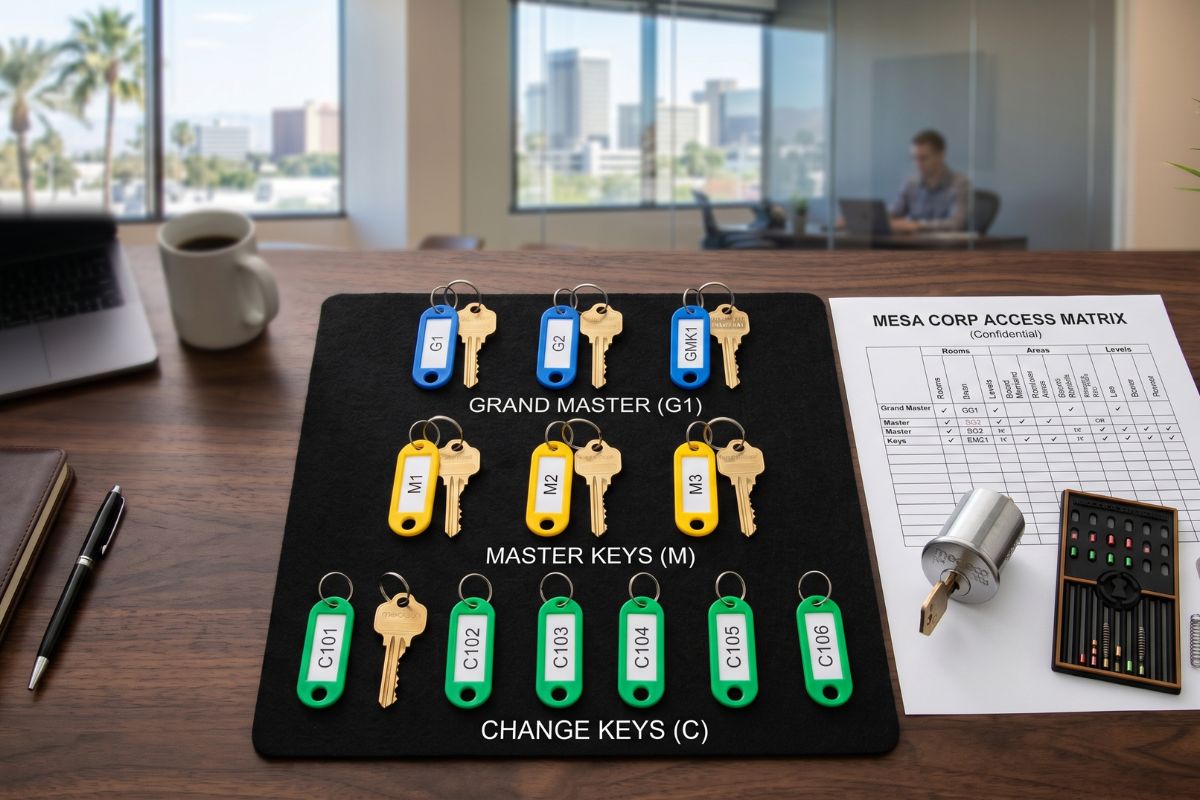
Master keying for offices is the process of configuring a building’s lock cylinders so that multiple keys can operate different combinations of doors — all within a single, organized hierarchy. Every lock is cut and pinned to allow both an individual key (called a change key) and a higher-level key (the master key) to operate it.

In the East Valley commercial market, we work with a wide range of buildings — from professional suites along Gilbert Road to large office complexes near the Fiesta District. Regardless of building size, the core security challenge is always the same: too many doors, too many people, and not enough control. Mesa’s commercial sector also deals with high employee turnover in certain industries, which makes re-keying individual cylinders regularly a significant expense — one that a master key system is specifically designed to minimize.

Our licensed technicians have over 10 years of hands-on experience in commercial lock installation and re-keying across Mesa and the broader East Valley. We follow ALOA (Associated Locksmiths of America) professional standards in every system we design, and we document every key combination and access tier we create so the building owner always has a complete, auditable record.

System Feature Single-Key Setup Master Key System Grand Master System Complexity Level
Access Hierarchy None — one key, one door 2 tiers (change key + master) 3+ tiers (change, master, grand master) Moderate
Suited For Single tenant, small office Medium office (5–50 doors) Large campus or multi-tenant building High
Re-key on Staff Exit Entire building Only affected zone/cylinder Only affected tier/zone Low effort
Lock Brands Compatible Any standard brand Schlage, Kwikset, Medeco, ASSA ABLOY Medeco, ASSA ABLOY, Mul-T-Lock Moderate
Key Control (Anti-Duplication) None unless patented keyway Available with restricted keyways Standard — high-security cylinders Low risk
BHMA Grade Recommendation Grade 3 (light commercial) Grade 1 or Grade 2 Grade 1 mandatory Critical
Deadbolt Security Integration Manual, standalone Integrated into master plan Full integration, all entry points Moderate
Thumbturn Lock Support Standard residential thumbturn Commercial thumbturn with key override Emergency override on all thumbturns Manageable
Documentation Provided Usually none Key bitting chart + access matrix Full key control log + master plan Essential
Scalability Limited Moderate (up to ~80 doors) Highly scalable, multi-building Advanced


Designing a Master Key System for Your Mesa Office: The Process We Follow

No two office buildings have identical access needs, which is why we never apply a one-size-fits-all approach to commercial locksmith services in Mesa. Our process starts with a physical walk-through of the property — we map every access point, identify which doors require restricted entry, and document the roles within the organization that correspond to each zone.

Step 1: Access Hierarchy Planning

The first step is building what we call an access matrix — a document that maps every door in the building against every role in the organization. An administrative assistant might need access to the front entry, the copy room, and their private office. A department head needs all of that, plus the server closet and the executive suite. The general manager needs access to everything. This matrix becomes the blueprint for every pinning decision we make.

For Mesa office buildings with HOA-governed commercial properties — particularly those in newer East Valley business parks — we also check whether the building has exterior door standards that affect hardware selection. BHMA Grade 1 cylinders are our standard recommendation for any commercial master key system, as they meet the highest durability and security thresholds defined by the Builders Hardware Manufacturers Association.

Step 2: Hardware Selection and Cylinder Pinning

Once the access hierarchy is planned, we select the appropriate lock cylinders and pinning configurations. For master keying for offices in Mesa, we most frequently work with Schlage commercial cylinders, ASSA ABLOY, and Medeco high-security locks for environments requiring restricted key duplication. Each cylinder is pinned with a specific combination of driver pins, key pins, and master wafers that allow both the individual change key and the master key to function — while still blocking unauthorized keys.

Our technicians are trained on pinning math and master key progression tables, which means we can expand the system later without having to start over. This is a technical detail that matters enormously if your business grows — adding 10 new doors to a poorly planned system can force a complete rebuild. We plan for scalability from day one.

[Pro Tip from 10+ Years in Mesa Commercial Locksmithing: Always request a restricted keyway with your master key system. A restricted keyway means that duplicate keys can only be cut by the authorized locksmith who holds the keyway license — so a departing employee cannot simply walk into a hardware store and copy their change key. This single decision eliminates one of the most common commercial security breaches we see in the East Valley.]

Step 3: Deadbolt Security and Thumbturn Integration

Many Mesa office buildings have exterior deadbolt locks on primary entry doors and thumbturn locks on interior offices. Both need to be incorporated into the master key plan carefully. A commercial deadbolt re-key must be pinned to match the master plan — otherwise the master key won’t operate it. Thumbturn locks present a different challenge: they are operated from the inside with a thumb lever, but the exterior side must also accept the appropriate key tier. We configure commercial-grade thumbturn cylinders with a key-override function on the exterior so that property managers retain access in all circumstances.

Arizona’s heat — regularly exceeding 110°F during Mesa summers — affects both deadbolt mechanisms and thumbturn components. We specify brass or steel cylinders rated for extreme temperature exposure and advise against plastic-composite thumb levers on exterior-facing doors, which can warp under direct desert sun exposure.

Key Control: The Part Most Office Managers Overlook

One of the most underestimated elements of master keying for offices is key control — the ongoing management of which keys exist, who holds them, and what happens when one is lost or unreturned. Without a key control plan, even the most precisely engineered master key system degrades over time.

At Locksmith Near Me Mesa Arizona, we provide every client with a key bitting chart and a physical key log at the time of installation. The key log tracks every key serial number, the name of the individual it was issued to, the date of issue, and the return date. We also note the specific access level of each key so that if a single key is reported lost, the facility manager knows immediately which doors are at risk — and which cylinder or cylinders need to be re-keyed.

For businesses that require a higher level of accountability, we also install high-security locks with serialized, patent-protected key blanks. These keys cannot be duplicated without the account holder’s written authorization — a standard that aligns with ALOA’s recommended key control protocols for commercial accounts.

Our team also works directly with building owners on their access control planning for properties that want to eventually migrate from mechanical master key systems to electronic or hybrid systems. The mechanical master plan can serve as the foundation for the electronic hierarchy, which makes future upgrades significantly less disruptive.

When to Re-Key vs. When to Replace the Entire System

A well-designed master key system does not require replacement every time there is a personnel change — that is one of its primary advantages over a standard single-key setup. However, there are specific scenarios where re-keying individual cylinders or upgrading the entire system is the right call.

We recommend a re-key service on individual cylinders when a change key holder leaves the organization without returning their key, when a key is reported lost or stolen, or when access responsibilities shift within a department. Because only the affected change key tier is impacted, the rest of the system remains secure and no other cylinders need to be touched.

A full system rebuild is advisable when the master key itself is lost or unaccounted for, when the building undergoes a significant ownership or management change, or when the system has been in place for more than 10–12 years without a security audit. In Mesa’s commercial market, we also recommend a security review any time a building changes its primary tenant roster — particularly in multi-suite office parks where common area access is part of the master key plan.

For a full security assessment of your property, our commercial locksmith team conducts on-site audits and delivers a written recommendation for the most appropriate course of action — whether that is a targeted re-key, a system upgrade, or a complete master key redesign.

Master Key Systems and Arizona Commercial Building Compliance

Mesa commercial properties are subject to both local building codes and Arizona fire safety regulations that affect how access control hardware is specified. Specifically, any door that serves as a means of egress under the International Fire Code — adopted by the City of Mesa — must allow free egress from the interior at all times without the use of a key, special knowledge, or effort. This is where thumbturn locks play a critical role: they must be positioned on the interior so that building occupants can exit freely, while the exterior key cylinder is incorporated into the master plan.

NFPA 101 (Life Safety Code) also governs exit door hardware in commercial occupancies, and our technicians are trained to specify door hardware that meets both the master key plan requirements and the applicable egress codes. We always cross-reference the Arizona State Fire Marshal’s requirements and Mesa’s local amendments when specifying hardware for any commercial job.

Our commitment to code compliance is part of what separates a licensed, experienced commercial locksmith from an unqualified operator. You can verify our licensing through the Arizona Registrar of Contractors, which maintains public records for all licensed contractors operating in the state.

Frequently Asked Questions — Master Key Systems for Offices in Mesa, AZ

Master keying for offices is a lock configuration process where each door cylinder is pinned to accept both an individual change key and a higher-level master key. The internal pin stacks in each cylinder are set at specific heights so that two different key cuts can reach the shear line and operate the lock. The result is a tiered access system where a department key opens only designated doors while the master key opens every door in its tier. This structure is designed, documented, and installed by a licensed commercial locksmith.

A master key system can have multiple tiers depending on the complexity of the building. The standard levels are: change key (individual door), master key (zone or department), grand master key (full building), and great grand master key (multi-building campus). Each tier is engineered using a key progression table to ensure no two levels share identical bitting, which is the safeguard that prevents unauthorized cross-tier access. For most Mesa office buildings, a two- or three-tier system is sufficient.

Yes — in most cases, existing deadbolt cylinders can be re-pinned to accept the master key plan without replacing the entire lock hardware. The cylinder is removed, re-pinned by a qualified locksmith using the master key specification, and reinstalled. The condition of the existing hardware matters: worn or low-grade cylinders may need to be replaced with BHMA Grade 1 equivalents to ensure the system’s overall security is not compromised by a weak link at any single door.

A lost master key is a serious security event that requires immediate attention. Because the master key operates every door in its tier, any unaccounted master key puts the entire floor or building at risk. The appropriate response is to re-key every cylinder in the affected tier, which is the only way to definitively eliminate the risk. This is also why we recommend restricted keyways with serialized key blanks — a restricted master key cannot be duplicated at a hardware store, which reduces the risk of unauthorized copies being made before a loss is even reported.

Yes — commercial-grade thumbturn locks are fully compatible with master key systems. The interior thumbturn functions independently for egress, while the exterior cylinder is pinned into the master plan just like any other lock. This configuration satisfies both security requirements and Arizona fire code egress regulations, which require that any exit door be operable from the interior without a key. Our technicians specify thumbturn models with key-override capability on the exterior so that authorized keyholders always retain access from outside.

We recommend a security audit of your master key system every two to three years under normal operating conditions, and immediately following significant events such as an ownership change, a burglary or attempted break-in, a major shift in staffing, or the loss of any key in the system. An audit includes verifying the integrity of each cylinder, cross-referencing the key log against current personnel, and assessing whether the existing access hierarchy still matches the organization’s structure. Proactive audits consistently identify vulnerabilities before they become incidents.

Absolutely. High-security lock brands like Medeco and ASSA ABLOY are specifically engineered for master key applications and actually perform better in master key configurations than standard commercial cylinders. These brands use patented keyways, rotating tumblers (in Medeco’s case), and controlled key duplication protocols that add a significant layer of security over standard commercial cylinders. For Mesa office buildings where sensitive data, financial assets, or controlled access to server infrastructure is involved, these brands are our primary recommendation.

Take Control of Your Building’s Access — Contact Locksmith Near Me Mesa Today

If your office building’s access management has become a tangled web of keys, re-keys, and security uncertainty, a professionally designed master key system is the structured solution your Mesa property needs. The system we design for your building will be documented, scalable, code-compliant, and built with the hardware quality to last through Arizona’s extreme climate conditions.

We’ve helped office managers, property owners, and facilities directors across Mesa and the entire East Valley take back control of their access hierarchy — and the process is more straightforward than most people expect. Our commercial locksmith team is ready to walk through your building, map your access needs, and deliver a master key plan tailored to your organization’s exact structure.

If you’re exploring related security topics for your property, our post on high-security lock upgrades for Mesa businesses is a strong companion read that covers the specific hardware tiers we recommend for commercial environments.

Ready to simplify access management in your Mesa office building? Contact Locksmith Near Me Mesa Arizona to schedule your on-site consultation — or find us directly on Google Maps to visit our local listing, read verified reviews from real Mesa business clients, and connect with our licensed team. Your building’s access control deserves a system that works as hard as your business does.
Retrofit smart locks

Retrofit Smart Locks: Keep Your Hardware and Upgrade Your Deadbolt Security in Mesa, AZ

Retrofit smart locks let you add keyless entry, remote access, and app control to the deadbolt you already own — without replacing the entire lock body. If your Mesa home has a solid deadbolt you trust, there’s no reason to yank it out just to go smart. We help East Valley homeowners make the right upgrade decision every day.

Replacing a working deadbolt to install a smart lock sounds like a reasonable trade — until you realize the exterior hardware, the strike plate, and the lock cylinder you’ve maintained for years get tossed in the trash. Many homeowners in Mesa and the surrounding East Valley don’t know that retrofit smart locks exist specifically to solve this problem. These devices mount directly onto your existing thumbturn lock from the inside, leaving everything else intact.

At Locksmith Near Me Mesa Arizona, we’ve spent years helping residents evaluate their deadbolt security and find the upgrade path that makes the most sense for their door, their lifestyle, and their existing hardware. Our technicians are trained and certified, and we back every installation with hands-on expertise developed across hundreds of East Valley homes.

If you’re searching for a way to modernize your entry door without compromising the lock you already trust, keep reading — we’re covering everything you need to know about retrofit smart locks, how they work with your current deadbolt, and when it’s worth calling a licensed locksmith in Mesa to get the job done right.

What Are Retrofit Smart Locks and How Do They Work?

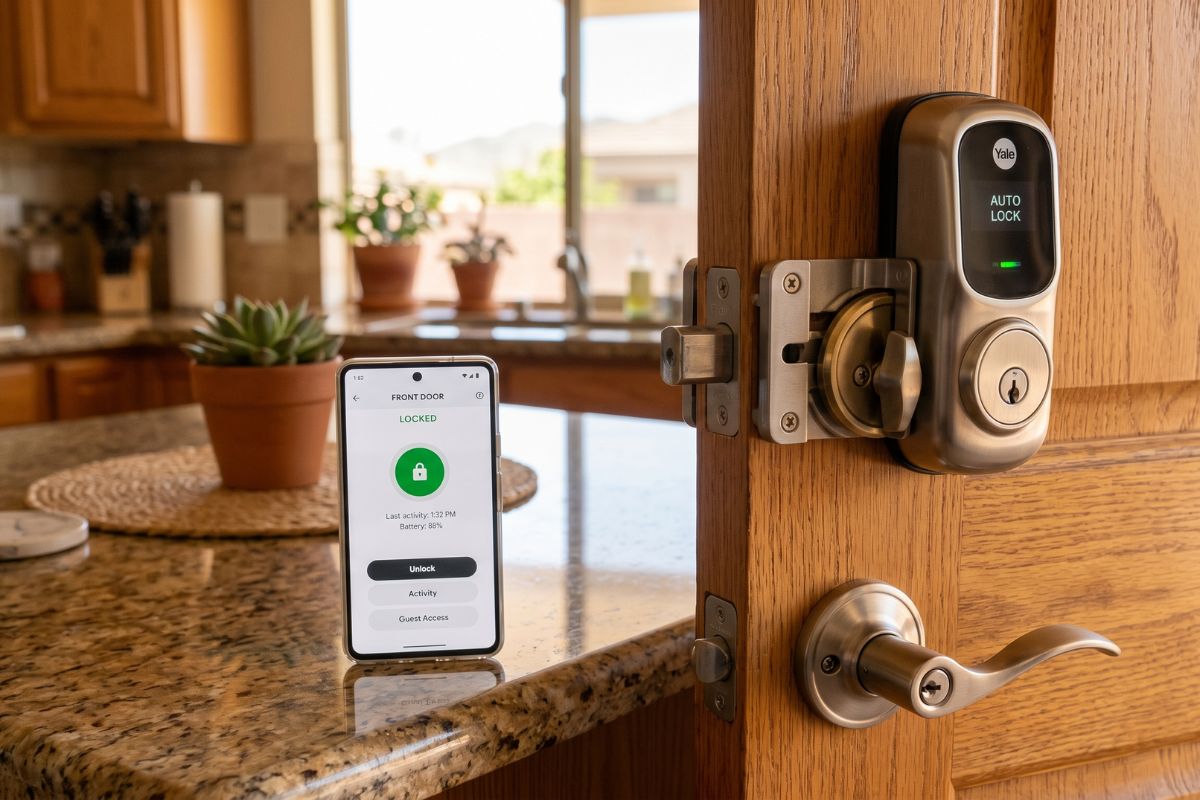
A retrofit smart lock is a motorized device that attaches to the interior side of your existing deadbolt. Instead of replacing the full lock assembly, it clamps onto your current thumbturn lock and drives it electronically using a motor, gears, and a battery pack. The exterior of your door stays completely unchanged — same keyway, same hardware finish, same strike plate.

From the inside, you control the lock through a companion app, a keypad, or a voice assistant integration. From the outside, your key still works exactly as it always did. That dual-function design is what makes retrofit smart locks so practical for homeowners who have invested in quality deadbolt hardware — brands like Schlage, Kwikset, Baldwin, and Medeco — and don’t want to compromise the physical security of that investment.

Here in Mesa, where front-door exposure to Arizona sun and heat can warp or stress lock components over time, keeping your tested, proven deadbolt cylinder in place rather than breaking it in a new one is a meaningful security advantage. Our residential locksmith team evaluates door thickness, deadbolt projection, and thumbturn geometry before recommending any retrofit device to make sure the fit is mechanically sound.

Retrofit Smart Lock Comparison: Top Models for Existing Deadbolts

The table below covers the most widely installed retrofit smart locks our technicians work with in Mesa and the East Valley. Use it as a starting reference — compatibility with your specific deadbolt brand and door prep should always be confirmed before purchase.

Model Compatible Deadbolts Connectivity Access Methods Battery Life BHMA Grade Works With
August Smart Lock Pro (Gen 3) Most single-cylinder deadbolts (Schlage, Kwikset, Baldwin) Z-Wave, Bluetooth, Wi-Fi (bridge) App, auto-lock/unlock, voice ~3 months (4 AA) Grade 2 Alexa, Google, HomeKit, SmartThings
Wyze Lock Schlage B60N, Kwikset 980, most standard deadbolts Bluetooth + Wi-Fi gateway App, auto-lock, voice ~6 months (4 AA) Grade 2 Alexa, Google
Schlage Encode Plus Designed for Schlage B-series replacement (full swap) Wi-Fi built-in Keypad, app, Apple Home Key ~6 months (4 AA) Grade 1 Apple Home, Alexa, Google
Level Bolt Single-cylinder deadbolts with standard thumbturn Bluetooth (Thread-ready) App, Apple Home, NFC ~1 year (CR2 battery) Grade 2 Apple Home, Google (limited)
Ultraloq U-Bolt Pro Most single-cylinder deadbolts, wide compatibility range Bluetooth + Wi-Fi (bridge) Fingerprint, keypad, app, key ~8 months (4 AA) Grade 2 Alexa, Google, SmartThings
Lockly Secure Pro (retrofit mode) Kwikset and Schlage single-cylinder models Bluetooth + Wi-Fi PIN Genie keypad, fingerprint, app, key ~6 months (4 AA) Grade 2 Alexa, Google
Danalock V3 Euro-profile cylinders + adapter kits for US deadbolts Bluetooth + Z-Wave App, auto-lock, voice ~6 months (4 CR123) Not BHMA rated SmartThings, Vera, Fibaro
August Wi-Fi Smart Lock (4th Gen) Single-cylinder deadbolts — Schlage, Kwikset, Yale Wi-Fi built-in (no bridge needed) App, auto-lock, DoorSense sensor ~6 months (4 AA) Grade 2 Alexa, Google, HomeKit


Deadbolt Compatibility: What to Check Before You Buy

Not every retrofit smart lock fits every deadbolt. Before purchasing any device, our professional locksmith team always checks four mechanical variables:

Thumbturn diameter and height. The motor clamp in a retrofit device grips the thumbturn directly. If your thumbturn is unusually small, oversized, or a non-standard shape, the mounting adapter may not secure properly. High-security deadbolt brands like Medeco and Mul-T-Lock use thumbturn profiles that don’t match standard retrofit adapters without modification.

Deadbolt projection (throw length). Standard deadbolts project 1 inch into the strike plate. Some retrofit smart locks require a minimum throw length to detect full lock/unlock position through sensor feedback. A short-throw auxiliary deadbolt won’t register correctly.

Door thickness. Most retrofit devices are designed for doors between 1 3/8″ and 2″ thick. Exterior doors in Mesa homes built before 1990 sometimes have non-standard thicknesses that require adapter plates — particularly on steel entry doors with foam core construction.

Interior clearance. Some deadbolts sit very close to a door lever or knob. The motor housing on a retrofit device adds bulk to the inside face of the door, and in tight configurations it can conflict with the lever trim. We see this frequently on older Mesa tract homes where the builder used compact Kwikset entry sets.

Our home security specialists carry compatibility gauges and adapter kits on every service call so these issues are identified before installation begins — not after you’ve already opened the box.

Understanding BHMA Security Grades

The Builders Hardware Manufacturers Association (BHMA) grades residential deadbolts and smart lock hardware on a three-tier scale:

  • Grade 1 — Highest residential duty rating. Withstands 250,000 open/close cycles and 10 strike attacks. Recommended for front entry doors.
  • Grade 2 — Standard residential duty. Most retrofit smart locks fall here. Appropriate for secondary entry doors or low-traffic residential use.
  • Grade 3 — Light duty. Not recommended for exterior doors.

Most retrofit smart locks earn a Grade 2 BHMA rating, which is adequate for secondary doors and interior applications. For your primary entry door, we generally recommend pairing a retrofit device with a Grade 1 underlying deadbolt — like the Schlage B60N or Kwikset 980 — so the physical cylinder holding everything together is rated for demanding real-world use.

For Mesa homeowners specifically, the Associated Locksmiths of America (ALOA) recommends that any smart lock upgrade retain or improve the BHMA rating of the underlying cylinder. Our technicians follow these same professional standards on every lock installation we complete in the East Valley.

Installation: Where DIY Ends and Professional Work Begins

Most retrofit smart locks are marketed as tool-free installs, and for a perfectly standard door with a perfectly standard deadbolt, that description is accurate. You remove the interior mounting plate, position the retrofit device, tighten the mounting bracket, and pair the app. On a new door with no complicating factors, a careful homeowner can complete the job.

The real-world cases we encounter are rarely that clean.

Our East Valley locksmith technicians regularly encounter installations complicated by:

  • Misaligned strike plates that cause the deadbolt to bind during motorized throw, triggering false lock/unlock alerts and draining batteries
  • Wood door expansion from Mesa summer monsoon humidity cycles that tighten the deadbolt action beyond what a retrofit motor can reliably drive
  • Worn deadbolt cylinders where the cam doesn’t rotate cleanly, causing the retrofit motor to stall mid-cycle
  • Loose door frames that allow the door to flex and prevent full deadbolt engagement even when the app shows the lock as secured

None of these issues are visible until the device is installed and tested under real operating conditions. A professional installation from our Mesa locksmith service includes a full mechanical check of the deadbolt, strike plate, and door alignment before the smart lock device is ever mounted — a step that prevents the majority of post-installation problems.

Pro Tip: Before installing any retrofit smart lock, lubricate your existing deadbolt cylinder with a graphite-based lubricant (not WD-40 or oil-based products). A clean, smooth thumbturn action reduces the torque load on the retrofit motor, extends battery life significantly, and prevents premature motor wear. In Mesa’s dry climate, deadbolt cylinders dry out faster than in humid regions — check and lubricate annually.

Smart Lock Features That Actually Matter for Mesa Home Security

The marketing around retrofit smart locks focuses heavily on convenience features — auto-lock, remote access, delivery notifications. Those features are real and useful. But from a home security standpoint, the features that matter most for Mesa homeowners are different.

Auto-lock with confirmation feedback. A retrofit smart lock that confirms full bolt engagement through a door-position sensor (like the August DoorSense system) is meaningfully more secure than one that assumes engagement based on motor cycle alone. Without a door sensor, a door that isn’t fully closed can still register as “locked” because the motor completed its rotation — leaving the bolt retracted against the door jamb with no actual engagement.

Access logging. Every retrofit smart lock maintains an entry/exit log. In a neighborhood context, that log provides documentation that traditional deadbolts can’t. Mesa Police Department property crime data — consistent with FBI Uniform Crime Report national trends — shows that access documentation is increasingly useful when investigating residential entry events.

Guest access controls. The ability to issue, limit, and revoke digital keys without physically rekeying the lock is the single most practical security improvement for homeowners who need to grant access to contractors, housekeepers, or family members. Our rekeying service remains the right solution when physical lock security needs to change, but digital key management handles most day-to-day access control needs between rekeying events.

Backup key access. Every retrofit smart lock we recommend retains physical key access through the unmodified exterior cylinder. Battery failure, app outages, and connectivity drops are all real possibilities. A smart lock with no key override is a liability in an emergency — especially given the extreme temperatures Mesa experiences, which can accelerate battery drain.

For broader context on residential security upgrades, the U.S. Department of Justice COPS Office recommends that homeowners treat electronic access controls as supplementary to — not replacements for — quality physical hardware. That principle guides every recommendation our licensed locksmith professionals make on the job.

What Happens to Your Existing Deadbolt During a Retrofit Install

One question we hear often: does installing a retrofit smart lock change how my deadbolt operates from the outside?

The short answer is no. The exterior face of your door, the keyway, the lockset trim, and the strike plate remain completely untouched. Your existing key continues to operate the lock exactly as it did before. The only change visible from outside the door is nothing — which is a meaningful security advantage, since there’s no visual indicator to a passerby that a smart lock has been installed.

From the inside, the thumbturn lock is now driven by the retrofit device’s motor rather than your hand. You can still override the motor and turn the thumbturn manually at any time — the motor disengages during manual operation on every major retrofit model.

Our residential security team also reviews your door’s overall security condition during any retrofit installation. This includes checking the strike plate depth (a standard 3/4″ strike plate is inadequate — we upgrade to 3″ deep-set security strike plates when the door frame allows), examining the door hinge configuration, and confirming the deadbolt cylinder hasn’t developed wear that would compromise security regardless of the smart device layered over it.

You can find us on Google Maps and read verified reviews from Mesa homeowners who have gone through this exact process with our team.

Retrofit vs. Full Replacement: Choosing the Right Path

Retrofit smart locks are the right solution for homeowners with quality existing deadbolts who want to add smart features without disturbing exterior hardware. Full smart lock replacement is the better path when the existing deadbolt is worn, lower-grade, or when the homeowner wants a Grade 1 integrated smart lock cylinder rather than a Grade 2 retrofit device.

Here’s how we think about the decision at Locksmith Near Me Mesa Arizona:

Situation Recommended Path
Good deadbolt, want app control Retrofit smart lock
Worn cylinder, want to upgrade Full replacement smart lock
High-security cylinder (Medeco, Mul-T-Lock) Retrofit — preserve the investment
Grade 3 existing deadbolt Full replacement (Grade 1 or 2)
Multi-unit rental, need access logs Either — depends on door prep
HOA restricts exterior hardware changes Retrofit (exterior unchanged)

Our lock installation specialists carry both retrofit devices and full replacement smart lock cylinders on service calls so the right recommendation can be made and executed the same visit.

Frequently Asked Questions About Retrofit Smart Locks

Will a retrofit smart lock work with my existing Schlage or Kwikset deadbolt?
+
Most major retrofit smart locks — including the August Smart Lock and Wyze Lock — are designed to fit single-cylinder deadbolts from Schlage, Kwikset, Baldwin, and Yale. Compatibility depends on your thumbturn geometry, door thickness, and deadbolt projection. We recommend having a licensed locksmith confirm compatibility before purchasing to avoid returns or installation issues.

Does installing a retrofit smart lock void my deadbolt’s warranty?
+
In most cases, no — because the retrofit device attaches to the interior thumbturn without modifying the lock cylinder, housing, or exterior hardware. The deadbolt warranty typically covers the mechanical cylinder, which remains unaltered. However, individual manufacturer warranty terms vary, so we recommend reviewing your deadbolt’s documentation or contacting the manufacturer directly if warranty preservation is a priority.

What happens to my retrofit smart lock if the battery dies?
+
Because retrofit smart locks leave your exterior keyway completely intact, your physical key always serves as a full backup. When the battery is low, most devices send app notifications and audible alerts before full discharge. If the battery does die completely, you can still enter your home with your existing key. We always recommend keeping a spare key accessible when relying on any battery-powered smart lock system.

Can I install a retrofit smart lock myself, or do I need a professional locksmith?
+
Many retrofit smart locks are designed for DIY installation on standard doors with properly aligned deadbolts. However, professional installation is strongly recommended when your door has alignment issues, the existing deadbolt shows wear, or the door has expanded from heat or humidity. In Mesa’s climate, these conditions are more common than in other regions, and an improper installation can result in motor stall, false lock readings, or battery drain. A professional inspection before installation prevents most of these problems.

Are retrofit smart locks as secure as traditional deadbolts?
+
Retrofit smart locks preserve the physical security level of your existing deadbolt — they don’t add to it or subtract from it. The BHMA security grade of your door remains determined by the underlying deadbolt cylinder. What retrofit devices add is access control, logging, and remote management — these are security enhancements in the digital sense, not improvements to physical resistance. For maximum entry door security, pair a Grade 1 deadbolt cylinder with a Grade 2 retrofit device and a deep-set security strike plate.

Do HOAs in Mesa typically allow retrofit smart locks?
+
In most cases, yes — because retrofit smart locks make no visible changes to the exterior of your door. The keyway, hardware finish, and trim remain exactly as they were. Many Mesa-area HOAs with exterior modification restrictions specifically accommodate retrofit devices for this reason. We recommend reviewing your CC&Rs or checking with your HOA management company to confirm before installation if your community has strict exterior standards.

How long does a professional retrofit smart lock installation take in Mesa?
+
A straightforward retrofit installation on a standard door with a compatible deadbolt typically takes our technicians 30 to 45 minutes, including the mechanical deadbolt inspection, device mounting, app pairing, and functional testing. Doors with alignment issues, worn cylinders, or non-standard hardware may require additional work before the retrofit device can be properly installed. We provide a complete assessment before beginning any work.

What We Recommend for Mesa Homeowners

Retrofit smart locks represent one of the most practical home security upgrades available today — not because they replace your deadbolt, but precisely because they don’t. Keeping a quality, tested cylinder in place while adding digital access control, entry logging, and remote management is a sensible path for any homeowner who values what they already have.

The decision between a retrofit device and a full smart lock replacement comes down to the condition and grade of your existing deadbolt. A well-maintained Grade 1 Schlage or Kwikset cylinder paired with an August or Wyze retrofit device is a stronger system than a Grade 2 integrated smart lock starting from scratch.

At Locksmith Near Me Mesa Arizona, our technicians carry professional-grade tools and a full stock of retrofit adapters and replacement deadbolt hardware on every service call. We’ve been serving Mesa, Gilbert, Chandler, and the broader East Valley for years — all our locksmiths are licensed, insured, and trained to ALOA industry standards. Every installation we complete includes a full door and deadbolt inspection so you know the entire entry system is sound, not just the smart device sitting on top of it.

If you’re ready to upgrade your deadbolt to smart without losing the hardware you trust, visit our local listing to read verified reviews from your Mesa neighbors, then contact our team to schedule a compatibility assessment. You might also find our article on residential lock installation and rekeying useful if you’re also evaluating whether your current cylinder is worth keeping.

Call Locksmith Near Me Mesa Arizona today. Our licensed technicians serve all of Mesa and the East Valley — and we’ll make sure your retrofit upgrade is installed right the first time.

📍 Find us on Google Maps | 🔗 locksmith-near-me-mesa-arizona.com

Sliding door security locks

Sliding Door Security Locks: How to Secure Your Sliding Glass Doors Effectively

Here in Mesa, we have seen a recurring pattern during home security audits: beautiful patio sliders that look solid but are the easiest entry point in the entire house. The factory latch that comes with most sliding glass doors is designed for convenience, not protection, and experienced burglars know it. The good news is that upgrading to proper sliding door security locks is one of the most affordable and effective hardening projects any homeowner can do, and in this guide we will walk you through exactly how to do it right. Keep reading to learn what actually works, what is sold as security but is not, and how our team approaches these installations across the East Valley.

Why Sliding Glass Doors Are the Weakest Link in Your Home

After more than a decade working as a professional locksmith in Arizona, we can confirm that patio sliders are involved in a disproportionate number of residential break-ins. According to the FBI Uniform Crime Reporting data, a significant percentage of home burglaries involve forced entry through secondary access points rather than front doors. The standard latch built into most sliders is a small hook-style mechanism that engages a plastic or thin metal catch on the frame. A determined intruder can defeat it with a flathead screwdriver, a shim, or by simply lifting the door panel off its track, which is a known vulnerability when the rollers are not properly adjusted.

Most homeowners do not realize that the glass itself is rarely the target. Breaking glass is loud, leaves evidence, and causes injuries. Intruders prefer silent entry, and the standard slider latch offers exactly that. During our residential security consultations, we frequently find sliders that can be opened from the outside in under thirty seconds without any special tools.

This is why proper home safety planning has to address the patio door as a distinct category, not as an afterthought. A front door with a high-grade deadbolt security system means very little if the back slider can be lifted off its track in seconds. Guidance published by the U.S. Department of Justice Office of Community Oriented Policing Services consistently emphasizes layered residential defense, and sliding doors are a well-documented weak point in that layered approach.

Sliding Door Security Lock Comparison

Lock Type Security Level Ease of Use Best For
Loop Thumbturn Lock High Keyless inside Families, primary defense
Foot / Floor Bolt High Foot operated Secondary layer
Keyed Patio Lock High Key required Non-egress doors only
Track Security Bar Medium Place and remove Budget layered defense
Anti-Lift Device Medium Set and forget Closing lift vulnerability
Factory Latch Only Low Standard Not recommended alone


The Real Vulnerabilities: What We See on Every Inspection

[IMAGE: Side-by-side comparison of a standard sliding door factory latch versus a reinforced loop-style thumbturn lock installed at the top of the frame]

A photorealistic close-up photograph showing two sliding glass door locks side by side on residential patio doors, with warm Arizona afternoon lighting highlighting the metallic finish of both hardware pieces. The image clearly contrasts the thin factory latch on the left with a robust reinforced security lock mounted at the top of the door frame on the right.

When our technicians inspect a patio slider, we look at four specific failure points, and understanding them will help you evaluate your own door at home.

The Factory Latch Hook

The hook-and-catch mechanism is the first problem. It is not a lock in the security sense, it is a convenience latch. It holds the door closed against wind, but it provides almost no resistance against prying or shimming. We recommend treating it as a secondary feature at best and never as your primary defense.

The Lift-Out Vulnerability

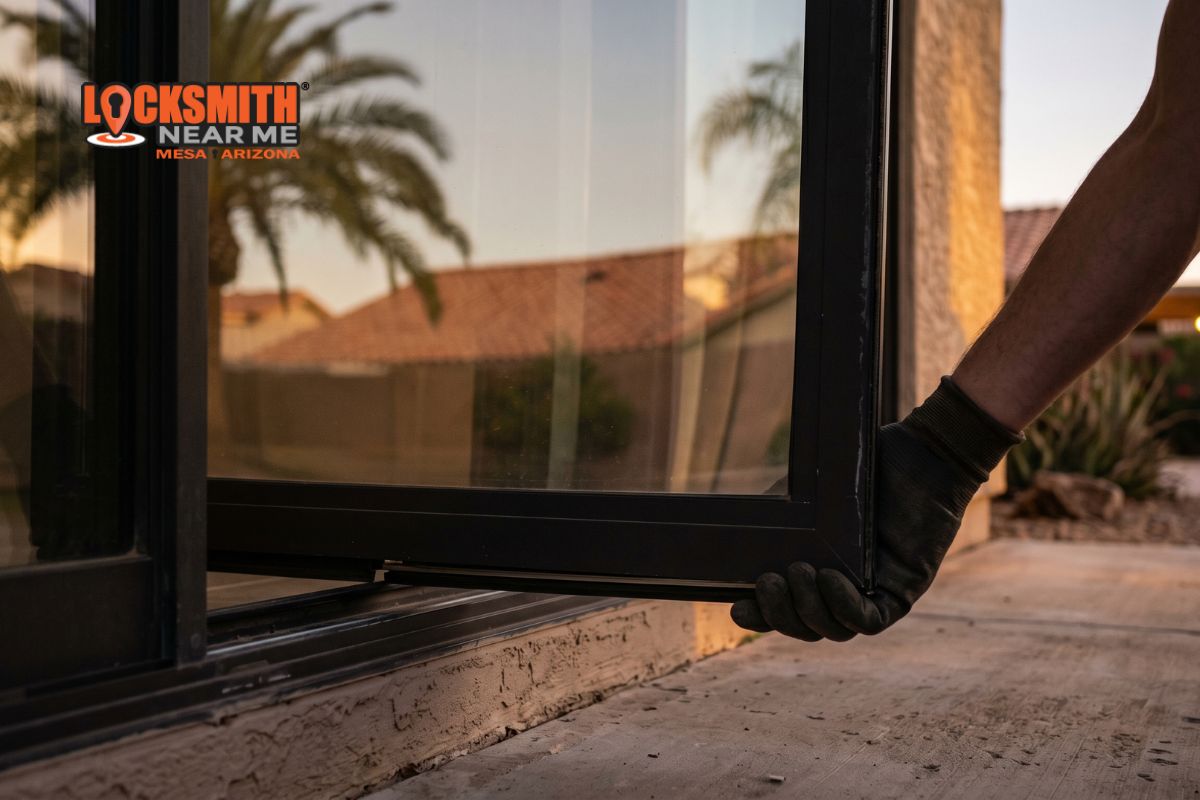
Sliding doors hang on rollers that ride on a bottom track. If there is enough vertical play in the frame, an intruder can lift the movable panel up and out of the track entirely, bypassing the latch completely. We have personally demonstrated this during client walkthroughs using nothing but our hands. Anti-lift hardware or properly adjusted rollers eliminate this risk. The Associated Locksmiths of America regularly publishes guidance on sliding door hardware standards, and lift resistance is consistently listed as a core requirement.

The Track Itself

An empty track is an invitation. Even a simple wooden dowel cut to length can prevent the door from sliding open, but most homeowners either do not install one or use a piece that is too short, leaving several inches of play. That play is all an intruder needs to reach in and defeat other locks.

The Strike Plate and Frame

The small metal piece the latch catches into is usually attached with short screws into soft aluminum or vinyl framing. Under real force, it tears out. Reinforcing this point is one of the upgrades our team regularly performs on Mesa homes.

Sliding Door Security Locks: What Actually Works

Based on years of field installations across Mesa, Gilbert, Tempe, and Chandler, here is our honest assessment of the options available to homeowners, starting with the most effective.

Loop-Style Thumbturn Locks

A thumbturn lock installed at the top or bottom of the door frame is, in our experience, the single best upgrade for a sliding glass door. It mounts to the stationary frame and loops over the edge of the movable panel, preventing both sliding and lifting. It is visible from outside, which is itself a deterrent, and it can be engaged or disengaged from the inside without a key, which matters for fire egress under NFPA life safety standards.

Foot Locks and Floor Bolts

These are mounted at the bottom of the movable panel and drop a bolt into the track. They are effective, relatively affordable, and easy to operate. We install them as a secondary layer on top of a thumbturn, not as a standalone solution.

Keyed Patio Door Locks

A keyed lock mounted through the frame offers strong resistance but requires a key for exit, which we generally advise against for any door that could be part of an emergency evacuation route. If you choose this route, please discuss code compliance with a licensed locksmith familiar with Arizona Registrar of Contractors requirements.

Security Bars and Rods

A properly sized bar in the track is a legitimate layer of defense and costs very little. The key word is properly sized. We see too many bars cut several inches too short, which makes them decorative rather than protective. Our installation team will cut and fit one to the exact dimensions of your door.

Anti-Lift Devices

These are small brackets or pins that prevent the movable panel from being raised out of its track. They are inexpensive, nearly invisible once installed, and close one of the most common bypass methods we see.

Our Hands-On Installation Process

When homeowners call our Mesa locksmith team for a patio door upgrade, we follow a consistent process refined over thousands of installations. First, we measure the door frame, assess the roller condition, and identify whether the frame material will hold standard fasteners or needs reinforcement. Aluminum frames common in Arizona construction require specific screw types to prevent the hardware from loosening over time in our heat cycles, something the National Weather Service Phoenix office documents as one of the most extreme thermal environments in the country.

Next, we discuss your household routine. A family with small children has different needs than a retired couple or a short-term rental property. The right lock is the one that you will actually use every day, and that choice depends on who lives in the home.

Installation itself typically involves drilling pilot holes, securing the lock body to the stationary frame, verifying alignment through multiple open-and-close cycles, and testing the lift resistance. Our technicians carry the tooling to address underlying issues like worn rollers or a bent track, which are often the real reason a door feels insecure in the first place.

We stand behind every installation, and our work is backed by the consistent five-star feedback our customers have shared about our East Valley service. You can also verify our standing through public business records maintained by the City of Mesa.

Pro Tip: The Test We Do on Every Job

Before we leave any sliding door installation, we do a simple test that you can do yourself right now. With the door locked using whatever hardware you currently have, stand outside and try to lift the movable panel straight up. If it moves more than a quarter inch vertically, your rollers or your anti-lift hardware need attention, regardless of how strong your main lock looks. This single check tells us more about real-world security than any sales brochure, and it is the reason we always verify lift resistance rather than just latch strength. If the panel lifts, the latch does not matter.

Credentials, Training, and Why They Matter

Our Mesa locksmith team has built its reputation on proper training, continuing education, and strict adherence to industry safety standards published by organizations like ASSA ABLOY and the Builders Hardware Manufacturers Association. Every technician on our roster has completed supervised field training before working independently, and we maintain current knowledge of lock manufacturer specifications through ongoing coursework. We are fully insured, which matters when you are inviting someone to drill into your home, and we document every job we perform.

Transparency is part of how we work. Before we touch a door, we explain what we are going to do, what hardware we recommend, and why. If a simpler fix will solve the problem, we say so, and our technicians are trained to give honest assessments rather than push unnecessary upgrades. Consumer protection guidance from the Federal Trade Commission recommends exactly this kind of upfront disclosure, and we consider it a baseline standard rather than a selling point.

Frequently Asked Questions About Sliding Door Security Locks

Are sliding glass doors really more vulnerable than regular doors?
Yes, in most residential homes the patio slider is the weakest entry point. The factory latch is a convenience feature, not a security lock, and the door itself can often be lifted out of its track. Upgrading to a proper sliding door security lock closes both vulnerabilities at once.
Can I install a sliding door lock myself?
Some options like track bars and anti-lift pins are homeowner-friendly. However, thumbturn locks and foot bolts require precise alignment and correct fastener selection for aluminum frames. If the installation is not plumb, the lock will fail under stress. For long-term performance we recommend a professional installation.
What is the best lock for a sliding glass door?
In our hands-on experience across Mesa, a loop-style thumbturn lock mounted at the top of the frame is the strongest single upgrade. It prevents sliding and lifting simultaneously, requires no key from the inside for safe egress, and provides visible deterrence from outside.
Will a new lock damage my sliding door frame?
When installed correctly by a trained technician, no. We pre-drill pilot holes to manufacturer specifications and use fasteners rated for the frame material. Poor installation is what damages frames, which is why we verify alignment and torque on every job.
Do sliding door security locks work with pet doors?
Yes, we regularly install security hardware on sliders that include integrated pet door inserts. The lock is mounted on the stationary frame above or below the insert, so the pet door continues to function normally while the slider itself is properly secured.
How do I know if my current sliding door is secure enough?
Try the lift test we described in the Pro Tip section. With the door locked, attempt to raise the panel vertically from outside. If it moves more than a quarter inch, the door is not secure regardless of the latch. A professional security audit will identify every weak point and recommend targeted fixes.

Securing More Than a Door: A Thought on Layered Protection

A sliding door upgrade is a meaningful step, but it works best as part of a layered approach to residential security. If you found this guide helpful, you may also want to read our related piece on rekeying versus replacing locks when you move into a new home in the East Valley. The principle is the same in both cases: the goal is not to create an impenetrable fortress, because no such thing exists, but to make your home a harder, slower, and louder target than the alternatives on your block. Good sliding door security locks accomplish exactly that, and they do it without changing the way you use your patio or enjoy your backyard. When you are ready to take the next step, our team is here to walk you through what your specific door needs, install it correctly the first time, and verify every point of resistance before we consider the job done. Visit our Google Maps listing for locksmith near me Mesa to see where we are located, read recent customer reviews from your neighbors, and get directions to our service area. You can also contact our Mesa locksmith team directly or stop by our local listing to discuss a security audit for your home. Your patio door does not have to be your weakest link, and we are ready to help you fix it today.

Trunk lockout service

Can’t Open Your Trunk? Why You Should Never Force a Car Lock

If your trunk won’t open, the worst thing you can do is force it. A professional trunk lockout service in Mesa, AZ can open your vehicle quickly, safely, and without damage — saving you hundreds in unnecessary repairs. Whether your key fob died, your latch mechanism failed, or you’re simply locked out, we have the tools and the training to solve it. Keep reading to understand why forcing a car trunk is dangerous, what actually causes trunk lockouts, and how our Mesa team gets you back on the road in minutes.

Here in Mesa, we’ve seen it happen on parking lots off Main Street, in the heat of a summer afternoon along the US-60 corridor, and in grocery store lots across the East Valley — a driver standing by their car, staring at a trunk that simply won’t budge. It’s frustrating, and the instinct to pull harder, wedge something in, or call a random number from a roadside flyer is completely understandable. But those choices almost always make the situation worse. Our Mesa locksmith service exists precisely for moments like this.

We’re a licensed, insured, and locally operated automotive locksmith team serving Mesa and the surrounding East Valley. We’ve been helping Mesa drivers with trunk lockouts, car key issues, and ignition problems for years — and we know this community, these roads, and the specific vehicle challenges that come with Arizona’s extreme heat. You can find us on Google Maps and read what our customers have to say. We respond fast, we work clean, and we never charge surprise fees.

Why Forcing a Trunk Lock Is Always the Wrong Move

We understand the temptation. You need something from your trunk, you’re already running late, and it seems like a little extra force should do it. But car trunks — especially on modern vehicles — are engineered with multiple interlocking components that were never designed to absorb lateral stress from human hands. When you force the latch, here’s what can go wrong:

  • Bent trunk latch assembly — The latch striker and catch are typically stamped steel. Bending them means the trunk may close but never fully lock again, creating a safety hazard on the road.
  • Damaged trunk liner and frame — Many sedans and SUVs have structural support at trunk edges. Prying damages the liner, warps the frame, and can void rust warranties.
  • Broken key in lock cylinder — If you’re twisting a physical key with excess torque, the blade can snap inside the cylinder, turning a simple lockout into an extraction job.
  • Triggered alarm or immobilizer system — Some vehicles interpret repeated failed trunk-open attempts as a break-in, triggering the alarm or engaging an electronic lockout mode.
  • Ruined weatherstripping and seals — Arizona’s UV exposure already degrades rubber seals faster than in cooler climates. Forcing the trunk edges accelerates that damage and leads to water intrusion.

Every one of those outcomes costs more to fix than a professional trunk lockout service call. Our technicians carry the right tools — automotive bypass tools, slim jims rated for modern vehicles, and trunk release access kits — to open your trunk without contacting the latch mechanism at all.

Trunk Lockout Cause DIY Risk Level Professional Solution Avg. Resolution Time
Dead key fob battery Low — but tricky Manual override or bypass 10–20 minutes
Broken trunk latch High — causes damage Latch release tool + inspection 20–35 minutes
Key stuck / broken in cylinder Very High — worsens jam Key extraction + re-cut 25–45 minutes
Frozen or corroded latch High — forces mechanism Penetrating lubricant + bypass 15–30 minutes
Child locked inside trunk Extreme — emergency Immediate on-site response Under 15 minutes
Electronic trunk release failure High — shorts circuit Manual cable release access 20–30 minutes


What Actually Causes a Trunk Lockout in Mesa, AZ

Understanding the cause is the first step toward the right fix. In our experience serving drivers across Mesa and the East Valley, the most common trunk lockout scenarios break down into three categories:

Mechanical Failures

The physical latch assembly inside your trunk contains a series of levers, springs, and a striker plate. In Arizona, where temperatures regularly push past 110°F from June through September, the expansion and contraction cycles that metal and plastic components endure are brutal. Springs weaken. Plastic guides crack. Latch pawls get sticky with desert dust and degraded lubrication. When a latch seizes mid-cycle, it can hold the trunk closed without any key or fob involvement at all.

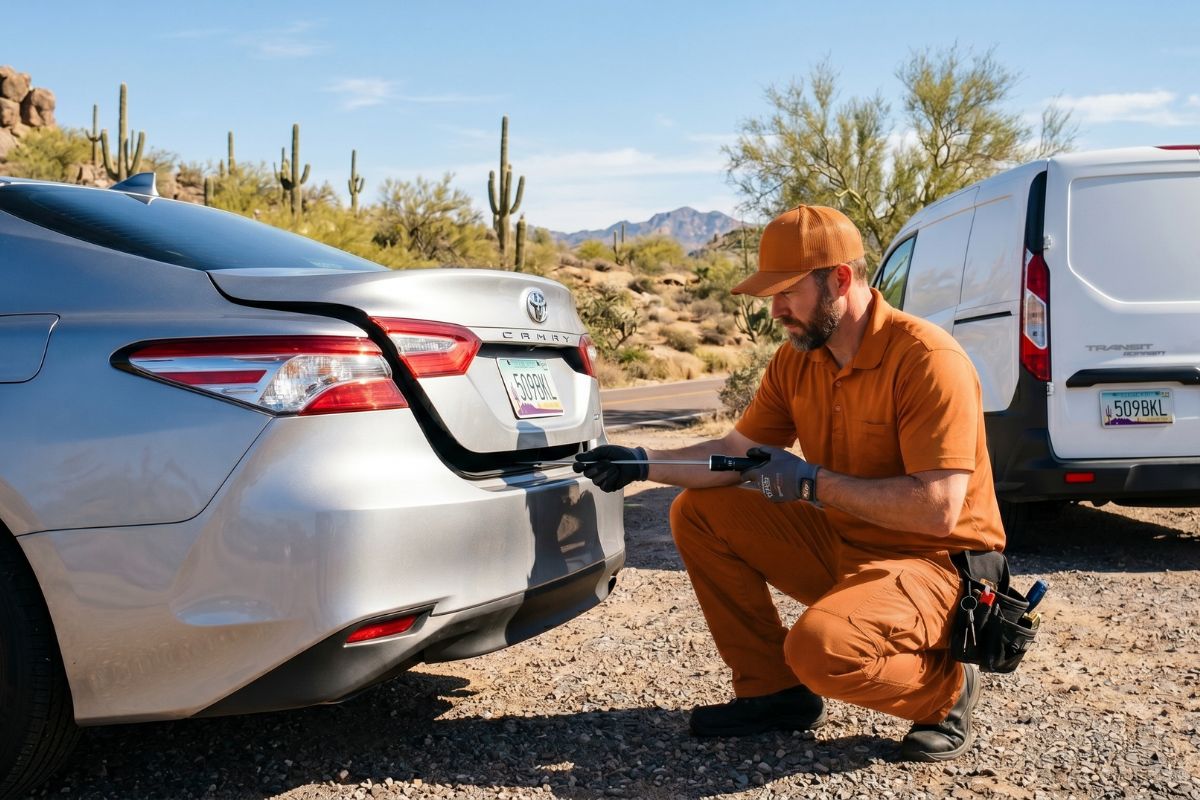
Our automotive locksmith team carries latch release tools sized for domestic and import vehicles alike. We can access the release cable through the rear seat or via the vehicle-specific bypass point — the same access the dealership uses — without drilling, prying, or removing trim.

Electronic System Failures

Modern vehicles — particularly those manufactured after 2015 — use an electronically actuated trunk release integrated into the body control module (BCM). If the BCM throws an error, if a fuse blows on the trunk release circuit, or if the key fob’s signal is no longer recognized by the receiver module, the trunk will not open via any electronic method.

open trunk
open trunk

This is where our technicians’ training matters. We don’t just pull handles — we diagnose. We check whether the issue is the fob, the receiver, the fuse, or the actuator before we attempt any bypass. That diagnostic step is what separates a professional car lockout service in Mesa from someone randomly probing at your vehicle’s electronics.

Key and Cylinder Issues

If your vehicle uses a physical key for trunk access — common on older Honda, Toyota, Ford, and GM models — a worn key blade or a degraded cylinder can cause the key to turn without engaging the latch mechanism. Worse, if forced, the key can snap off inside the cylinder. A broken key in a trunk cylinder requires an extraction tool (we carry several sizes), and depending on the cylinder condition, may require a cylinder replacement and key re-cut.

Our car key replacement service covers this scenario fully — we cut replacement keys on-site for most makes and models using our mobile key machine.

The Right Way to Handle a Trunk Lockout

When your trunk won’t open, here’s the correct sequence of actions:

Step 1 — Check the fob battery first. If your vehicle has push-button trunk release, a dead fob is the most common cause. Try holding the fob directly against the trunk release button on some vehicles for a low-battery workaround. If that doesn’t work, check whether your car has a manual backup key slot on the trunk exterior or the key cylinder hidden under a cover.

Step 2 — Try the interior release. Most vehicles with folding rear seats have an internal trunk release. If you can access the rear seat, look for a trunk release cord or lever near the trunk latch area. Check your owner’s manual for vehicle-specific instructions.

Step 3 — Call a professional. If neither of the above options works, stop. Do not insert screwdrivers, coat hangers, or pry tools. Call our emergency locksmith line and we’ll dispatch a trained technician to your exact location in Mesa, whether you’re near Downtown Mesa, Dobson Ranch, Red Mountain, or anywhere in between.

Pro Tip: Save our number in your phone before you ever need it. Trunk lockouts — like most car lockouts — happen at the worst possible times, and searching for a reputable locksmith from a parking lot while stressed leads to scam operators. We’re a verified, locally listed locksmith in Mesa with a documented track record of honest, damage-free service.

Why Professional Trunk Lockout Service Protects Your Investment

Your vehicle is one of the largest assets you own. A trunk lockout is inconvenient, but it’s also a test of who you trust with your car’s mechanical integrity. Here’s what our professional locksmith service provides that no shortcut can match:

Licensed and insured technicians. We’re fully licensed in Arizona and carry liability insurance, which means if anything goes wrong — however unlikely — you’re protected. An unlicensed operator who damages your vehicle has no accountability.

Non-destructive entry methods. Our tools are designed for access without damage. We use automotive bypass kits, latch release cables, and cylinder-specific pick sets that leave zero marks on your vehicle. We also document the condition of your trunk latch before and after service, so there’s never a question about pre-existing damage.

On-site key cutting and programming. If the root cause of your trunk lockout is a lost or damaged key, our mobile unit carries the key-cutting and transponder programming equipment to solve it in one visit — no towing to the dealership required. This applies to most makes including Toyota, Honda, Ford, Chevrolet, Chrysler/Dodge, Nissan, Hyundai, and Kia.

Transparent, upfront pricing. We quote before we work. You’ll know the cost before a single tool leaves our bag. Our locksmith pricing page has general service ranges, and our dispatcher will confirm the specific rate for your situation when you call.

Warrantied work. All parts we install — including replacement cylinders, latch assemblies, or cut keys — carry a workmanship warranty. If something we serviced fails due to our work, we come back and make it right.

When you choose a reliable, vetted locksmith near you in Mesa, you’re not just buying an unlock — you’re buying peace of mind and the guarantee that your car leaves in better condition than it arrived.

Trunk Lockouts Involving Safety Emergencies

We want to address this directly because it matters: if a child, a pet, or any person is trapped inside a vehicle trunk — call 911 first. Emergency responders are equipped to break glass and remove the rear seat within seconds. Our technicians respond quickly, but emergency services are always the first call in a life-safety situation.

That said, our 24/7 emergency locksmith team does respond to urgent trunk access situations outside of medical emergencies — including medication left in a locked trunk, temperature-sensitive cargo, or situations where waiting for law enforcement isn’t practical. We cover all of Mesa and serve neighboring communities including Gilbert, Chandler, Tempe, and Scottsdale.

Frequently Asked Questions

How fast can you respond to a trunk lockout in Mesa?

Our average response time for trunk lockout service in Mesa is 20–35 minutes depending on your location and time of day. We operate 24 hours a day, 7 days a week — including holidays. When you call, our dispatcher will give you an accurate ETA based on the closest available technician to your location.

Will you damage my car opening the trunk?

No. We use professional-grade non-destructive entry tools specifically designed for automotive trunk access. Our technicians are trained to open trunks without contacting the latch, the bodywork, or the weatherstripping. We document the condition of your vehicle before we begin, so there’s never any ambiguity about pre-existing damage versus anything related to our service.

My key fob is dead — can you still open the trunk?

Yes. A dead key fob is one of the most common reasons for a trunk lockout. We can access the trunk using manual bypass methods or through the vehicle’s internal cable release system. If you need a fob battery replacement or a fob reprogramming at the same time, we can handle that on-site as well.

Can you cut a new trunk key on the spot?

Yes, in most cases. Our mobile units are equipped with key-cutting machines and transponder programming tools for the most common domestic and import vehicles. We can cut and program a new key on-site for Toyota, Honda, Ford, Chevrolet, Nissan, Hyundai, Kia, and many others. Call us to confirm availability for your specific make and model year.

How much does trunk lockout service cost in Mesa?

Trunk lockout service typically starts at a straightforward flat rate that covers the dispatch and the standard bypass procedure. If additional work is needed — such as key extraction, cylinder replacement, or key programming — we quote those separately before proceeding. We never charge surprise fees and always confirm the total cost before we begin any work.

Do you serve areas outside of Mesa?

Yes. While Mesa is our primary service area, we also cover Gilbert, Chandler, Tempe, Scottsdale, and other East Valley communities. If you’re not sure whether we serve your location, call us and we’ll confirm availability and give you an honest ETA before you commit to anything.

Is your locksmith service licensed and insured in Arizona?

Yes. We are fully licensed and insured to provide locksmith services in the state of Arizona. Our technicians are background-checked, trained, and required to carry ID verification on every call. We will always show credentials before touching your vehicle — it’s your right and a good security practice.

What if the trunk latch is physically broken?

If the latch mechanism is damaged or seized, we can still access the trunk using internal cable release methods or controlled bypass techniques. After opening it, we’ll assess whether a latch repair or replacement is needed. We carry common replacement latch assemblies for popular vehicle models and can perform the repair on-site in many cases.

Before You Call Anyone

A trunk that won’t open is almost never as catastrophic as it feels in the moment — but the damage caused by forcing it often is. The latch assembly, the cylinder, the weatherstripping, the electronics: these are precision components that respond poorly to amateur intervention, especially in Mesa’s brutal summer heat, where materials are already under stress from UV exposure and thermal cycling.

What starts as a $60–$80 lockout call can turn into a $400–$600 latch replacement and bodywork repair if the wrong approach is taken. We’ve seen it more times than we can count, and every time, the driver wishes they’d just called a professional locksmith near Mesa first.

Our team is licensed, insured, and has built a track record of five-star reviews across Google and other local platforms because we do the job right the first time. We show up with the right tools, we quote before we work, and we guarantee our service. Whether you’re on the east side near Power Road or parked downtown near Center Street, we’re close by and ready to roll.

If you found this article helpful, you might also want to read our guide on what to do when your car key won’t turn in the ignition — another situation where forcing the issue causes far more damage than calling us would have.

Ready to get your trunk open the right way? Call our Mesa locksmith team now, or visit our Google listing to confirm our verified local presence, read customer reviews, and get directions to reach us if needed. We’re here 24/7 — no hold music, no automated systems, just a real dispatcher and a trained technician heading your way.

📞 Contact Locksmith Near Me Mesa — Call Now and let’s get your vehicle sorted today.