
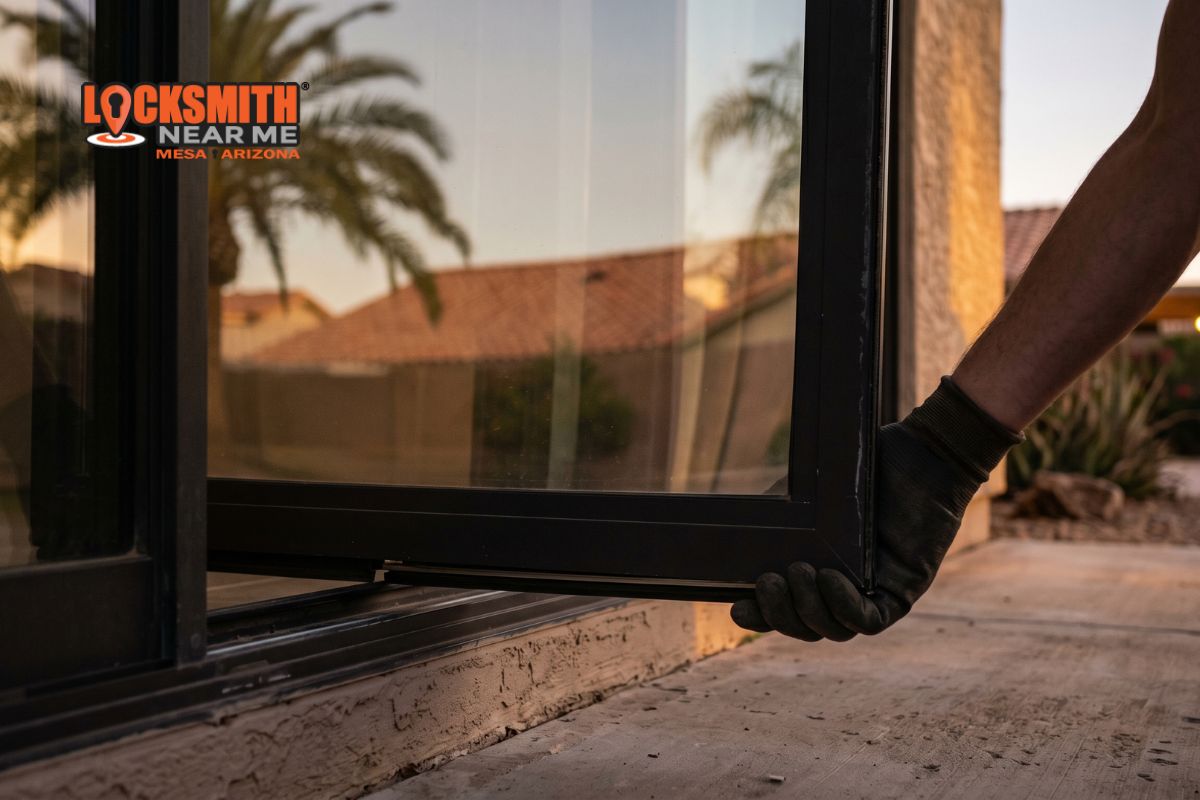
Here in Mesa, we have seen a recurring pattern during home security audits: beautiful patio sliders that look solid but are the easiest entry point in the entire house. The factory latch that comes with most sliding glass doors is designed for convenience, not protection, and experienced burglars know it. The good news is that upgrading to proper sliding door security locks is one of the most affordable and effective hardening projects any homeowner can do, and in this guide we will walk you through exactly how to do it right. Keep reading to learn what actually works, what is sold as security but is not, and how our team approaches these installations across the East Valley.
Why Sliding Glass Doors Are the Weakest Link in Your Home
After more than a decade working as a professional locksmith in Arizona, we can confirm that patio sliders are involved in a disproportionate number of residential break-ins. According to the FBI Uniform Crime Reporting data, a significant percentage of home burglaries involve forced entry through secondary access points rather than front doors. The standard latch built into most sliders is a small hook-style mechanism that engages a plastic or thin metal catch on the frame. A determined intruder can defeat it with a flathead screwdriver, a shim, or by simply lifting the door panel off its track, which is a known vulnerability when the rollers are not properly adjusted.
Most homeowners do not realize that the glass itself is rarely the target. Breaking glass is loud, leaves evidence, and causes injuries. Intruders prefer silent entry, and the standard slider latch offers exactly that. During our residential security consultations, we frequently find sliders that can be opened from the outside in under thirty seconds without any special tools.
This is why proper home safety planning has to address the patio door as a distinct category, not as an afterthought. A front door with a high-grade deadbolt security system means very little if the back slider can be lifted off its track in seconds. Guidance published by the U.S. Department of Justice Office of Community Oriented Policing Services consistently emphasizes layered residential defense, and sliding doors are a well-documented weak point in that layered approach.
Sliding Door Security Lock Comparison
| Lock Type | Security Level | Ease of Use | Best For |
|---|---|---|---|
| Loop Thumbturn Lock | High | Keyless inside | Families, primary defense |
| Foot / Floor Bolt | High | Foot operated | Secondary layer |
| Keyed Patio Lock | High | Key required | Non-egress doors only |
| Track Security Bar | Medium | Place and remove | Budget layered defense |
| Anti-Lift Device | Medium | Set and forget | Closing lift vulnerability |
| Factory Latch Only | Low | Standard | Not recommended alone |
The Real Vulnerabilities: What We See on Every Inspection
[IMAGE: Side-by-side comparison of a standard sliding door factory latch versus a reinforced loop-style thumbturn lock installed at the top of the frame]
A photorealistic close-up photograph showing two sliding glass door locks side by side on residential patio doors, with warm Arizona afternoon lighting highlighting the metallic finish of both hardware pieces. The image clearly contrasts the thin factory latch on the left with a robust reinforced security lock mounted at the top of the door frame on the right.
When our technicians inspect a patio slider, we look at four specific failure points, and understanding them will help you evaluate your own door at home.
The Factory Latch Hook
The hook-and-catch mechanism is the first problem. It is not a lock in the security sense, it is a convenience latch. It holds the door closed against wind, but it provides almost no resistance against prying or shimming. We recommend treating it as a secondary feature at best and never as your primary defense.
The Lift-Out Vulnerability
Sliding doors hang on rollers that ride on a bottom track. If there is enough vertical play in the frame, an intruder can lift the movable panel up and out of the track entirely, bypassing the latch completely. We have personally demonstrated this during client walkthroughs using nothing but our hands. Anti-lift hardware or properly adjusted rollers eliminate this risk. The Associated Locksmiths of America regularly publishes guidance on sliding door hardware standards, and lift resistance is consistently listed as a core requirement.
The Track Itself
An empty track is an invitation. Even a simple wooden dowel cut to length can prevent the door from sliding open, but most homeowners either do not install one or use a piece that is too short, leaving several inches of play. That play is all an intruder needs to reach in and defeat other locks.
The Strike Plate and Frame
The small metal piece the latch catches into is usually attached with short screws into soft aluminum or vinyl framing. Under real force, it tears out. Reinforcing this point is one of the upgrades our team regularly performs on Mesa homes.
Sliding Door Security Locks: What Actually Works
Based on years of field installations across Mesa, Gilbert, Tempe, and Chandler, here is our honest assessment of the options available to homeowners, starting with the most effective.
Loop-Style Thumbturn Locks
A thumbturn lock installed at the top or bottom of the door frame is, in our experience, the single best upgrade for a sliding glass door. It mounts to the stationary frame and loops over the edge of the movable panel, preventing both sliding and lifting. It is visible from outside, which is itself a deterrent, and it can be engaged or disengaged from the inside without a key, which matters for fire egress under NFPA life safety standards.
Foot Locks and Floor Bolts
These are mounted at the bottom of the movable panel and drop a bolt into the track. They are effective, relatively affordable, and easy to operate. We install them as a secondary layer on top of a thumbturn, not as a standalone solution.
Keyed Patio Door Locks
A keyed lock mounted through the frame offers strong resistance but requires a key for exit, which we generally advise against for any door that could be part of an emergency evacuation route. If you choose this route, please discuss code compliance with a licensed locksmith familiar with Arizona Registrar of Contractors requirements.
Security Bars and Rods
A properly sized bar in the track is a legitimate layer of defense and costs very little. The key word is properly sized. We see too many bars cut several inches too short, which makes them decorative rather than protective. Our installation team will cut and fit one to the exact dimensions of your door.
Anti-Lift Devices
These are small brackets or pins that prevent the movable panel from being raised out of its track. They are inexpensive, nearly invisible once installed, and close one of the most common bypass methods we see.
Our Hands-On Installation Process
When homeowners call our Mesa locksmith team for a patio door upgrade, we follow a consistent process refined over thousands of installations. First, we measure the door frame, assess the roller condition, and identify whether the frame material will hold standard fasteners or needs reinforcement. Aluminum frames common in Arizona construction require specific screw types to prevent the hardware from loosening over time in our heat cycles, something the National Weather Service Phoenix office documents as one of the most extreme thermal environments in the country.
Next, we discuss your household routine. A family with small children has different needs than a retired couple or a short-term rental property. The right lock is the one that you will actually use every day, and that choice depends on who lives in the home.
Installation itself typically involves drilling pilot holes, securing the lock body to the stationary frame, verifying alignment through multiple open-and-close cycles, and testing the lift resistance. Our technicians carry the tooling to address underlying issues like worn rollers or a bent track, which are often the real reason a door feels insecure in the first place.
We stand behind every installation, and our work is backed by the consistent five-star feedback our customers have shared about our East Valley service. You can also verify our standing through public business records maintained by the City of Mesa.
Pro Tip: The Test We Do on Every Job
Before we leave any sliding door installation, we do a simple test that you can do yourself right now. With the door locked using whatever hardware you currently have, stand outside and try to lift the movable panel straight up. If it moves more than a quarter inch vertically, your rollers or your anti-lift hardware need attention, regardless of how strong your main lock looks. This single check tells us more about real-world security than any sales brochure, and it is the reason we always verify lift resistance rather than just latch strength. If the panel lifts, the latch does not matter.
Credentials, Training, and Why They Matter
Our Mesa locksmith team has built its reputation on proper training, continuing education, and strict adherence to industry safety standards published by organizations like ASSA ABLOY and the Builders Hardware Manufacturers Association. Every technician on our roster has completed supervised field training before working independently, and we maintain current knowledge of lock manufacturer specifications through ongoing coursework. We are fully insured, which matters when you are inviting someone to drill into your home, and we document every job we perform.
Transparency is part of how we work. Before we touch a door, we explain what we are going to do, what hardware we recommend, and why. If a simpler fix will solve the problem, we say so, and our technicians are trained to give honest assessments rather than push unnecessary upgrades. Consumer protection guidance from the Federal Trade Commission recommends exactly this kind of upfront disclosure, and we consider it a baseline standard rather than a selling point.
Frequently Asked Questions About Sliding Door Security Locks
Securing More Than a Door: A Thought on Layered Protection
A sliding door upgrade is a meaningful step, but it works best as part of a layered approach to residential security. If you found this guide helpful, you may also want to read our related piece on rekeying versus replacing locks when you move into a new home in the East Valley. The principle is the same in both cases: the goal is not to create an impenetrable fortress, because no such thing exists, but to make your home a harder, slower, and louder target than the alternatives on your block. Good sliding door security locks accomplish exactly that, and they do it without changing the way you use your patio or enjoy your backyard. When you are ready to take the next step, our team is here to walk you through what your specific door needs, install it correctly the first time, and verify every point of resistance before we consider the job done. Visit our Google Maps listing for locksmith near me Mesa to see where we are located, read recent customer reviews from your neighbors, and get directions to our service area. You can also contact our Mesa locksmith team directly or stop by our local listing to discuss a security audit for your home. Your patio door does not have to be your weakest link, and we are ready to help you fix it today.