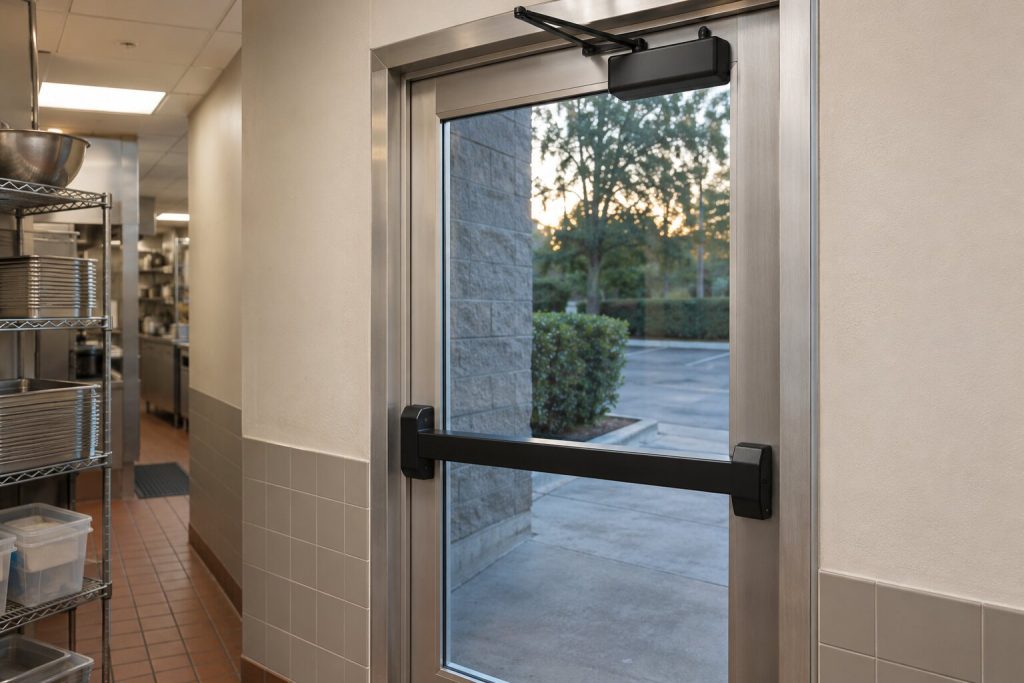
Short answer: Panic bar installation puts a push-to-exit device on a door so people can leave with one motion while the door stays locked from outside. Building codes require panic hardware on many assembly, educational and high-hazard spaces. A commercial locksmith checks the door, picks the right device and installs it to code. Call (480) 418-7560.
Panic bars, also called push bars, crash bars or exit devices, are on the back doors of restaurants, the front doors of churches and schools, and the rear exits of warehouses all over Mesa. They let anyone leave a building by pushing the bar, even in a crowd and even in the dark, while still keeping the door secure from the outside. For business owners and property managers, panic bar installation is part of life safety, code compliance and day-to-day security.
This guide covers when panic hardware is required, the types of exit devices, what affects the job, and how to keep your doors working. Our exit door push bar service installs, repairs and adjusts panic hardware for businesses across Mesa and the East Valley, every day from 6 AM to 12 AM.
When Is Panic Hardware Required?
Requirements come from the building and fire codes your city has adopted. In general terms, the International Building Code requires panic hardware on latching or locking doors that serve assembly (Group A) and educational (Group E) occupancies with an occupant load of 50 or more, and on doors serving high-hazard (Group H) occupancies. NFPA 101, the Life Safety Code, uses an occupant load of 100 for assembly, educational and day care occupancies. Lori Greene explains the details well in this breakdown of which doors need panic hardware.
Restaurants, bars, gyms, event spaces, churches, schools and daycares are the most common places that need it. Offices and retail stores may not always require it, but many owners choose panic hardware anyway for safety and convenience. The final word comes from your local building official or fire marshal, so check with them for your specific space.
Types of Panic Bars
| Type | How it latches | Common use |
|---|---|---|
| Rim exit device | Latch on the edge of the door, strike on the frame | Single doors, back exits |
| Surface vertical rod | Rods to the top and bottom of the door | Double doors without a center post |
| Concealed vertical rod | Rods hidden inside the door | Storefronts and finished entrances |
| Mortise exit device | Latch inside a mortise pocket | High-traffic doors needing strength |
| Alarmed exit device | Sounds an alarm when pushed | Exit-only doors |
Fire-rated doors need fire exit hardware, which is a panic device that is also listed for use on fire doors. Fire exit hardware does not allow the latch to be held back (dogged) with a key, because a fire door must latch.
Panic Bar Installation: What the Job Involves
- Inspect the door and frame. We check the door material, the frame, the hinges and whether the door closes and latches on its own.
- Choose the device. Rim, vertical rod or mortise, with the right finish, length and outside trim (pull, lever or key cylinder).
- Install and align. Mount the device, install the strike and adjust so the door latches every time without slamming.
- Add outside access. A keyed trim, a cylinder dogging feature or access control integration if needed.
- Test. Push from inside, check the latch, check the closer, and walk you through daily use.
A panic bar works best with a properly adjusted door closer. In Mesa, strong monsoon winds can catch doors, so the closer and the panic device need to work together. Our article on heavy-duty door closers explains this side of the job.
What Affects the Cost of Panic Bar Installation
- Device type: rim devices are simpler than concealed vertical rods.
- Door material: hollow metal, aluminum storefront and wood doors need different hardware and mounting.
- Fire rating: fire doors need listed fire exit hardware.
- Outside trim and keying: matching your master key system adds work.
- Access control: electrified latch retraction or alarms add parts and wiring.
We give you an upfront quote before any work starts.
Signs Your Panic Bar Needs Repair
- The door does not latch on its own.
- You have to push very hard to open the door.
- The bar sticks in the pushed position.
- The outside key or lever no longer works.
- Screws are loose or the device is crooked.
- The door rattles or the latch drags on the strike.
A door that does not latch is a security gap; a bar that is hard to push is a safety problem. Both are worth fixing soon. If the device is old and parts are hard to find, replacement may cost less than repeated repairs. We also repair mortise locks and handle commercial lock changes.
Panic Bars and Access Control
Many businesses pair panic hardware with card readers or keypads. With electrified hardware, employees badge in from outside, while the inside bar always lets people out. If you are planning a larger security upgrade, see our access control installation page and our guide to master keying for offices.
Mistakes to Avoid
- Adding a chain, padlock or slide bolt to a door with panic hardware. That blocks the exit.
- Leaving the bar dogged open overnight so the door does not latch.
- Installing residential locks on a door that requires panic hardware.
- Ignoring a weak closer that lets the door swing in the wind.
A Typical Panic Bar Installation for a Mesa Business
A common example is a restaurant along Main Street that adds a patio and increases its seating. The fire marshal points out that the back exit now needs panic hardware. We visit, check the hollow metal door and frame, and recommend a rim exit device with a keyed outside trim so staff can still use the door for deliveries. The old deadbolt is removed, since a separate lock on an exit door with panic hardware would block the exit. We install the device, align the strike, adjust the closer so the door latches every time even on windy monsoon afternoons, and show the manager how the key trim works.
For larger buildings, panic bar installation may include several doors, vertical rod devices on double doors, and connections to a card reader system. In every case the goal is the same: people can always get out with one push, and the door stays secure from the outside.
Where We Install Panic Bars
Locksmith Near Me works from 1855 E. Southern Ave., Suite #214, Mesa. We handle panic bar installation for businesses in Mesa, Tempe, Chandler, Gilbert, Apache Junction and Queen Creek, every day from 6 AM to 12 AM.
Frequently Asked Questions About Panic Bar Installation
Locksmith Near Me · Mesa, AZ
Need a panic bar installed in Mesa?
Our insured & certified mobile locksmiths come to you anywhere in Mesa and the East Valley, and you approve the price before any work starts.
More guides: Commercial Locksmith articles · All locksmith tips