
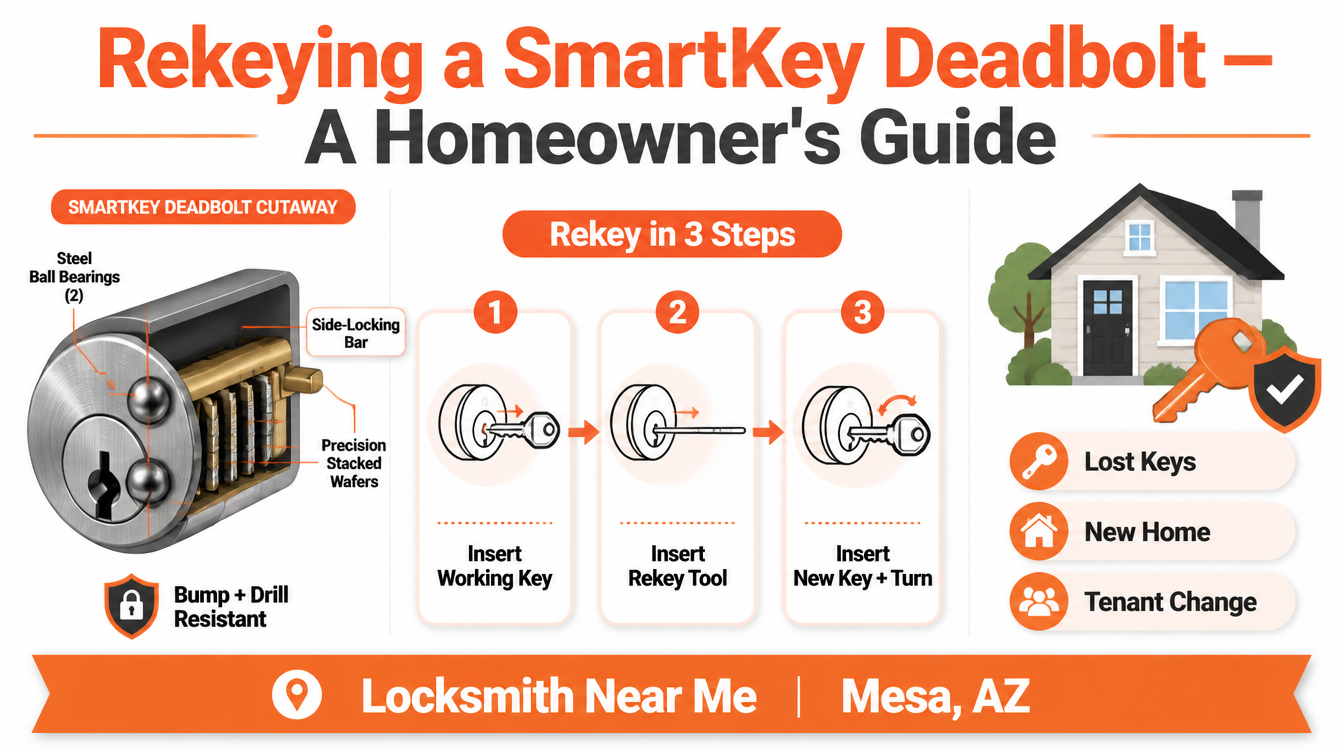
Infographic on rekeying a Kwikset SmartKey deadbolt by Locksmith Near Me Mesa, AZ

Rekeying a Kwikset SmartKey: A Homeowner’s Guide to SmartKey Technology

Rekeying a Kwikset SmartKey resets which key opens your deadbolt without replacing the hardware. The cylinder uses a patented side-locking bar instead of a traditional pin stack, so a homeowner or a locksmith can retire an old key and assign a new one using the manufacturer’s SmartKey tool and the current working key. It is one of the simplest ways to take back control of who can enter your home.

A handed-out spare key you never got back, a previous owner who still has a copy, a roommate who moved out — these are the moments when your front door stops feeling like yours. Replacing every lock is one answer, but rekeying a Kwikset SmartKey gives you the same control while keeping the deadbolt you already trust. As the mobile locksmith service in Mesa that handles these resets across the East Valley, we want to walk you through how the technology works, when to use it, and where its limits are. Keep reading and you will know exactly what is happening inside that little orange-keyed cylinder.

What Is Kwikset SmartKey Technology?

Kwikset introduced SmartKey Security in 2008 as the first do-it-yourself rekeying system on the consumer market. Instead of the brass pin-and-tumbler stack found in most older locks, a SmartKey cylinder uses a side-locking bar paired with sliding aluminum wafers. When the right key lifts those wafers to the correct heights, the bar drops into a channel and the plug turns. Reprogramming the lock simply repositions where that bar engages — no re-pinning, no cylinder removal from the door.

The table below compares SmartKey rekeying with the older pin-tumbler approach our certified technicians still service regularly.

Feature Kwikset SmartKey Security Traditional Pin-Tumbler
Rekeying method Side-locking bar reset with the SmartKey tool Re-pinning the cylinder with new pin stacks
Tool required Manufacturer SmartKey tool Full pinning kit and plug follower
Current working key needed Yes — required to reset Not required (cylinder is re-pinned)
Bump resistance BumpGuard side-bar design Often vulnerable without upgrades
Drill resistance Two hardened steel ball bearings in the face Varies by hardware grade
Master-key capability Not supported Supported via bitting hierarchy
Cylinder material Aluminum wafers Brass pins
Independent certification Meets/exceeds ANSI/BHMA; Grade 1 deadbolts available Grade varies by model
Best handled by Homeowner or locksmith Locksmith with pinning experience

How the Side-Locking Bar Works

In a standard cylinder, spring-loaded pins must line up at a shear line. SmartKey replaces that with a sidebar that reads a row of wafers. The geometry is what makes reprogramming possible: a small internal learning slot lets the wafers “remember” a new key pattern. This is the same principle that makes rekeying your home locks far cleaner than dismantling hardware. According to Kwikset’s own SmartKey Security documentation, the patented design is built specifically to resist picking and bumping.

BumpGuard and Drill Resistance

Two features set SmartKey apart on the security side. BumpGuard counters lock bumping, a method where a specially cut key is tapped to jump pins. Because there are no traditional pins, that attack has nothing to act on. The cylinder also seats two steel ball bearings at the face to improve drill resistance. Many SmartKey deadbolts are tested to ANSI/BHMA Grade 1, the highest residential rating, which you can verify through the Builders Hardware Manufacturers Association. When we install a new handleset and deadbolt, this rating is one of the first things we point out.

How Rekeying a Kwikset SmartKey Actually Works

The process is intentionally short. With the working key inserted and turned a quarter-turn, the SmartKey tool is pressed into the small port beside the keyway. That disengages the wafers from their guide pins. The old key comes out, the new key goes in fully, and a controlled turn teaches the cylinder its new pattern. Once the key returns to the starting position, the lock recognizes only the new key. Kwikset publishes the exact step-by-step rekey instructions for each model.

We see homeowners try this and run into one recurring snag: skipping the full key insertion, which leaves the wafers half-set. That is usually why a self-rekeyed lock “forgets” the key soon after. Our mobile technicians in Mesa carry replacement cylinders for exactly these cases.

What You Need Before Rekeying

You need the current working key. SmartKey is designed so the cylinder can only be reset by someone who already has access — a deliberate security choice. If the only key is lost or was never returned, the lock cannot be reprogrammed through the standard method, and the right move is a cylinder swap or a full lock replacement. When tenants change over, we often pair a rekey with a check of the mailbox locks so the whole property turns over cleanly.

When to Rekey a Kwikset SmartKey

Reprogramming the cylinder makes sense in several everyday situations:

  • Moving into a previously owned home, where you cannot account for every copy ever made
  • A lost or stolen key that may be tied to your address
  • A roommate, tenant, or house cleaner whose access you want to retire
  • Aligning multiple doors to one key after adding matching SmartKey hardware
  • Routine turnover for rental units, paired with keyless access control on the business side

For Mesa rentals and small offices, we frequently combine a residential rekey with exit door panic hardware checks and a fresh set of replacement keys for vehicles in the same visit.

SmartKey Strengths and Limitations Homeowners Should Know

We believe a homeowner makes better decisions with the full picture, so here is the balanced view from our bench. On the plus side, SmartKey resists bumping and drilling, reprograms without tools beyond the included pin, and reaches Grade 1 ratings on many deadbolts. The trade-offs: the wafers are aluminum rather than brass, the system does not support true master keying, and a small number of forced-bypass tools exist for SmartKey cylinders. Independent professional groups such as ALOA Security Professionals Association track these developments, which is part of why our technicians keep their training current. None of this disqualifies SmartKey — it simply means the hardware should be installed correctly and inspected over time, the same care we give every garage door lock and track.

Pro Tip From Our Mesa Locksmith Bench

In Arizona’s heat, the thing that quietly degrades a SmartKey cylinder is fine desert dust working into the keyway alongside thermal expansion. When we get called for a lock that “won’t take the rekey,” roughly half the time the cylinder is gritty rather than broken. Our pro tip: before reprogramming, exercise the lock with the working key a dozen times and apply a dry graphite or PTFE lubricant — never an oil-based spray, which traps dust and gums the wafers. If the action is still sticky, that is the signal to call us for a professional rekey or cylinder service rather than forcing the tool. We would always rather inspect a cylinder than replace one you did not need to.

Frequently Asked Questions

What does it mean to rekey a Kwikset SmartKey?
Rekeying resets the cylinder so a new key works and every old key stops working, all without removing the deadbolt from the door. The hardware stays; only the key pattern changes. It is the cleanest way to retire copies you cannot account for.
Do we need the original working key to rekey a SmartKey lock?
Yes. SmartKey is built so only someone with the current working key can reprogram the cylinder, which is a security feature, not a flaw. If the working key is missing, the lock cannot be reset the standard way and we typically swap the cylinder or change the lock instead.
Is a rekeyed SmartKey as secure as a brand-new lock?
A correctly rekeyed SmartKey deadbolt keeps its full BumpGuard and drill-resistance properties, so the security level does not drop. What matters is that the reset was completed fully so the cylinder holds the new pattern. We verify this with several test turns before we leave.
Can a SmartKey deadbolt join a master key system?
No. SmartKey cylinders are single-key by design and do not support a master-key hierarchy. For homes or businesses that need one key for staff and another for management, we recommend a traditional pin-tumbler master setup, which our commercial team installs across Mesa.
What if the SmartKey lock jams or rejects the tool?
A jam usually points to dust, debris, or a partially completed previous reset rather than a defective lock. Forcing the tool can lock the wafers in a stuck position. At that point we inspect the cylinder, clean and lubricate it properly, and rekey or replace only what is needed.
Should we rekey it ourselves or call a Mesa locksmith?
Many homeowners handle a single SmartKey reset on their own. When several doors must match one key, when the working key is lost, or when the cylinder feels gritty, a professional visit prevents a half-set lock later. We are glad to confirm your hardware and reprogram it correctly the first time.

Taking Control of Who Holds Your Keys in Mesa

The whole point of rekeying a Kwikset SmartKey is control: you decide which key opens your door today, without throwing away hardware that is already built to a Grade 1 standard. Done right, the cylinder forgets every old copy and answers only to the key in your hand. Done in a hurry, a half-finished reset can leave you locked out later — which is the situation we would rather help you avoid entirely. If you are also weighing a full security refresh, our guide to upgrading your deadbolt and handleset pairs naturally with this one.

When you want it handled correctly, our owner-operated shop has served homes and businesses across the East Valley, and you can reach out to our Mesa team to schedule a professional rekeying service. Call Locksmith Near Me Mesa at (480) 418-7560, see our work and reviews on our Google Business listing, and stop by the same Google Maps location to confirm you are working with the local team that knows SmartKey hardware inside and out. Let us reprogram your SmartKey properly and put your keys back where they belong — with you.
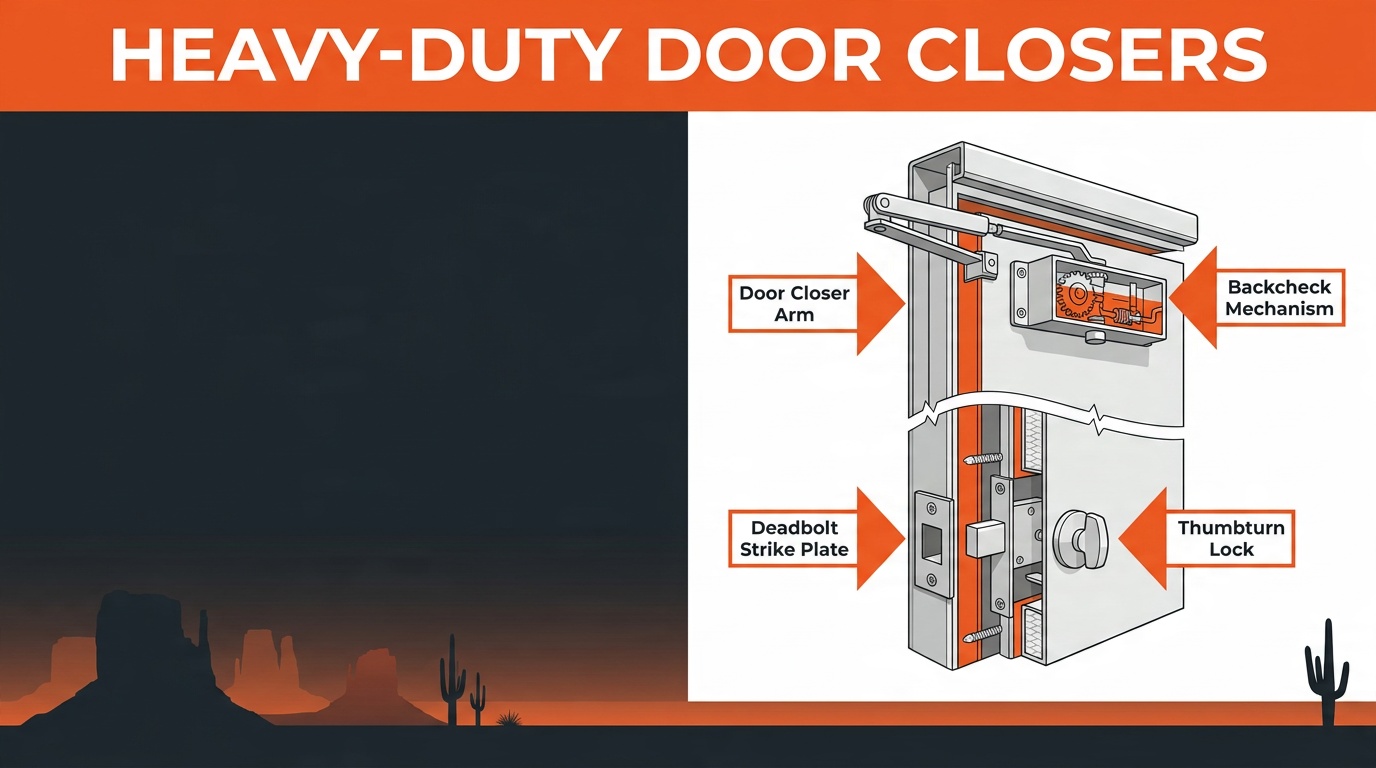
Infographic showing heavy-duty door closer components for commercial wind resistance in Mesa AZ

Heavy-Duty Door Closers: Why Your Business Needs Wind-Resistant Hardware

Every commercial property owner in Mesa, Arizona knows what a powerful desert gust can do to an uncontrolled door. One strong surge of wind swings the entry wide open, slams it back against the stop, stresses the frame, and — over time — quietly destroys the latch geometry that keeps your business locked at night. Heavy-duty door closers engineered for wind resistance are the hardware solution that stops this damage chain before it starts. Keep reading and we’ll walk you through how these systems work, how they protect your building’s overall security, and what to look for before buying.

What Separates a Standard Door Closer From a Heavy-Duty Door Closer

A standard residential closer is built for one purpose: pulling a lightweight interior door shut after someone walks through. It is not rated for exterior commercial doors, high-traffic cycles, or wind loading — and asking it to perform that job is how frame damage and latch failures begin.

Heavy-duty door closers are built to a completely different specification. The ANSI/BHMA hardware standards grade door closers on a Size 1 through 6 scale. Size 1 handles lightweight interior doors in low-traffic environments. Size 6 — the top of the range — handles massive fire-rated commercial doors in exposed exterior locations with engineered wind resistance built directly into the hydraulic mechanism.

Three features distinguish heavy-duty units in practice:

Hydraulic valve control: Adjustable closing speed, latching speed, and backcheck tension are all critical for managing a door under wind load. Without them, a gust dictates the door’s behavior — not the hardware.

Backcheck function: This acts as a hydraulic shock absorber, decelerating the door dramatically before it reaches its maximum open position. Without backcheck, a strong wind simply tears the door — and often the closer arm — off the frame.

Cycle ratings: A standard closer may carry a 250,000-cycle rating. Commercial-grade units from manufacturers like LCN Door Controls and ASSA ABLOY exceed one million cycles — because a busy commercial entry door reaches that volume.

When Wind Becomes a Deadbolt Security Issue

A door that repeatedly slams or blows open against its stop puts stress on every component in the assembly — including the deadbolt strike plate, the door frame, and the thumbturn lock on the interior side. That stress creates micro-fractures in the frame, loosens strike plate fasteners, and misaligns the latch over time — producing exactly the gap a forced-entry attempt exploits.

Our commercial locksmith team in Mesa encounters this pattern consistently: a business owner calls about a deadbolt that’s difficult to turn or a latch that no longer seats cleanly, and when we inspect the door, the root cause is not the lock — it is an undersized door closer that has allowed months of wind stress to silently degrade the frame and hardware around it.

Heavy-Duty Door Closer Comparison

Feature Standard Closer Heavy-Duty Closer Commercial Grade Closer
ANSI/BHMA Size Rating Size 1–3 Size 4–5 Size 5–6
Wind Resistance Low (interior only) Moderate–High (exposed doors) High (engineered exterior)
Cycle Rating ~250,000 cycles 500,000+ cycles 1,000,000+ cycles
Backcheck Function Rarely included Standard Standard + adjustable
Delayed Action No Optional Standard
ADA Opening Force Compliance Varies Adjustable to comply Yes — adjustable
Fire Door Compatibility No Often yes Yes — NFPA 80 compliant
Best Application Interior residential Commercial entry doors High-traffic exterior doors

Choosing the Right Heavy-Duty Door Closer for Your Property

Not every heavy-duty unit suits every commercial application. These are the variables that determine correct sizing:

Door weight and width: A 36-inch solid wood door and a 48-inch aluminum storefront door require different size ratings. Matching the closer to the door specification is the most critical decision in the selection process.

Exposure and wind direction: Doors directly exposed to prevailing wind need a higher backcheck rating than sheltered interior courtyard openings. In the Mesa area, the dominant wind patterns move from the southwest — doors with a southwest-facing exposure warrant close attention when sizing hardware.

ADA opening force limits: ADA standards cap interior door opening force at 5 lbf for accessibility compliance. Quality hydraulic closers can be adjusted to meet this threshold without giving up controlled closing performance.

Fire door rating: Many commercial exit doors carry an NFPA 80 fire-rated designation. That standard requires the door to close completely and latch under all conditions — including during a wind event. A closer that fails to consistently seat the latch is a code violation waiting to be flagged.

Pro Tip: If your commercial property is in a strip mall or shared building complex, the door closer you select may affect fire egress compliance for the entire unit — not just your suite. Before purchasing hardware independently, have a licensed Mesa locksmith inspect the full door assembly. A short inspection confirms the NFPA status, ADA requirements, and the correct closer size before any hardware is ordered. Getting that sequence wrong means pulling the unit back out and starting over.

How Door Closer Failures Undermine Deadbolt Security and Thumbturn Locks

Deadbolt security depends on the door sitting correctly in its frame. A BHMA Grade 1 deadbolt installed in a wind-damaged, misaligned frame is no longer operating at specification. The bolt throw may not fully seat in the strike box, or the clearance may have widened enough that the latch can be worked without a key.

The same principle applies to thumbturn locks on commercial interior doors — conference rooms, server closets, supply rooms. These components require the door to sit true. Once repetitive impact stress warps the frame, a thumbturn lock can bind, fail to latch, or lose the material contact that provides meaningful resistance to forced entry.

In many cases the fix is not a lock replacement. Correcting the closer to a properly rated unit, re-squaring the frame, and reinforcing the strike plate restores the deadbolt performance the property owner assumed they already had. Our professional locksmith services in Mesa, AZ include exactly this kind of door assembly audit — not just hardware sales.

Why Professional Locksmith Installation Makes the Difference

A heavy-duty door closer installed with the wrong arm geometry, incorrect spring tension, or a misaligned bracket defeats its own engineering. We have inspected commercial properties where a properly rated Size 5 unit was mounted in the wrong arm configuration — parallel instead of top-jamb — leaving the backcheck function completely disengaged.

ALOA-certified locksmiths are trained to evaluate the full door assembly: frame condition, door handing, fire rating, ADA compliance, and hardware compatibility. The installation requires reading the door, reading the environment, and calibrating the hydraulic adjustments to the specific conditions of that opening.

Our team at Locksmith Near Me Mesa approaches every commercial door closer installation as a full door security assessment. Find us on Google Maps to confirm our service area covers your property in the East Valley.

Frequently Asked Questions

Most standard commercial entry doors — 36 to 48 inches wide, solid wood or hollow metal construction — require a Size 4 or Size 5 closer under ANSI/BHMA standards. Doors in high-wind exposure locations, oversized fire doors, or high-traffic entrances typically require a Size 5 or 6. The correct size depends on door weight, width, and the specific environmental conditions of the opening. A licensed locksmith can verify the correct specification for your property before any hardware is purchased.

Yes — and it does so gradually. Repeated impact stress from an uncontrolled door loosens strike plate screws, micro-fractures wood door frames, and misaligns the latch over time. A deadbolt that once operated at BHMA Grade 1 tolerances can develop enough play in the strike that the bolt no longer fully engages. This compromises your lock’s rated security performance without any obvious signs of damage to the lock itself. A door assembly inspection identifies this before it becomes a vulnerability.

For doors along accessible routes, yes. ADA standards limit door opening force to 5 lbf on interior doors. Quality hydraulic door closers include adjustable spring tension that can be set to meet this threshold. The challenge is balancing ADA opening force compliance with enough closing power to fully seat the latch — especially on exterior doors with wind exposure. This balance is one of the key reasons professional installation matters: the hydraulic adjustments need to be dialed to both requirements simultaneously.

Backcheck is a hydraulic cushion built into the closer that decelerates the door sharply before it reaches its maximum open position. Without it, a strong wind gust — or a person pushing the door forcefully — drives it into the stop at full speed, stressing the frame, the hinges, and the closer arm itself. For any exterior commercial door or any door in a wind-exposed location, backcheck is not optional. On interior doors with heavy foot traffic, it also prevents damage from doors swinging into walls or adjacent fixtures.

Common signs include: the door fails to latch completely when released from midpoint, the arm struggles to pull the door closed against wind, the closer leaks hydraulic fluid (indicating internal wear from overwork), or the door slams shut faster than the latching speed adjustment can control. If any of these are present, the closer is likely undersized or at end of service life. A professional assessment will confirm the right replacement specification and identify any frame or strike damage that occurred while the undersized unit was in service.

Yes. NFPA 80 requires that every fire door assembly include a self-closing device capable of closing and latching the door from any open position, under all normal use conditions. This means the closer must have enough spring tension to seat the latch against the strike every single time — including during wind events that create negative pressure differentials across the opening. Not every commercial door closer carries the fire door listing required by NFPA 80. Our Mesa locksmith team verifies fire door compliance as part of every commercial door closer installation.

Secure Your Entry Points Before the Next Wind Event

Heavy-duty door closers are not a premium upgrade for Mesa commercial properties — they are a baseline requirement for any exterior door exposed to desert wind conditions. When the closer fails to control the door, every downstream component in your security stack begins absorbing damage that accumulates silently: the deadbolt strike loosens, the frame shifts, the thumbturn lock binds, and one day something fails at exactly the wrong moment.

If your business entry doors are currently running standard or light-commercial closers, this is the moment to schedule a hardware assessment. Our commercial locksmith services in Mesa, AZ include a full door assembly inspection, proper closer sizing, and professional installation with hydraulic adjustments calibrated to your specific opening. Contact Locksmith Near Me Mesa to get started, or visit our Google Maps listing to find us in the East Valley — your door hardware should be working with your security system, not undermining it.

Smart Locks with Cameras: The Future of Front Door Security

Most homeowners in Mesa have stood at their front door at some point, realizing their deadbolt answers one question — is this door locked? — but leaves a bigger one completely open: who is standing on the other side right now? A missed delivery, an unrecognized face, or a stranger testing door hardware are all scenarios a traditional lock cannot address on its own. Smart locks with cameras solve that gap by combining keyless access control with real-time visual verification in a single device mounted where your existing deadbolt already lives. Keep reading for a complete breakdown of how these systems work, what features actually matter for home safety in Mesa, and why the installation step deserves a trained professional locksmith.

What Are Smart Locks with Cameras?

A smart lock with a built-in camera is exactly what the name describes: a door lock that integrates a video sensor — typically wide-angle, night-vision capable, and motion-triggered — directly into the lock body. Unlike a separate video doorbell paired with a separate smart lock, these combined units share a single power source, a single app interface, and a single mounting footprint on your door.

The lock side typically uses one of two mechanisms: a motorized deadbolt that extends and retracts on command, or a motorized thumbturn lock that mimics the interior turn knob you already use manually. Both can be triggered by a smartphone app, a keypad, a fingerprint reader, or a traditional physical key — giving you multiple access methods rather than dependency on any single one.

Leading manufacturers including Schlage, Yale, and Level have each introduced models that blend deadbolt security with integrated optics. The ASSA ABLOY group, which owns several of these brands, has published independent testing data confirming that modern smart deadbolts meet or exceed ANSI/BHMA Grade 1 standards — the highest residential classification for pick resistance, drill resistance, and forced entry.

For homeowners in Mesa who rely on our residential locksmith services, we’ve installed dozens of these systems over the past several years. The questions we hear most often fall into two categories: security and reliability. Both are addressable with the right hardware choices and correct installation.

Key Features That Define Smart Locks with Cameras

Not all products marketed as smart locks with cameras deliver the same level of deadbolt security. These are the specifications worth scrutinizing before you purchase:

Video resolution and field of view. A minimum of 1080p resolution with a 150° or wider field of view captures enough of a porch or entryway to identify faces and packages clearly. Narrower lenses miss activity at the edges of the frame.

Night vision. Mesa’s evenings and early mornings are low-light environments for most of the year. Infrared or color night vision keeps the camera useful after dark without requiring additional exterior lighting.

Motion detection zones. The ability to define specific detection areas — a porch step rather than a passing car — reduces unnecessary alerts while keeping focus on genuine activity at your door.

Local vs. cloud storage. Some systems store video footage exclusively on cloud servers with a subscription requirement. Others offer a local SD card or hub-based backup. For home safety purposes, having a copy of footage that doesn’t depend on a subscription or internet uptime is a meaningful advantage.

Encryption and authentication. Look for systems that use end-to-end encryption for video streams and require multi-factor authentication for app access. The ALOA (Associated Locksmiths of America) recommends treating smart lock firmware like any other connected device — update it regularly and use strong, unique credentials.

Feature Traditional Deadbolt Smart Lock with Camera
Visual Verification None Built-in wide-angle camera
Remote Access Not possible Smartphone app or keypad
Entry History Log None Timestamped digital records
Guest Access Physical key copy required Temporary digital codes
Night Visibility None IR or color night vision
ANSI/BHMA Grade 1 Available on select brands Available on certified models
Thumbturn Lock Option Standard interior turn Available on select models
Forced Entry Resistance Grade-dependent Equivalent on Grade 1 models
Power Source None required Battery or hardwired
Remote Feature Dependency None Internet connection required

Pro Tip: Test the Camera Angle Before Finalizing the Mounting Height

One mistake we correct during installation calls is a camera mounted too high or too low relative to the average face height at the door. If the unit goes in at standard deadbolt height (typically 36–44 inches from the floor), the camera angle may capture the top of a visitor’s head rather than their face — especially on taller individuals. Before drilling the final mounting holes, hold the unit in position and check the live video feed on your phone. Adjust the height by a few inches if the frame clips the face zone. This is the single most common setup error we find on self-installed units, and it costs nothing to correct before the screws go in.

Professional Locksmith Installation: What Changes and Why It Matters

A smart lock with a camera is a more complex installation than a standard deadbolt swap. The door bore — the hole the lock cylinder passes through — must align precisely with the camera lens angle and the strike plate geometry. Misalignment by even a few millimeters can cause the deadbolt to bind under load, which accelerates wear on the motor and eventually produces a failure at the lock mechanism itself.

At Locksmith Near Me Mesa, our technicians also verify door frame alignment, strike plate depth, and whether the existing door prep accepts the new hardware without additional boring. Mesa’s temperature swings — triple-digit summers followed by cooler winters — cause wood and metal frames to expand and contract seasonally. A door that closes cleanly in January may bind in July. We account for that tolerance during installation, which prevents operational issues months down the line.

For homeowners who already have a smart lock installed and are experiencing intermittent failures, our lock repair and inspection service identifies whether the issue is mechanical, firmware-related, or a door alignment problem — and we resolve it at the source rather than replacing hardware unnecessarily.

Smart Locks with Cameras as Part of a Complete Home Safety Plan

A single smart lock with a camera is a significant improvement over a standard deadbolt, but it functions best as one layer in a broader home safety strategy. The most effective setups we see combine the camera lock at the primary entry point with secondary deadbolt security on side doors and sliding entries, a properly installed strike plate with 3-inch screws reaching the door frame stud, and a simple alarm system on windows and secondary entries.

If you’re evaluating your home’s full perimeter, our team conducts residential security assessments throughout Mesa and the East Valley. We document every entry point, grade the existing hardware against ANSI/BHMA benchmarks, and provide a prioritized list of improvements.

Ready to Upgrade Your Front Door?

Smart locks with cameras represent a genuine shift in what residential hardware can do. The combination of verified access control and visual monitoring changes the front door from a passive barrier into an active security checkpoint. The technology is sound, the product options are broad, and the installation process is well within reach for any experienced locksmith in Mesa.

If you’re ready to upgrade, or you’d simply like a professional assessment of your current front door setup before committing to a product, contact our team at Locksmith Near Me Mesa or find us directly on Google Maps. We’ll evaluate your door, your frame, and your existing hardware — and recommend the combination that makes the most sense for your home.

Frequently Asked Questions

Yes — when you select a model that carries ANSI/BHMA Grade 1 certification, the deadbolt mechanism itself meets or exceeds the same forced-entry resistance standards as the best traditional hardware. The camera and electronics add features on top of that mechanical foundation without weakening it. Our professional locksmiths in Mesa verify the Grade 1 rating and correct installation on every smart lock job we complete.

Most quality smart locks retain their core functions offline. The physical key, the thumbturn lock on the interior, and stored access codes on the keypad all continue to work without an internet connection. Remote app access and live video streaming require connectivity, but the lock itself does not become inoperable. We always confirm offline functionality during installation.

A licensed locksmith can install virtually any residential smart lock brand, including models from Schlage, Yale, Level, Ultraloq, and ASSA ABLOY. The installation process involves verifying door bore compatibility, strike plate alignment, and frame condition — factors that matter regardless of brand. Our Mesa team works with all major manufacturers and can advise on which model fits your door prep best.

Most smart lock bodies are designed to fit the standard 2-1/8-inch door bore that has been common in U.S. residential construction since the 1970s. Where older doors present challenges — non-standard bore sizes, deteriorated frames, or misaligned strike plates — a professional locksmith assesses those conditions before installation and identifies whether additional prep work is needed. Skipping that evaluation is the primary cause of smart lock operational failures on older doors.

Not on properly engineered products. Reputable manufacturers integrate the camera into the exterior escutcheon without modifying the bolt mechanism or cylinder geometry. The deadbolt security rating is preserved because the locking components remain structurally separate from the electronics. Confirm Grade 1 certification on any model you purchase rather than relying solely on marketing language.

Start by checking the app’s motion detection settings — sensitivity and detection zone configurations reset on some devices after firmware updates. If settings are correct and the issue persists, verify that the lock’s battery level is above 25%; low power affects camera performance before it affects the lock mechanism. If neither resolves the issue, our Mesa locksmith team can run a diagnostic and determine whether it’s a hardware or firmware problem.

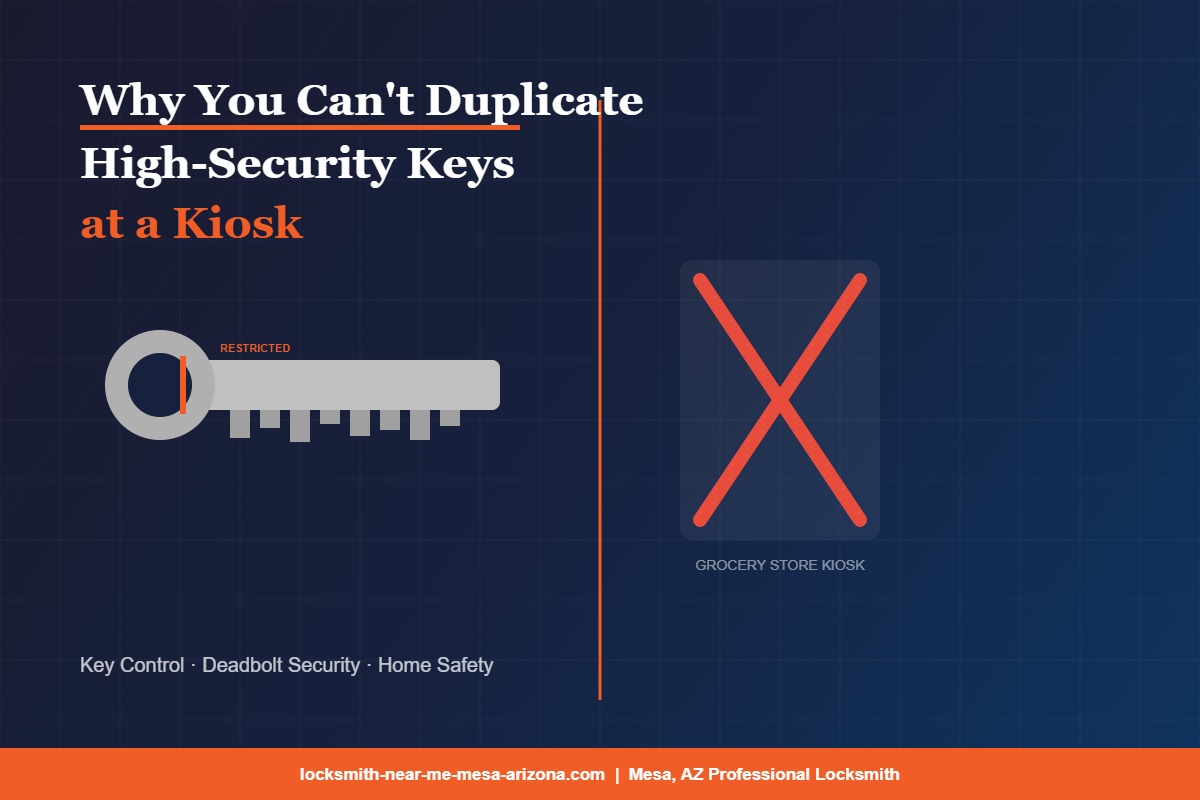
High-security key with RESTRICTED label next to a grocery store kiosk with a red X

Why You Can’t Duplicate High-Security Keys at a Grocery Store Kiosk

Most homeowners have been in this situation: you need a spare key made, you spot a self-service kiosk at the grocery store, you insert your key — and the machine either rejects it outright or spits out a copy that doesn’t work. That frustration has a very specific explanation. Duplicating high security keys is a controlled, precision-based process that requires certified equipment, manufacturer authorization, and a trained locksmith. Grocery store kiosks are not built for that. In this post, we walk you through exactly why these keys are different, what happens to your deadbolt security when this process goes wrong, and what the right path forward looks like.

What Makes a High-Security Key Different From a Standard Key

A standard house key uses a basic pin tumbler mechanism with simple depth-and-angle cuts along a single blade. Those keys are easy to duplicate because compatible blanks are everywhere and the tolerances are forgiving. High-security keys are engineered on an entirely different level.

Manufacturers like Medeco, Mul-T-Lock, and ASSA ABLOY build their keys with patented keyways, secondary locking mechanisms, and rotating or magnetic elements. These keys meet ANSI/BHMA Grade 1 standards — the highest residential security certification in the United States.

The table below breaks down the core differences at a glance.

Feature Standard Key High-Security Key
Keyway Protection Generic, widely available blanks Patented keyway — no retail blank exists
Duplication Access Any hardware store or kiosk Authorized, certified locksmiths only
Locking Mechanism Single pin tumbler Sidebar, rotating pins, or magnetic elements
Cut Precision Standard depth cuts Angled/rotary cuts at thousandths of an inch
Key Control No tracking — unlimited copies possible Owner authorization required for every copy
ANSI/BHMA Grade Grade 2 or 3 typical Grade 1 certified
Pick & Drill Resistance Low to moderate High — tested to BHMA Grade 1 specs

Why Duplicating High Security Keys Requires a Certified Professional Locksmith

A self-service kiosk works by optically scanning your key and matching it to a pre-loaded blank inventory. That approach works for commodity keys. With high-security keys, the machine runs into three hard walls it cannot overcome.

Patented Keyways and Restricted Blanks

The keyway profile of a Medeco or Mul-T-Lock key is protected under active U.S. patents. No compatible blank exists in any consumer-accessible inventory. Manufacturing or importing counterfeit blanks is a federal patent violation. The kiosk has nothing to copy onto — full stop.

Precision Tolerances Beyond Retail Equipment

High-security keys frequently incorporate angled cuts, secondary cuts, or rotary elements measured in thousandths of an inch. The optical scanners inside retail kiosks are calibrated for standard-depth keys. They cannot detect or reproduce the three-dimensional geometry of a restricted key. Even if a blank existed, the copy would fail.

Authorization and Key Control Protocols

ALOA-certified locksmiths operate under strict manufacturer key control agreements. Every duplicate requires documented owner authorization: a photo ID, a key card issued at installation, and in some cases a PIN. A kiosk has no mechanism to enforce it.

When our professional locksmith team in Mesa duplicates a restricted key, we verify ownership first. That step protects you — not us.

The Impact on Deadbolt Security and Thumbturn Locks

Upgrading to a high-security cylinder is one of the best investments in deadbolt security a Mesa homeowner can make. We see this scenario regularly: a Grade 1-rated exterior cylinder paired with a flimsy Grade 3 interior thumbturn lock. That mismatch undermines the entire security stack.

A thumbturn lock on the interior should match the security grade of your exterior cylinder. BHMA Grade 1 thumbturn hardware resists forced rotation and is built to the same tolerances as the cylinder it complements.

Our residential locksmith services in Mesa, AZ include a full audit of both sides of every entry door — because deadbolt security is only as strong as its weakest component.

Home Safety: Why Key Control Is Your First Line of Defense

According to FBI crime data, a significant portion of residential burglaries involve no forced entry. The intruder walked in — through a copied key, an unlocked door, or a compromised lock that had never been rekeyed after the previous occupant left.

Key control is the practice of knowing exactly how many copies of your key exist, who has them, and under what conditions new copies can be made. A restricted key system enforces that control mechanically and legally. It starts with a conversation with a certified Mesa locksmith.

If you have recently purchased a home, ended a tenancy, or had any personnel change, a rekeying service or full cylinder upgrade resets your key control baseline completely.

Pro Tip: Before committing to a high-security key system, ask your locksmith to confirm the manufacturer’s restricted program is still active in your region. Some patents have expired, meaning the “restricted” blank may now be available at retail — negating the key control benefit. An ALOA-certified locksmith can verify this before you invest.

How to Get a Legitimate Duplicate of a High-Security Key

Step 1 — Locate the original installer. The locksmith who installed your system holds the authorization record for your key series. Start there.

Step 2 — Contact a manufacturer-authorized locksmith. Our team at Locksmith Near Me Mesa maintains authorizations with multiple restricted key manufacturers. Find us on Google Maps.

Step 3 — Bring proof of ownership. A valid ID and your key card are typically required. Some manufacturers also require a matching PIN.

Step 4 — Consider a system review. If your high-security lock is over a decade old, pair any key duplication appointment with a brief security audit of your entry doors.

Frequently Asked Questions

Can any locksmith duplicate high-security keys? ▼

No. Duplicating high security keys requires a locksmith who holds a specific manufacturer authorization for that brand. Medeco, Mul-T-Lock, and ASSA ABLOY each run their own restricted key programs with separate certification requirements. A general locksmith without that authorization cannot legally or physically produce a duplicate.

What brands manufacture high-security keys? ▼

The most recognized brands in the U.S. include Medeco, Mul-T-Lock, ASSA ABLOY (Abloy Protec), Schlage Primus, and Sargent & Greenleaf. For residential use in Mesa, AZ, Medeco and Schlage Primus are the most common upgrades we install and service.

Is a high-security lock worth it for a home in Mesa? ▼

For most homeowners — especially those in HOA communities, multi-family units, or homes that have changed hands — yes. The combination of pick resistance, drill resistance, and key control that a BHMA Grade 1 system provides is a meaningful upgrade over standard builder-grade hardware.

What is key control and how does it protect my home? ▼

Key control is the documented practice of knowing exactly how many copies of your key exist and who holds them. In a restricted system, every duplication requires owner authorization — making it impossible for unauthorized parties to quietly copy your key.

How do I know if my key is already a high-security key? ▼

Look for a brand name stamped on the key bow — Medeco, Mul-T-Lock, and Schlage Primus print their name directly on the key. If unsure, bring it to a licensed locksmith for a quick visual assessment.

The Right Key for the Right Lock — Make It Count

Duplicating high security keys is not an inconvenience designed to drive business to locksmiths. It is a deliberate engineering decision to ensure that the lock protecting your home stays under your control — and only yours. A grocery store kiosk cannot honor that design. It cannot verify ownership, it has no compatible blank, and it cannot reproduce the precision geometry these keys require.

If you are ready to upgrade your deadbolt security, explore high-security key options, or simply need a properly authorized duplicate, our team is here to help. Contact Locksmith Near Me Mesa for a residential security assessment, or visit us on Google Maps to find us in the East Valley. Your home’s first line of defense should never be a coin-operated machine.