
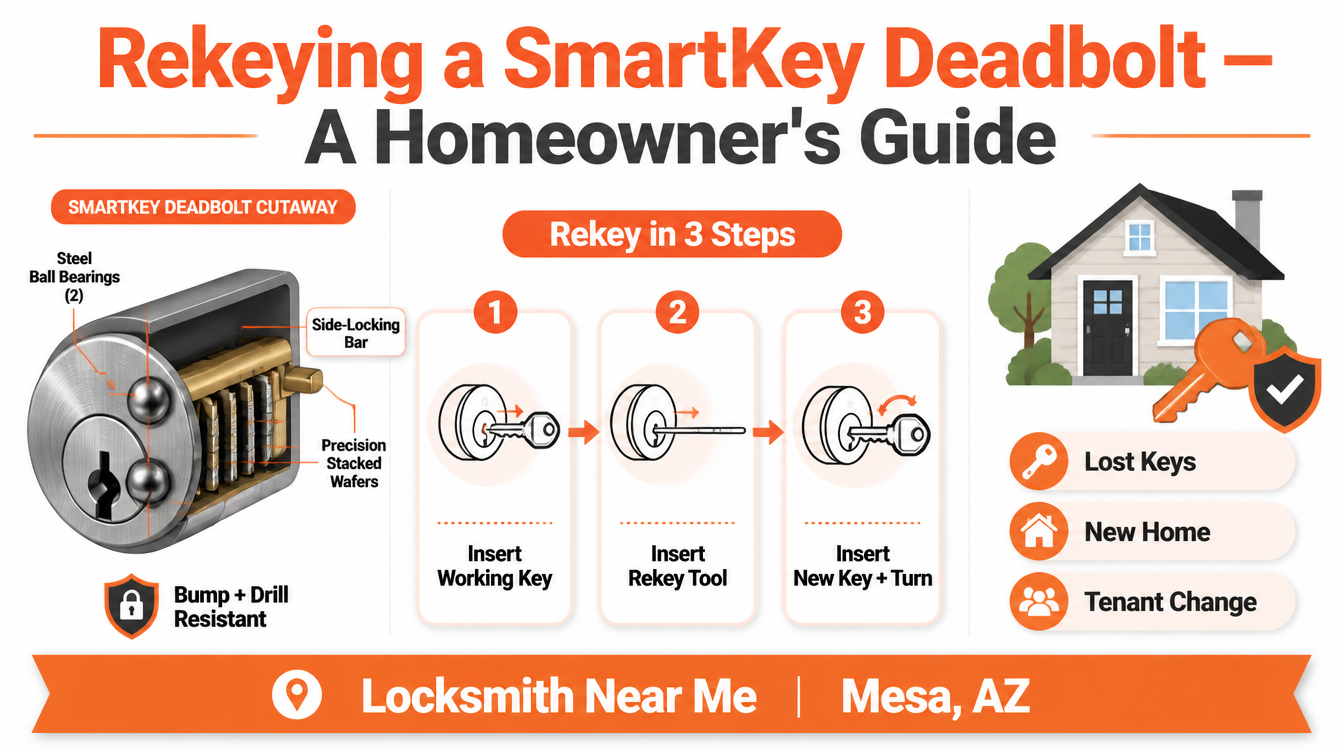
Infographic on rekeying a Kwikset SmartKey deadbolt by Locksmith Near Me Mesa, AZ

Rekeying a Kwikset SmartKey: A Homeowner’s Guide to SmartKey Technology

Rekeying a Kwikset SmartKey resets which key opens your deadbolt without replacing the hardware. The cylinder uses a patented side-locking bar instead of a traditional pin stack, so a homeowner or a locksmith can retire an old key and assign a new one using the manufacturer’s SmartKey tool and the current working key. It is one of the simplest ways to take back control of who can enter your home.

A handed-out spare key you never got back, a previous owner who still has a copy, a roommate who moved out — these are the moments when your front door stops feeling like yours. Replacing every lock is one answer, but rekeying a Kwikset SmartKey gives you the same control while keeping the deadbolt you already trust. As the mobile locksmith service in Mesa that handles these resets across the East Valley, we want to walk you through how the technology works, when to use it, and where its limits are. Keep reading and you will know exactly what is happening inside that little orange-keyed cylinder.

What Is Kwikset SmartKey Technology?

Kwikset introduced SmartKey Security in 2008 as the first do-it-yourself rekeying system on the consumer market. Instead of the brass pin-and-tumbler stack found in most older locks, a SmartKey cylinder uses a side-locking bar paired with sliding aluminum wafers. When the right key lifts those wafers to the correct heights, the bar drops into a channel and the plug turns. Reprogramming the lock simply repositions where that bar engages — no re-pinning, no cylinder removal from the door.

The table below compares SmartKey rekeying with the older pin-tumbler approach our certified technicians still service regularly.

Feature Kwikset SmartKey Security Traditional Pin-Tumbler
Rekeying method Side-locking bar reset with the SmartKey tool Re-pinning the cylinder with new pin stacks
Tool required Manufacturer SmartKey tool Full pinning kit and plug follower
Current working key needed Yes — required to reset Not required (cylinder is re-pinned)
Bump resistance BumpGuard side-bar design Often vulnerable without upgrades
Drill resistance Two hardened steel ball bearings in the face Varies by hardware grade
Master-key capability Not supported Supported via bitting hierarchy
Cylinder material Aluminum wafers Brass pins
Independent certification Meets/exceeds ANSI/BHMA; Grade 1 deadbolts available Grade varies by model
Best handled by Homeowner or locksmith Locksmith with pinning experience

How the Side-Locking Bar Works

In a standard cylinder, spring-loaded pins must line up at a shear line. SmartKey replaces that with a sidebar that reads a row of wafers. The geometry is what makes reprogramming possible: a small internal learning slot lets the wafers “remember” a new key pattern. This is the same principle that makes rekeying your home locks far cleaner than dismantling hardware. According to Kwikset’s own SmartKey Security documentation, the patented design is built specifically to resist picking and bumping.

BumpGuard and Drill Resistance

Two features set SmartKey apart on the security side. BumpGuard counters lock bumping, a method where a specially cut key is tapped to jump pins. Because there are no traditional pins, that attack has nothing to act on. The cylinder also seats two steel ball bearings at the face to improve drill resistance. Many SmartKey deadbolts are tested to ANSI/BHMA Grade 1, the highest residential rating, which you can verify through the Builders Hardware Manufacturers Association. When we install a new handleset and deadbolt, this rating is one of the first things we point out.

How Rekeying a Kwikset SmartKey Actually Works

The process is intentionally short. With the working key inserted and turned a quarter-turn, the SmartKey tool is pressed into the small port beside the keyway. That disengages the wafers from their guide pins. The old key comes out, the new key goes in fully, and a controlled turn teaches the cylinder its new pattern. Once the key returns to the starting position, the lock recognizes only the new key. Kwikset publishes the exact step-by-step rekey instructions for each model.

We see homeowners try this and run into one recurring snag: skipping the full key insertion, which leaves the wafers half-set. That is usually why a self-rekeyed lock “forgets” the key soon after. Our mobile technicians in Mesa carry replacement cylinders for exactly these cases.

What You Need Before Rekeying

You need the current working key. SmartKey is designed so the cylinder can only be reset by someone who already has access — a deliberate security choice. If the only key is lost or was never returned, the lock cannot be reprogrammed through the standard method, and the right move is a cylinder swap or a full lock replacement. When tenants change over, we often pair a rekey with a check of the mailbox locks so the whole property turns over cleanly.

When to Rekey a Kwikset SmartKey

Reprogramming the cylinder makes sense in several everyday situations:

  • Moving into a previously owned home, where you cannot account for every copy ever made
  • A lost or stolen key that may be tied to your address
  • A roommate, tenant, or house cleaner whose access you want to retire
  • Aligning multiple doors to one key after adding matching SmartKey hardware
  • Routine turnover for rental units, paired with keyless access control on the business side

For Mesa rentals and small offices, we frequently combine a residential rekey with exit door panic hardware checks and a fresh set of replacement keys for vehicles in the same visit.

SmartKey Strengths and Limitations Homeowners Should Know

We believe a homeowner makes better decisions with the full picture, so here is the balanced view from our bench. On the plus side, SmartKey resists bumping and drilling, reprograms without tools beyond the included pin, and reaches Grade 1 ratings on many deadbolts. The trade-offs: the wafers are aluminum rather than brass, the system does not support true master keying, and a small number of forced-bypass tools exist for SmartKey cylinders. Independent professional groups such as ALOA Security Professionals Association track these developments, which is part of why our technicians keep their training current. None of this disqualifies SmartKey — it simply means the hardware should be installed correctly and inspected over time, the same care we give every garage door lock and track.

Pro Tip From Our Mesa Locksmith Bench

In Arizona’s heat, the thing that quietly degrades a SmartKey cylinder is fine desert dust working into the keyway alongside thermal expansion. When we get called for a lock that “won’t take the rekey,” roughly half the time the cylinder is gritty rather than broken. Our pro tip: before reprogramming, exercise the lock with the working key a dozen times and apply a dry graphite or PTFE lubricant — never an oil-based spray, which traps dust and gums the wafers. If the action is still sticky, that is the signal to call us for a professional rekey or cylinder service rather than forcing the tool. We would always rather inspect a cylinder than replace one you did not need to.

Frequently Asked Questions

What does it mean to rekey a Kwikset SmartKey?
Rekeying resets the cylinder so a new key works and every old key stops working, all without removing the deadbolt from the door. The hardware stays; only the key pattern changes. It is the cleanest way to retire copies you cannot account for.
Do we need the original working key to rekey a SmartKey lock?
Yes. SmartKey is built so only someone with the current working key can reprogram the cylinder, which is a security feature, not a flaw. If the working key is missing, the lock cannot be reset the standard way and we typically swap the cylinder or change the lock instead.
Is a rekeyed SmartKey as secure as a brand-new lock?
A correctly rekeyed SmartKey deadbolt keeps its full BumpGuard and drill-resistance properties, so the security level does not drop. What matters is that the reset was completed fully so the cylinder holds the new pattern. We verify this with several test turns before we leave.
Can a SmartKey deadbolt join a master key system?
No. SmartKey cylinders are single-key by design and do not support a master-key hierarchy. For homes or businesses that need one key for staff and another for management, we recommend a traditional pin-tumbler master setup, which our commercial team installs across Mesa.
What if the SmartKey lock jams or rejects the tool?
A jam usually points to dust, debris, or a partially completed previous reset rather than a defective lock. Forcing the tool can lock the wafers in a stuck position. At that point we inspect the cylinder, clean and lubricate it properly, and rekey or replace only what is needed.
Should we rekey it ourselves or call a Mesa locksmith?
Many homeowners handle a single SmartKey reset on their own. When several doors must match one key, when the working key is lost, or when the cylinder feels gritty, a professional visit prevents a half-set lock later. We are glad to confirm your hardware and reprogram it correctly the first time.

Taking Control of Who Holds Your Keys in Mesa

The whole point of rekeying a Kwikset SmartKey is control: you decide which key opens your door today, without throwing away hardware that is already built to a Grade 1 standard. Done right, the cylinder forgets every old copy and answers only to the key in your hand. Done in a hurry, a half-finished reset can leave you locked out later — which is the situation we would rather help you avoid entirely. If you are also weighing a full security refresh, our guide to upgrading your deadbolt and handleset pairs naturally with this one.

When you want it handled correctly, our owner-operated shop has served homes and businesses across the East Valley, and you can reach out to our Mesa team to schedule a professional rekeying service. Call Locksmith Near Me Mesa at (480) 418-7560, see our work and reviews on our Google Business listing, and stop by the same Google Maps location to confirm you are working with the local team that knows SmartKey hardware inside and out. Let us reprogram your SmartKey properly and put your keys back where they belong — with you.
Rekeying a lock at home with DIY kit versus professional Mesa locksmith

Can You Rekey Your Own Locks? The Risks and Rewards of DIY Kits

Many Mesa homeowners discover an uncomfortable truth after moving into a new property or losing a key: too many people may still hold a working copy. Previous tenants, contractors, real estate agents, and even old roommates can keep access long after the situation has changed. Rekeying a lock at home is the most direct way to retire those old keys without replacing the entire hardware. In this guide, we explain how DIY rekey kits actually work, where they shine, where they fail, and when calling a professional locksmith in Mesa is the smarter call. Keep reading to make an informed decision before you pick up a screwdriver.

What Rekeying Actually Means

Rekeying does not replace your lock. It changes the internal pin stack inside the cylinder so the old key no longer turns it, and a new key takes over. As licensed locksmiths serving Mesa and the East Valley, we rekey hundreds of cylinders every year — from Schlage and Kwikset residential pin tumblers to higher-security deadbolts on commercial frames. Our residential lock rekey service covers single-family homes, condos, and rental properties across the city.

The process sounds straightforward: remove the lock, dismantle the cylinder, swap the bottom pins to match a new key bitting, reassemble, and verify the action. The reality depends on the cylinder design, the brand, and your tolerance for finicky mechanical work on small spring-loaded parts.

How DIY Rekey Kits Work

Rekeying a lock at home with DIY kit versus professional Mesa locksmith

Most consumer kits target one ecosystem — typically Kwikset SmartKey or a generic Schlage-compatible pin set. SmartKey uses a learn tool and a working key, which makes it the easiest entry point for an absolute beginner. Traditional pin-tumbler kits require sorting tiny bottom pins by height, dropping them into chambers without losing springs, and aligning the plug perfectly before reinstalling the cylinder back into the door.

A standard kit usually includes a plug follower, a key gauge, small tweezers, and labeled pins. What it does not include is the ability to recover from a mistake. One spring lost on a tile floor, one pin inserted upside down, and the lock will not function — or worse, it will function intermittently and refuse to open at the wrong moment, which is a real home safety concern. When that happens, our emergency home lockout service is the most common follow-up call we receive after a failed DIY attempt.

DIY vs Professional Rekey: A Practical Comparison

For homeowners with a single Kwikset SmartKey deadbolt and a steady hand, the DIY route can work. For households with multiple entry points, mixed brands, or a thumbturn lock that has weathered several Mesa summers, a professional rekey produces a cleaner, more durable result. The full comparison appears in the table below. If your hardware is already showing wear, our deadbolt installation and replacement service is often a better investment than rekeying a fatigued cylinder.

Factor DIY Rekey Kit Professional Locksmith
Skill required Moderate to high Trained and licensed
Compatible brands Usually one ecosystem All major manufacturers
Bump and pick resistance Standard pins only Upgraded pin options available
Risk of cylinder damage Real and common Minimal under proper handling
Master key setups Not supported Fully supported
Higher-security cylinders Not supported Supported (Medeco, Mul-T-Lock, ASSA)
Code-cut replacement keys Not included Cut on site to bitting code
Documentation for HOA / insurance None Service receipt provided
Warranty on workmanship None Yes

Where DIY Kits Often Fail

In our shop we routinely rebuild locks that homeowners attempted to rekey themselves. The pattern repeats:

  • Wrong brand kit. A Kwikset SmartKey kit will not rekey a Schlage. A Schlage pin set will not rekey a Yale, Baldwin, or Emtek estate cylinder.
  • Worn cylinders. Mesa’s heat cycles dry out internal lubricants. A cylinder that already binds will not tolerate disassembly without further damage to the plug or tailpiece.
  • Mixed pin heights. Pins look identical at a glance. A misread bitting code creates a lock that turns with the new key only sometimes — a serious deadbolt security weakness.
  • Lost springs and top pins. Small parts disappear into carpet and floor vents. Without the full pin stack, the lock simply cannot be rebuilt at home.
  • High-security cylinders. Medeco, Mul-T-Lock, ASSA, and similar brands use sidebars, telescoping pins, and restricted keyways that consumer kits do not address. These belong to our high-security lock installation category and require manufacturer-certified technicians.

Pro Tip From the Field

After more than a decade rekeying residential and commercial locks across Mesa, our most consistent advice is this: before you open the cylinder, test the lock with the existing key ten times in a row, slowly. If the key catches, hesitates, or requires lifting the door to turn, the cylinder needs more than a rekey — it needs cleaning, lubrication with a dry graphite-based product, and possibly replacement of the strike or latch.

Rekeying a worn lock simply transfers the wear to a new key. We see this regularly on doors that have been through multiple monsoon seasons without service.

For a thumbturn lock interior, also check the spindle. A loose spindle on the inside of a deadbolt is a home safety issue that no amount of rekeying will solve, and it is one of the most overlooked items in a home security audit in Mesa. The performance standards published by BHMA and the certification body ALOA define how a residential deadbolt should behave, and a professional inspection catches what a DIY kit cannot.

When to Call a Professional Locksmith

Some scenarios are not DIY territory:

  • You just bought a home and want every exterior door rekeyed to a single key
  • You have mixed-brand hardware (Kwikset front, Schlage back, Baldwin patio)
  • Your insurance carrier or HOA requires a documented rekey by a licensed technician
  • You want a higher pin count, anti-bump pins, or a restricted keyway
  • Your deadbolt is BHMA Grade 1 or Grade 2 and the manufacturer warranty matters to you
  • You manage rentals or commercial property and need a master key system configured across multiple doors
  • You also need key duplication and code-cut keys made on site after the rekey is complete

Our team works under ALOA standards and follows residential security guidance published by the DOJ Office of Community Oriented Policing Services and the FBI Uniform Crime Reporting program, which consistently identifies entry-door hardware as the primary residential burglary point in the United States.

If you are weighing a rekey, a hardware upgrade, or a full residential lock replacement, a licensed Mesa locksmith can audit every entry point in a single visit. You can also explore our complete residential locksmith services in Mesa or review our guide to home lock replacement and security upgrades for related information. Considering a hardware upgrade? Take a look at our smart lock installation options before committing to traditional pin-tumbler hardware.

Final Thoughts on Rekeying a Lock at Home

DIY kits have a legitimate place. For a single Kwikset SmartKey deadbolt and a confident hand, they save a service visit. For everything else — multiple doors, mixed brands, thumbturn lock issues, higher-security cylinders, or any sign of mechanical wear — a professional rekey protects your investment and reinforces your overall home safety.

Schedule a residential rekey or full security audit with our licensed Mesa locksmith team and find our shop on Google Maps. We will inspect every entry point, recommend the correct pin configuration, and rekey the entire home to a single key when that is the goal. To request a visit or talk to a technician about your specific door hardware, contact our Mesa locksmith team directly.

Frequently Asked Questions

Is rekeying a lock at home as secure as installing a new lock?
Yes, when performed correctly. A rekey changes the bitting that operates the cylinder, so old keys no longer work. Security depends on the existing hardware grade — a worn or low-grade deadbolt should be upgraded rather than rekeyed.
Can a DIY kit rekey any brand of lock?
No. Most consumer kits work only with one brand or one keyway. Kwikset SmartKey kits will not work on Schlage, and standard Schlage pin sets will not service Yale, Baldwin, or any high-security cylinder.
Will rekeying fix a sticky deadbolt?
Rarely. A sticky deadbolt usually points to internal wear, dry lubrication, or a misaligned strike plate. Rekeying without addressing the underlying issue transfers the same friction to a new key. A professional locksmith will inspect the cylinder, latch, strike, and frame before recommending a fix.
Is a thumbturn lock harder to rekey than a keyed deadbolt?
The exterior cylinder rekeys the same way. The interior thumbturn does not contain pins and only needs inspection of the spindle and torque blade. If the thumbturn is loose or rotates without engaging the bolt, rekeying alone will not restore deadbolt security.
Can a locksmith rekey every lock in my home to one key?
Yes. Even when brands are mixed, a professional locksmith can either rekey compatible cylinders to a single bitting or replace incompatible hardware so the entire home opens with one key. This is a common request after a real estate purchase.
When should I replace a lock instead of rekeying it?
Replace the lock when the hardware is below BHMA Grade 2, when the cylinder shows visible corrosion or pin wear, when the latch and bolt no longer line up cleanly with the strike, or when you want to upgrade to anti-bump or restricted-keyway protection. Otherwise, a rekey is the more efficient option.

Rekeying a Lock at Home: The Final Verdict for Mesa Homeowners

Choosing between a DIY rekey kit and a professional service comes down to one honest question: how much risk are you comfortable absorbing on the door that protects your family? A SmartKey deadbolt on a single front door is a manageable weekend project for the patient homeowner. A whole-home rekey across mixed Kwikset, Schlage, and Baldwin hardware — or a thumbturn lock that has spent several Mesa summers exposed to dust and heat — is a different conversation entirely.

If you are still in the research phase, our companion guide on how to upgrade your home deadbolt to BHMA Grade 1 walks through the hardware decisions that pair naturally with a fresh rekey. Many of the homeowners who call us for a rekey end up combining it with a small hardware upgrade in the same visit, which is why our technicians always carry a stocked van.

For a complete entry-point inspection, a master key configuration, or a documented rekey for your insurance file, our Mesa locksmith team is ready to help. Visit our shop on Google Maps, see what neighbors across Mesa are saying about our work, and contact a licensed technician to schedule your residential rekey or deadbolt security audit. Your locks are the most-used piece of security hardware in the home — they deserve a job done right.