
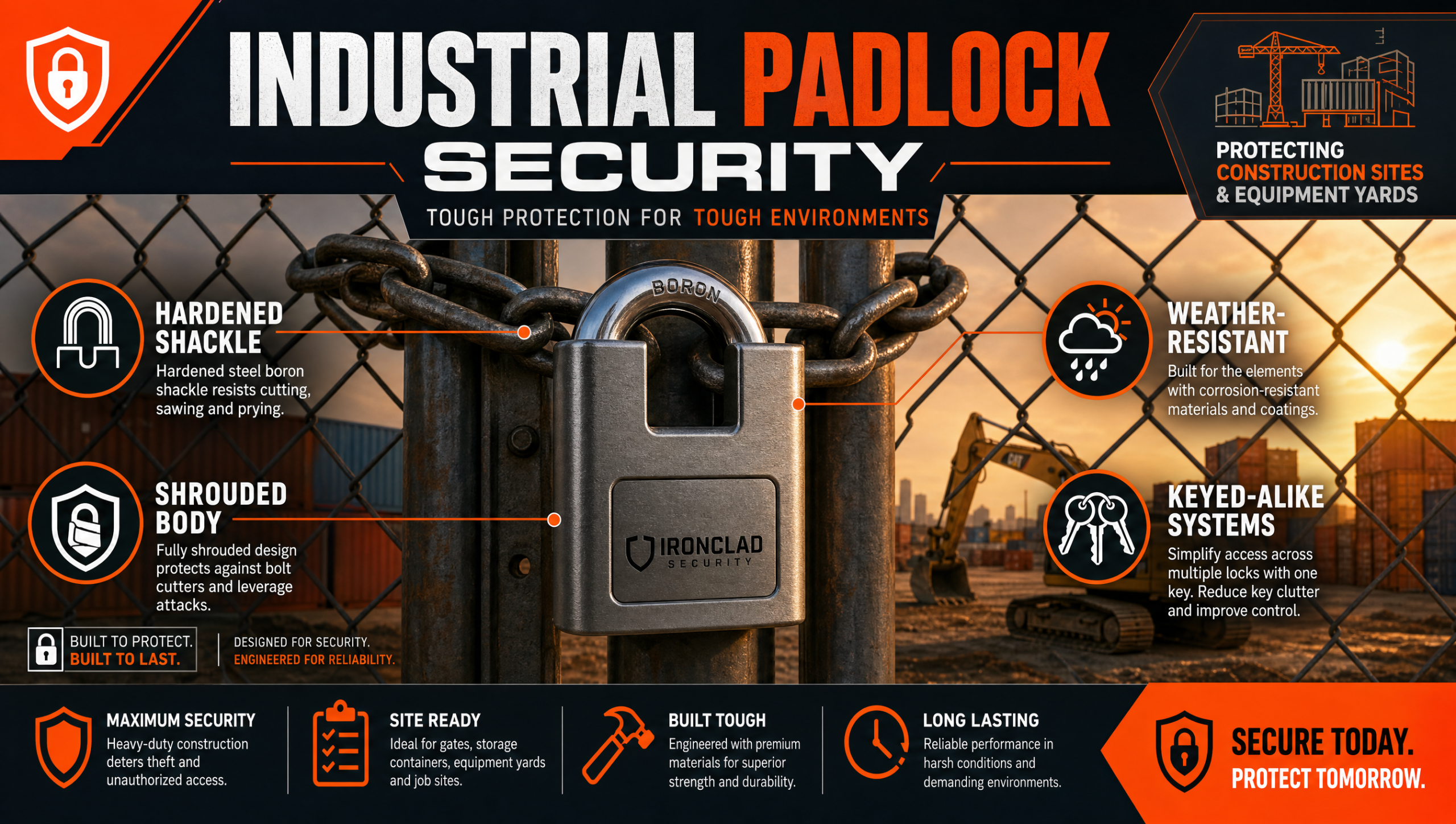
High-security industrial padlock locking a construction yard gate in Mesa, Arizona

Industrial Padlock Security: High-Security Padlocks for Construction Sites and Yards

A contractor walks onto the job site and finds the gate chain cut, a generator gone, and copper wire stripped from the equipment trailer. Standard hardware-store locks invite exactly this kind of loss, because their soft shackles and exposed bodies give bolt cutters and pry bars an easy target. The answer is purpose-built industrial padlock security: hardened, shrouded, weather-tested locks engineered for outdoor abuse. As a Mesa-based team with more than a decade securing yards across the East Valley, we want to walk you through what truly protects a site, so read on.

Industrial padlock security relies on three things: a hardened boron-alloy shackle that resists cutting, a shrouded or shielded body that blocks pry and impact attacks, and a corrosion-rated finish built for outdoor exposure. Pairing the right padlock grade with keyed-alike management is what keeps construction sites and storage yards protected.

Why Construction Sites and Yards Are Targets

Open lots, perimeter fencing, and high-value equipment make construction sites and equipment yards a standing invitation for theft. The National Insurance Crime Bureau reports that heavy equipment and tool theft ranks among the heaviest losses the construction industry absorbs, and most of those losses trace back to a single weak point: the lock on the gate, the gang box, or the conex container.

Thieves rarely pick locks on a job site. They cut them. A pocket-size bolt cutter defeats a brass shackle in one squeeze, and a long pry bar can shear a thin lock body off its hasp. That is why our commercial locksmith team treats site security as a system rather than a single product. The padlock is the front line, but the hasp, the chain, and the key management plan all matter just as much.

What Makes Industrial Padlock Security Different

A genuine industrial padlock is built around attack resistance, not convenience. Three engineered features separate it from a discount-bin lock.

Hardened Shackles and Shrouded Bodies

The shackle is the U-shaped loop most people grab first. Industrial models use boron-alloy or hardened steel shackles that dull and damage cutting blades instead of yielding to them. Better still, a shrouded padlock encloses most of the shackle inside a thick steel collar, leaving almost nothing for a cutter to grip. We see this design on manufacturers like ABUS, and we cover its real-world quirks in our guide on removing the Z-bar retainer on an ABUS padlock.

Weather and Corrosion Resistance

Mesa heat punishes hardware. A lock that seizes in dust and high temperatures is as useless as one that gets cut. Industrial padlocks carry sealed cylinders, brass or stainless internals, and weatherproof boots so the mechanism keeps turning after heavy exposure on a fence line. When a cylinder does fail in the field, our high-security lock and key service can rebuild or replace it without scrapping the whole assembly.

Choosing the Right Padlock Grade for Your Site

Not every gate needs the same lock. A tool cage inside a fenced yard faces a different threat than a street-facing entry gate. Matching the grade to the exposure keeps you protected without over-buying. The comparison below reflects how we spec hardware for clients across Mesa and the East Valley.

Padlock Grade Best Use On Site Shackle & Body Cut Resistance Weather Rating
Standard Brass Low-risk interior cages Exposed brass shackle Low Basic
Hardened Steel General gates & gang boxes Hardened steel shackle Moderate Coated, dust-sealed
Boron-Alloy Shrouded Perimeter & container doors Boron shackle, shrouded body High Sealed, corrosion-rated
High-Security Restricted Main entry & high-value yards Shrouded body, restricted keyway Very High Marine-grade sealed

The grade you choose should also account for key control. A site running ten gates with ten different keys becomes unmanageable, which is why we often set up keyed-alike or master-keyed systems and handle business re-keying when crews rotate. If a key ever goes missing, you can read more about duplicating high-security keys and why those blanks are deliberately restricted.

Pro Tip From the Field

After years of pulling cut locks off Mesa gates, here is the lesson that surprises most site managers: the padlock is rarely the weak link once you upgrade it. The hasp is. We have replaced dozens of premium padlocks that survived an attack while the bargain hasp they hung on was peeled away with a crowbar. Spec a welded, concealed-screw hasp rated to match the lock, and back the gate chain with a hardened, case-protected chain rather than a hardware-store loop. A lock is only as strong as the steel it secures, and a commercial lock change that ignores the mounting hardware leaves the door half open.

Layering Padlocks With Access Control

Padlocks guard the perimeter, but the most secure yards add a second layer at the office trailer and storage container. A keypad lock on the trailer door removes shared physical keys from the equation, and a full access control system logs who enters and when. For the trailer’s main door, a commercial-grade deadbolt adds real holding power — the same deadbolt installation and thumbturn hardware we fit on homes scales up to job-site offices. The principle behind strong home safety and strong site security is identical: remove the easy entry point before anyone tests it.

We also recommend securing on-site cash boxes and document safes; if one ever jams or the combination is lost, our safe service handles it without destroying the unit. And when a crew needs to rotate a single padlock instead of buying new, our walkthrough on how to re-key a padlock shows the process step by step.

Frequently Asked Questions

What makes a padlock “industrial” instead of standard?
An industrial padlock uses a hardened boron-alloy or steel shackle, a shrouded or shielded body that resists prying, and a sealed, corrosion-rated cylinder built for outdoor exposure. Standard brass locks have none of these, which is why they fall to bolt cutters.
Will a high-security padlock survive Mesa heat and dust?
Yes. Industrial padlocks carry sealed cylinders and weatherproof boots that keep the mechanism turning after heavy exposure on a fence line. Our technicians can service or rebuild a cylinder in the field if dust ever works its way in.
Can multiple gates share one key?
They can. We set up keyed-alike and master-keyed systems so a single key opens every gate you authorize, and we re-key the system whenever crews rotate or a key goes missing.
Is the padlock or the hasp the real weak point?
Once the padlock is upgraded, the hasp usually becomes the weakest link. A welded, concealed-screw hasp rated to match the lock is essential, because a premium padlock on a bargain hasp can still be peeled off with a pry bar.
Should I add access control as well as padlocks?
For office trailers and storage containers, yes. Keypad locks and access control systems remove shared physical keys and log who enters, layering electronic control on top of the mechanical protection your padlocks provide at the perimeter.
Can our team service padlocks instead of replacing them?
Often, yes. A padlock with a working body can be re-keyed rather than discarded, which keeps your hardware standardized. Our technicians assess the lock and recommend service or replacement based on its condition and your security needs.

Lock Down Your Mesa Job Site the Right Way

Equipment theft does not announce itself, and the gap between a cut brass lock and a shrouded industrial padlock is the gap between a secured site and a stripped one. If you manage a site or yard around the Valley, let our certified technicians audit your gates, hasps, and containers and spec hardware that matches the real threat — the same field-tested approach we describe in our piece on heavy-duty door closers and wind resistance. You can learn more about our team, review the full range of services we bring to commercial clients, and reach out through our contact page to schedule a security audit. Find us and read verified reviews on our Google Business listing, then call Locksmith Near Me to protect what your crew works hard to build.
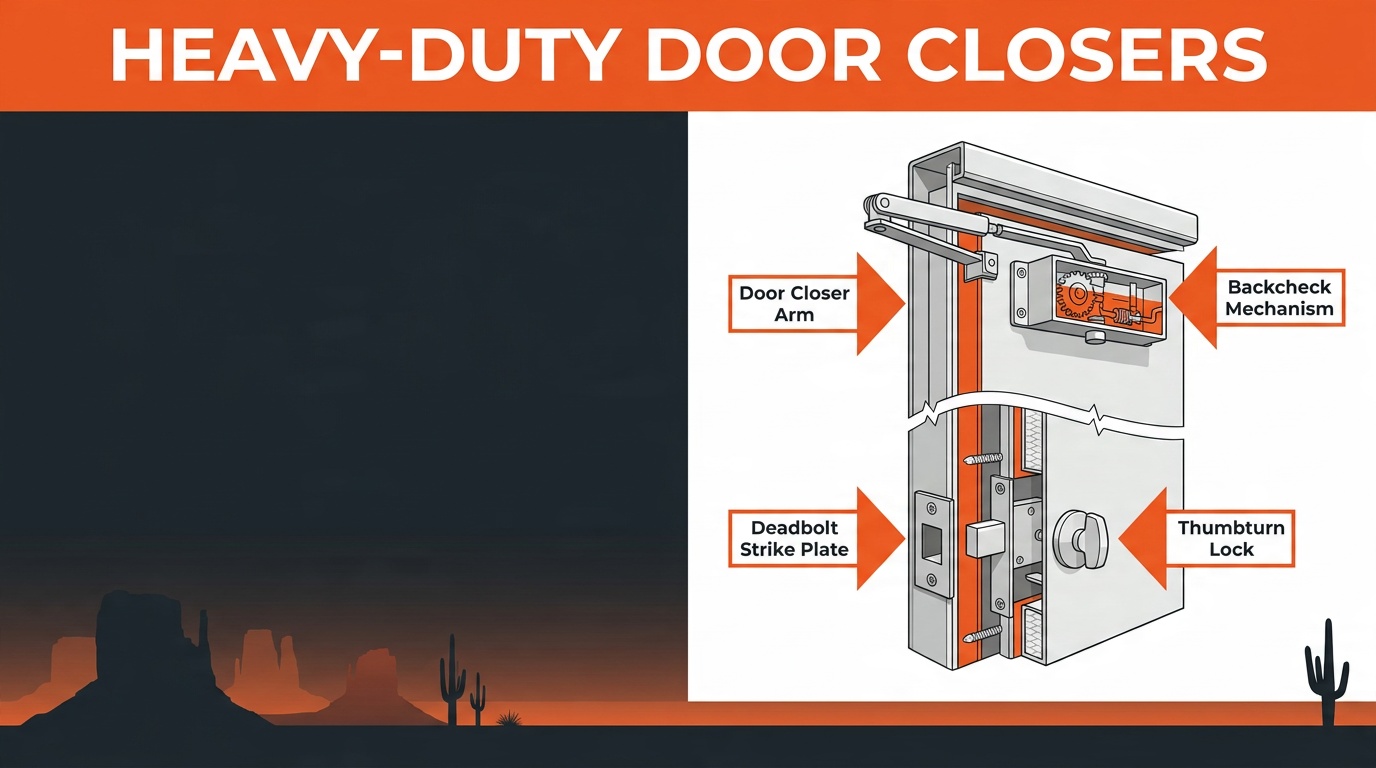
Infographic showing heavy-duty door closer components for commercial wind resistance in Mesa AZ

Heavy-Duty Door Closers: Why Your Business Needs Wind-Resistant Hardware

Every commercial property owner in Mesa, Arizona knows what a powerful desert gust can do to an uncontrolled door. One strong surge of wind swings the entry wide open, slams it back against the stop, stresses the frame, and — over time — quietly destroys the latch geometry that keeps your business locked at night. Heavy-duty door closers engineered for wind resistance are the hardware solution that stops this damage chain before it starts. Keep reading and we’ll walk you through how these systems work, how they protect your building’s overall security, and what to look for before buying.

What Separates a Standard Door Closer From a Heavy-Duty Door Closer

A standard residential closer is built for one purpose: pulling a lightweight interior door shut after someone walks through. It is not rated for exterior commercial doors, high-traffic cycles, or wind loading — and asking it to perform that job is how frame damage and latch failures begin.

Heavy-duty door closers are built to a completely different specification. The ANSI/BHMA hardware standards grade door closers on a Size 1 through 6 scale. Size 1 handles lightweight interior doors in low-traffic environments. Size 6 — the top of the range — handles massive fire-rated commercial doors in exposed exterior locations with engineered wind resistance built directly into the hydraulic mechanism.

Three features distinguish heavy-duty units in practice:

Hydraulic valve control: Adjustable closing speed, latching speed, and backcheck tension are all critical for managing a door under wind load. Without them, a gust dictates the door’s behavior — not the hardware.

Backcheck function: This acts as a hydraulic shock absorber, decelerating the door dramatically before it reaches its maximum open position. Without backcheck, a strong wind simply tears the door — and often the closer arm — off the frame.

Cycle ratings: A standard closer may carry a 250,000-cycle rating. Commercial-grade units from manufacturers like LCN Door Controls and ASSA ABLOY exceed one million cycles — because a busy commercial entry door reaches that volume.

When Wind Becomes a Deadbolt Security Issue

A door that repeatedly slams or blows open against its stop puts stress on every component in the assembly — including the deadbolt strike plate, the door frame, and the thumbturn lock on the interior side. That stress creates micro-fractures in the frame, loosens strike plate fasteners, and misaligns the latch over time — producing exactly the gap a forced-entry attempt exploits.

Our commercial locksmith team in Mesa encounters this pattern consistently: a business owner calls about a deadbolt that’s difficult to turn or a latch that no longer seats cleanly, and when we inspect the door, the root cause is not the lock — it is an undersized door closer that has allowed months of wind stress to silently degrade the frame and hardware around it.

Heavy-Duty Door Closer Comparison

Feature Standard Closer Heavy-Duty Closer Commercial Grade Closer
ANSI/BHMA Size Rating Size 1–3 Size 4–5 Size 5–6
Wind Resistance Low (interior only) Moderate–High (exposed doors) High (engineered exterior)
Cycle Rating ~250,000 cycles 500,000+ cycles 1,000,000+ cycles
Backcheck Function Rarely included Standard Standard + adjustable
Delayed Action No Optional Standard
ADA Opening Force Compliance Varies Adjustable to comply Yes — adjustable
Fire Door Compatibility No Often yes Yes — NFPA 80 compliant
Best Application Interior residential Commercial entry doors High-traffic exterior doors

Choosing the Right Heavy-Duty Door Closer for Your Property

Not every heavy-duty unit suits every commercial application. These are the variables that determine correct sizing:

Door weight and width: A 36-inch solid wood door and a 48-inch aluminum storefront door require different size ratings. Matching the closer to the door specification is the most critical decision in the selection process.

Exposure and wind direction: Doors directly exposed to prevailing wind need a higher backcheck rating than sheltered interior courtyard openings. In the Mesa area, the dominant wind patterns move from the southwest — doors with a southwest-facing exposure warrant close attention when sizing hardware.

ADA opening force limits: ADA standards cap interior door opening force at 5 lbf for accessibility compliance. Quality hydraulic closers can be adjusted to meet this threshold without giving up controlled closing performance.

Fire door rating: Many commercial exit doors carry an NFPA 80 fire-rated designation. That standard requires the door to close completely and latch under all conditions — including during a wind event. A closer that fails to consistently seat the latch is a code violation waiting to be flagged.

Pro Tip: If your commercial property is in a strip mall or shared building complex, the door closer you select may affect fire egress compliance for the entire unit — not just your suite. Before purchasing hardware independently, have a licensed Mesa locksmith inspect the full door assembly. A short inspection confirms the NFPA status, ADA requirements, and the correct closer size before any hardware is ordered. Getting that sequence wrong means pulling the unit back out and starting over.

How Door Closer Failures Undermine Deadbolt Security and Thumbturn Locks

Deadbolt security depends on the door sitting correctly in its frame. A BHMA Grade 1 deadbolt installed in a wind-damaged, misaligned frame is no longer operating at specification. The bolt throw may not fully seat in the strike box, or the clearance may have widened enough that the latch can be worked without a key.

The same principle applies to thumbturn locks on commercial interior doors — conference rooms, server closets, supply rooms. These components require the door to sit true. Once repetitive impact stress warps the frame, a thumbturn lock can bind, fail to latch, or lose the material contact that provides meaningful resistance to forced entry.

In many cases the fix is not a lock replacement. Correcting the closer to a properly rated unit, re-squaring the frame, and reinforcing the strike plate restores the deadbolt performance the property owner assumed they already had. Our professional locksmith services in Mesa, AZ include exactly this kind of door assembly audit — not just hardware sales.

Why Professional Locksmith Installation Makes the Difference

A heavy-duty door closer installed with the wrong arm geometry, incorrect spring tension, or a misaligned bracket defeats its own engineering. We have inspected commercial properties where a properly rated Size 5 unit was mounted in the wrong arm configuration — parallel instead of top-jamb — leaving the backcheck function completely disengaged.

ALOA-certified locksmiths are trained to evaluate the full door assembly: frame condition, door handing, fire rating, ADA compliance, and hardware compatibility. The installation requires reading the door, reading the environment, and calibrating the hydraulic adjustments to the specific conditions of that opening.

Our team at Locksmith Near Me Mesa approaches every commercial door closer installation as a full door security assessment. Find us on Google Maps to confirm our service area covers your property in the East Valley.

Frequently Asked Questions

Most standard commercial entry doors — 36 to 48 inches wide, solid wood or hollow metal construction — require a Size 4 or Size 5 closer under ANSI/BHMA standards. Doors in high-wind exposure locations, oversized fire doors, or high-traffic entrances typically require a Size 5 or 6. The correct size depends on door weight, width, and the specific environmental conditions of the opening. A licensed locksmith can verify the correct specification for your property before any hardware is purchased.

Yes — and it does so gradually. Repeated impact stress from an uncontrolled door loosens strike plate screws, micro-fractures wood door frames, and misaligns the latch over time. A deadbolt that once operated at BHMA Grade 1 tolerances can develop enough play in the strike that the bolt no longer fully engages. This compromises your lock’s rated security performance without any obvious signs of damage to the lock itself. A door assembly inspection identifies this before it becomes a vulnerability.

For doors along accessible routes, yes. ADA standards limit door opening force to 5 lbf on interior doors. Quality hydraulic door closers include adjustable spring tension that can be set to meet this threshold. The challenge is balancing ADA opening force compliance with enough closing power to fully seat the latch — especially on exterior doors with wind exposure. This balance is one of the key reasons professional installation matters: the hydraulic adjustments need to be dialed to both requirements simultaneously.

Backcheck is a hydraulic cushion built into the closer that decelerates the door sharply before it reaches its maximum open position. Without it, a strong wind gust — or a person pushing the door forcefully — drives it into the stop at full speed, stressing the frame, the hinges, and the closer arm itself. For any exterior commercial door or any door in a wind-exposed location, backcheck is not optional. On interior doors with heavy foot traffic, it also prevents damage from doors swinging into walls or adjacent fixtures.

Common signs include: the door fails to latch completely when released from midpoint, the arm struggles to pull the door closed against wind, the closer leaks hydraulic fluid (indicating internal wear from overwork), or the door slams shut faster than the latching speed adjustment can control. If any of these are present, the closer is likely undersized or at end of service life. A professional assessment will confirm the right replacement specification and identify any frame or strike damage that occurred while the undersized unit was in service.

Yes. NFPA 80 requires that every fire door assembly include a self-closing device capable of closing and latching the door from any open position, under all normal use conditions. This means the closer must have enough spring tension to seat the latch against the strike every single time — including during wind events that create negative pressure differentials across the opening. Not every commercial door closer carries the fire door listing required by NFPA 80. Our Mesa locksmith team verifies fire door compliance as part of every commercial door closer installation.

Secure Your Entry Points Before the Next Wind Event

Heavy-duty door closers are not a premium upgrade for Mesa commercial properties — they are a baseline requirement for any exterior door exposed to desert wind conditions. When the closer fails to control the door, every downstream component in your security stack begins absorbing damage that accumulates silently: the deadbolt strike loosens, the frame shifts, the thumbturn lock binds, and one day something fails at exactly the wrong moment.

If your business entry doors are currently running standard or light-commercial closers, this is the moment to schedule a hardware assessment. Our commercial locksmith services in Mesa, AZ include a full door assembly inspection, proper closer sizing, and professional installation with hydraulic adjustments calibrated to your specific opening. Contact Locksmith Near Me Mesa to get started, or visit our Google Maps listing to find us in the East Valley — your door hardware should be working with your security system, not undermining it.